Introduction
Pneumatic rotary actuators and rotary cylinders are used when a machine needs angular motion instead of straight-line movement. They rotate parts, index fixtures, turn small arms, swing gates, position tooling, and operate clamping mechanisms. In many automation systems, a 90 degree or 180 degree movement is easier to create with a rotary actuator than with a linear cylinder and linkage.
Rotary motion needs a different selection approach. Instead of bore and stroke only, buyers must consider torque, rotation angle, load inertia, stopping accuracy, mounting, shaft support, cushioning, and the force acting at the end of an arm. A rotary actuator that is too small may not complete the movement. One that is too large may hit too hard and stress the mechanism.
HOMIPNEU supplies rotary actuator options such as MSQB compact rotary table pneumatic actuators, CRQ2B compact rotary actuators, CDRA1 pneumatic rotary actuators, DSM pneumatic rotary actuators, and rotary clamp cylinders such as MKB, ACK, MRB, and SRC series.
When Rotary Actuators Make Sense
Rotary actuators are useful when a machine needs a controlled angle movement. Common examples include turning a small part from one orientation to another, moving a stopper arm into position, rotating a fixture plate, flipping a component, or opening a gate.
Using a linear cylinder with a linkage can work, but it adds mechanical parts and alignment concerns. A rotary actuator packages the angular movement into a compact unit. This can make the design cleaner and easier to repeat across machines.
For compact equipment, rotary actuators can save space because the movement happens around the actuator body rather than along a long cylinder stroke.
Torque and Load Inertia
Torque is the rotational force produced by the actuator. The required torque depends on load weight, distance from the rotation center, friction, movement direction, and acceleration. A small load mounted far from the shaft can require more torque than a heavier load mounted close to the shaft.
Load inertia matters when movement is fast. Even if the actuator can start the movement, stopping the load smoothly may be difficult. High inertia can create shock at the end of rotation.
When selecting a rotary actuator, calculate or estimate torque with a safety factor. If the movement is vertical or lifting against gravity, the requirement may be higher than a simple horizontal swing.
Rotation Angle
Common rotation angles include 90 degrees and 180 degrees, but some actuators support adjustable angles or wider rotation ranges. The correct angle depends on the machine function. A part transfer unit may need 180 degrees, while a gate or stopper may need 90 degrees.
Products such as QGK adjustable rotary cylinders and QSW 360 degree rotary cylinders support applications where angle flexibility matters.
Angle adjustment should be locked securely after setting. If the stop point changes during operation, downstream sensors and fixtures may lose alignment.
Rotary Tables for Positioning
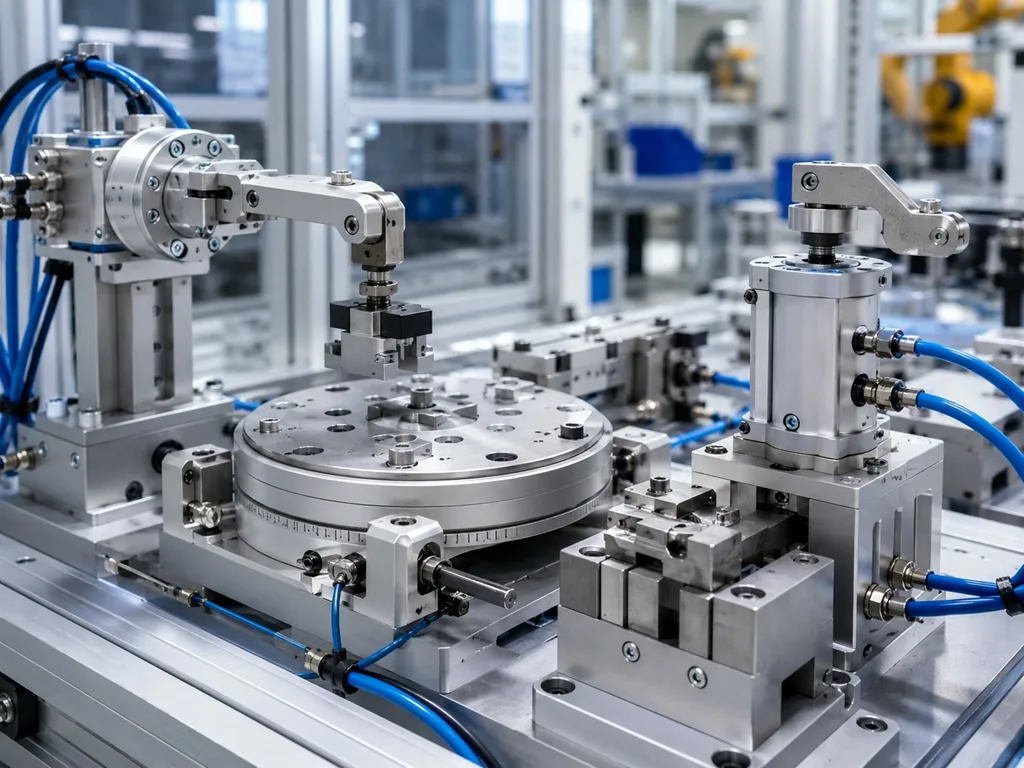
Rotary table actuators are used when the load needs a stable rotating platform. The MSQB series pneumatic rotary table and MSQB compact rotary table actuator are suitable for indexing, fixture rotation, and compact positioning tasks.
A rotary table supports the load better than a simple shaft-style actuator in many applications. It can be useful when a plate, fixture, or small assembly must rotate while remaining stable.
As with slide table cylinders, mounting rigidity matters. The actuator should be installed on a flat, strong surface to maintain positioning accuracy.
Rotary Clamp Cylinders
Rotary clamp cylinders combine rotation and clamping. They are common in fixtures where a clamp arm must swing into position and then hold a workpiece. This saves space because the clamp arm can move away during loading and rotate back during clamping.
HOMIPNEU products such as MKB rotary clamp cylinders, ACK rotary clamp cylinders, MRB rotary clamp cylinders, and SRC rotary pneumatic cylinders support fixture automation and clamping systems.
For clamp cylinders, arm length and clamp force are critical. A longer arm reduces effective clamping force and increases bending load. Use the correct arm length and mounting support.
Cushioning and End Stops
Rotary movement often needs controlled stopping. If the actuator hits the end stop too hard, the machine may shake, the load may shift, or the actuator may wear early. Cushioning, shock absorbers, and speed control help reduce impact.
Do not tune the actuator with no load and assume it will behave the same with the final tooling. The real inertia of the arm, gripper, or fixture changes the stopping behavior.
For high-cycle machines, smooth end-of-rotation control protects both the actuator and the product.
Installation and Air Circuit Tips
Use a valve and tube size that can supply enough airflow for the desired speed. If the actuator moves slowly, check valve flow, tube diameter, fittings, and exhaust restriction before replacing the actuator.
Mounting bolts should be secure, and the load should be balanced where possible. Avoid heavy overhung loads unless the actuator is rated for them. If the load needs additional support, use bearings or external guides.
Sensors may be needed to confirm rotated positions. Place sensors where they can be adjusted and protected from damage.
Common Selection Mistakes
One mistake is estimating torque only from load weight. Rotary applications depend heavily on radius. A light tool mounted on a long arm may require more torque than expected because the force acts far from the rotation center.
Another mistake is ignoring stop accuracy. Some applications only need a part to swing open and closed. Others need accurate repeatable angle positioning. If the machine needs precision, check stop design, backlash, cushioning, and whether external hard stops are required.
Buyers should also check whether the actuator shaft or table can support the load directly. If the tooling is heavy or offset, an external bearing support may be needed. The actuator should provide rotation, not carry every mechanical load by itself.
Practical Application Examples
In packaging equipment, a rotary actuator may open and close a guide gate, turn a small reject arm, or rotate a suction head between pickup and placement. In fixture automation, a rotary clamp cylinder can move the clamp arm away during loading and return it to hold the workpiece. In assembly equipment, a rotary table actuator can index a small part between stations.
Each example has a different priority. A guide gate may need speed and simple repeatability. A clamp cylinder needs holding force and stable arm position. A rotary table needs load support and angle accuracy. Matching the actuator to the real priority is more reliable than choosing by size alone.
Related Pneumatic Products
Rotary actuators work with solenoid valves, speed controllers, fittings, tubes, sensors, and air preparation units. HOMIPNEU’s pneumatic cylinder category includes rotary tables, compact rotary actuators, vane actuators, semi-rotary drives, and rotary clamp cylinders.
For linear movement, standard or compact pneumatic cylinders may be simpler. For angular movement, rotary actuators usually create a cleaner machine design.
FAQ
What is a pneumatic rotary actuator used for?
It is used to create controlled angular movement, such as turning, indexing, swinging, clamping, and fixture rotation.
How do I choose rotary actuator torque?
Consider load weight, distance from the shaft, friction, movement direction, speed, and safety factor. Load inertia is important for fast movement.
What is a rotary clamp cylinder?
It is a cylinder that rotates a clamp arm into position and applies clamping force, often used in fixtures.
Can rotary actuators rotate 360 degrees?
Some models support wider rotation or 360 degree movement, while many standard actuators are designed for 90 or 180 degrees.
Why does a rotary actuator hit too hard?
Possible causes include excessive speed, high load inertia, poor cushioning, wrong flow control setting, or an oversized actuator.
Conclusion
Pneumatic rotary actuators and rotary cylinders are useful when automation equipment needs controlled angle motion. Good selection means checking torque, angle, load inertia, mounting, cushioning, and air circuit design. When matched correctly, rotary actuators make turning, indexing, and clamping operations compact and repeatable.