Introduction
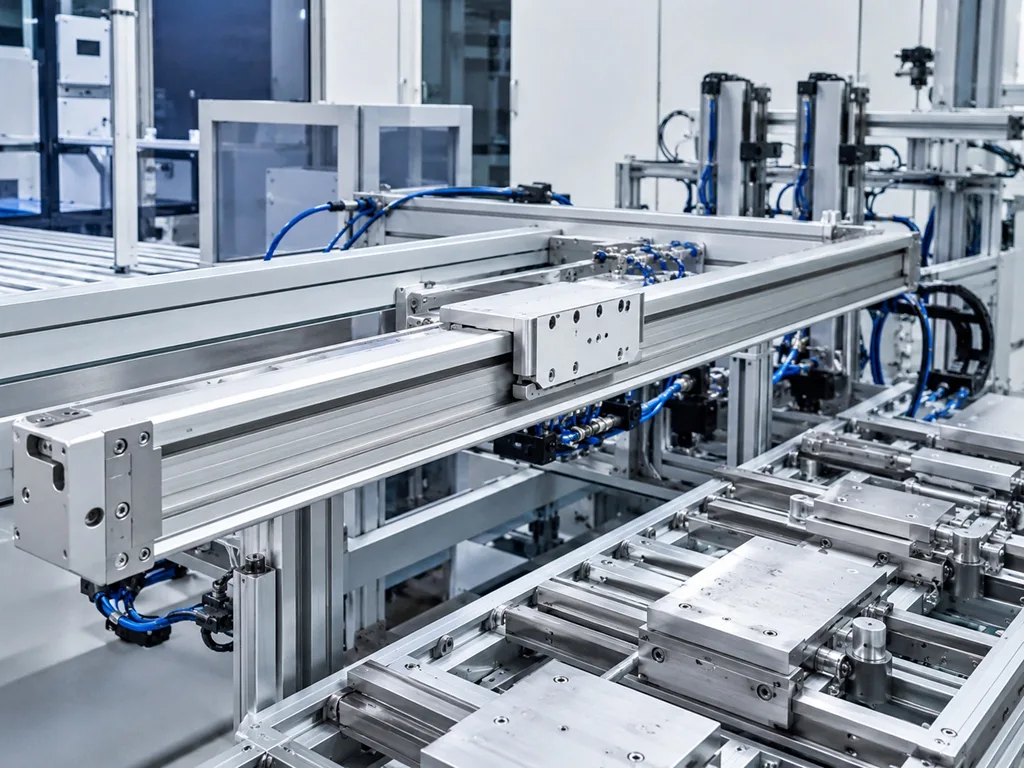
Rodless pneumatic cylinders are used when a machine needs long linear travel but does not have enough room for a standard cylinder with an extending piston rod. In a normal cylinder, the full stroke adds to the installation length because the rod extends out of the body. For long strokes, this can make the machine too large. A rodless cylinder solves this by moving a carriage along the cylinder body.
Long-stroke movement appears in transfer systems, sliding doors, product pushers, loading stations, cutting machines, packaging lines, and material handling equipment. A rodless cylinder can move a load across a long distance while keeping the actuator footprint shorter and cleaner.
HOMIPNEU offers different rodless cylinder options, including CY1B magnetically coupled rodless cylinders, CY1R magnetically coupled rodless cylinders, CY1S guided rodless pneumatic cylinders, CY1L linear guide rodless cylinders, and MY1B mechanically jointed rodless cylinders.
Why Use a Rodless Cylinder?
The main reason is space. If a standard cylinder needs a 1000 mm stroke, the installation space may need to include both the cylinder body and the extended rod. A rodless cylinder can provide the same stroke with a carriage moving along the body, reducing the total machine length.
Rodless cylinders also make some layouts cleaner. The load can be mounted directly on the carriage instead of connected to the end of a long rod. This can reduce bending risk and make the transfer path easier to design.
They are especially useful when the movement is horizontal and the load needs to travel along a machine frame, conveyor, or guide path.
Magnetically Coupled Rodless Cylinders
Magnetically coupled rodless cylinders use magnetic force to connect the internal piston to the external carriage. Because there is no mechanical slot through the cylinder tube, the design can reduce leakage risk in some applications and keep the structure relatively clean.
The CY1B magnetically coupled rodless cylinder is a common option for basic long-stroke motion. The RMH magnetically coupled rodless cylinder is another option for automation systems needing this style of movement.
However, magnetic coupling has load limits. If the load is too heavy or the acceleration is too high, the magnetic coupling may slip. For demanding applications, load, speed, and friction should be checked carefully.
Mechanically Jointed Rodless Cylinders
Mechanically jointed rodless cylinders connect the internal piston to the external carriage through a mechanical structure. This can provide stronger load transmission than magnetic coupling in some applications.
The MY1B mechanically jointed rodless cylinder is suitable where stable carriage movement and long stroke operation are needed. These cylinders are often used in transfer equipment, sliding units, and automation lines.
Because the structure is mechanically connected, sealing and contamination protection should be considered. The working environment and maintenance plan matter.
Guided Rodless Cylinders
Some rodless cylinders include guide support. Guided rodless cylinders are useful when the load needs better stability, anti-rotation support, or more accurate movement. A plain rodless cylinder may move the carriage, but external guides may still be needed if the load creates moment.
The CY1S guided rodless pneumatic cylinder and CY1L linear guide rodless cylinder are examples for applications where guidance is built into the actuator.
If the load is offset from the carriage centerline, moment load becomes important. A guided rodless cylinder or external rail can prevent twisting and improve long-term reliability.
Load, Speed, and Stroke
Rodless cylinders are often selected for long travel, but stroke length is only one part of the decision. Load weight, friction, mounting direction, acceleration, speed, and stopping method all matter.
A light load moving slowly across a supported guide is easier than a heavy load mounted far from the carriage and moving quickly. The farther the load is from the carriage, the higher the moment load. This can stress bearings and guides.
Speed should be controlled with suitable valves and flow controls. Long-stroke movement can create strong end impact if the carriage stops suddenly. Cushioning, shock absorbers, or external stops may be needed for higher-speed systems.
Mounting and Alignment
A rodless cylinder should be mounted on a straight, rigid surface. If the mounting surface is twisted or uneven, the carriage can bind. Long cylinders are more sensitive to alignment than short actuators because small errors accumulate over the full stroke.
When the rodless cylinder drives a separate guided load, the cylinder and guide must be aligned. Forcing the carriage to follow a misaligned external rail can cause friction, wear, and inconsistent movement.
Leave space for fittings, sensors, stroke adjustment, and maintenance. Long-stroke actuators are often installed deep inside machine frames, so service access should be planned early.
Air Supply and Control
Long-stroke cylinders require enough air volume. If the valve, tube, or fitting is too small, the cylinder may move slowly or unevenly. Exhaust flow is just as important as supply flow.
For precise speed control, use suitable flow controls and stable pressure. If the load changes during the stroke, movement may need careful tuning.
Position sensing can be useful at both ends of travel. Some systems may also need intermediate sensors or external position feedback depending on the process.
Common Mistakes with Long-Stroke Systems
One common mistake is choosing a rodless cylinder only because the stroke is long, without checking load support. The carriage may move the load, but the load still needs proper guidance if it is heavy, offset, or exposed to vibration. A long unsupported bracket can overload the carriage even when the total weight is moderate.
Another mistake is ignoring cable and tube movement. If air tubes, sensor cables, or moving hoses drag along the stroke, they can add friction and create uneven movement. Cable carriers, flexible routing, and proper clamps help protect the actuator.
Long-stroke systems also need careful stopping. A carriage moving a long distance can build speed, and the end impact can be stronger than expected. Use speed control, cushioning, or external shock absorption when the load or cycle rate is high.
Buying Tips for OEM Long-Stroke Equipment
For OEM machinery, confirm the working stroke, load position, mounting orientation, and required speed before requesting a quote. A vague request such as “one rodless cylinder, 800 mm stroke” is not enough for reliable selection. The supplier should know whether the load is directly mounted, externally guided, vertically lifted, or moved horizontally.
It is also helpful to define sensor requirements early. Some long-stroke systems only need end-position signals, while others need intermediate detection or external position feedback. Planning this during selection prevents wiring and bracket changes later.
Related Pneumatic Products
Rodless pneumatic cylinders work with solenoid valves, speed controllers, air fittings, tubes, sensors, and air source treatment units. HOMIPNEU’s pneumatic cylinder category includes magnetically coupled, guided, and mechanically jointed rodless options for different long-stroke applications.
If a machine only needs a short push, a standard or compact cylinder may be simpler. If the machine needs long travel with space saving, rodless cylinders become much more attractive.
FAQ
What is a rodless pneumatic cylinder?
It is a cylinder that moves an external carriage along the body instead of extending a piston rod from one end.
When should I use a rodless cylinder?
Use it when long linear travel is needed but a standard cylinder would take too much installation space.
What is the difference between magnetic and mechanical rodless cylinders?
Magnetic types use magnetic coupling between piston and carriage. Mechanical types use a physical connection and may handle stronger load transmission in some applications.
Do rodless cylinders need guides?
Some include built-in guides. If the load creates side or moment load, guidance is important for stability and service life.
Why does a rodless cylinder move unevenly?
Possible causes include misalignment, undersized air supply, friction, excessive load, poor speed control, or contamination.
Conclusion
Rodless pneumatic cylinders are practical for long-stroke motion where standard cylinders become too long or awkward. The key is to match cylinder type, load, stroke, speed, guidance, and mounting accuracy. Used correctly, they create cleaner transfer systems and more space-efficient machine layouts.