Introduction
Pneumatic grippers and clamp cylinders are used when automation equipment must hold, position, transfer, or secure a workpiece. They are common in pick-and-place systems, robotic end tooling, assembly machines, fixture stations, packaging equipment, and inspection lines. Unlike a simple cylinder that only pushes or pulls, grippers and clamp cylinders interact directly with the part.
This makes selection more sensitive. The actuator must match part shape, gripping force, stroke, jaw style, clamp arm length, cycle speed, and available space. Too little force can drop the part. Too much force can damage it. Poor alignment can create uneven wear or unstable handling.
HOMIPNEU’s pneumatic cylinder category includes parallel grippers, 3-finger grippers, low-profile grippers, thin grippers, finger grippers, rotary clamp cylinders, lever clamp cylinders, and stopper cylinders for different handling and fixture tasks.
Pneumatic Grippers in Pick-and-Place Systems
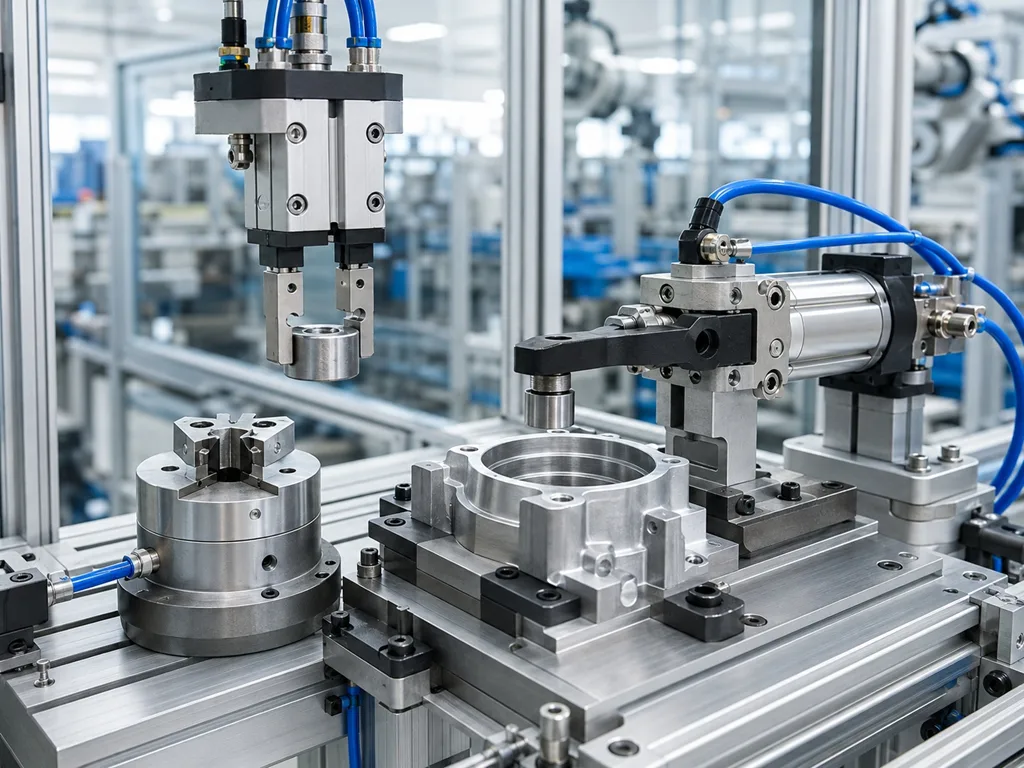
Pneumatic grippers are used to hold a part so it can be moved from one position to another. A parallel gripper closes two jaws toward each other. A 3-finger gripper can center round or irregular parts. A low-profile gripper saves space where height is limited.
Products such as the MHZ2 pneumatic parallel gripper, MHL2 pneumatic parallel gripper, MHS parallel pneumatic gripper, and MHSH3 through-hole 3-finger gripper support different gripping needs.
The best gripper is not just the one with the highest force. It is the one that matches part geometry, contact surface, jaw travel, and cycle speed.
Gripping Force and Part Protection
Gripping force should be strong enough to hold the part during acceleration, movement, and release. However, excessive force can mark plastic parts, deform soft materials, or damage finished surfaces. For delicate parts, jaw pads or custom fingers may be needed.
Part weight is only one factor. Friction between the jaws and part, movement speed, direction of acceleration, and safety factor all affect the required force. A part held vertically may need more gripping force than the same part supported from below.
For OEM machines, test the gripper with real parts, including acceptable tolerance variations. A gripper that works on one sample may fail when part size changes slightly.
Jaw Stroke and Finger Design
Jaw stroke must cover the part size range. If the stroke is too short, the gripper cannot open enough for loading or close enough for secure holding. If the stroke is too long, cycle time may increase and the gripper may be larger than necessary.
Custom fingers are often attached to the gripper jaws. Finger length should be kept as short and rigid as practical. Long fingers increase moment load and can reduce gripping accuracy. Lightweight fingers are helpful on fast moving end tooling.
Finger design should make the part self-locating where possible. V-grooves, soft pads, and shaped contact surfaces can improve repeatability.
Clamp Cylinders for Fixtures
Clamp cylinders secure a part during machining, assembly, welding, inspection, or packaging. They may press down, swing into position, or hold a workpiece against a fixture surface.
Rotary clamp cylinders such as MKB rotary clamp cylinders, ACK rotary clamp cylinders, and MRB rotary clamp cylinders are useful when the clamp arm must move out of the way for loading. Lever clamp cylinders such as JGL pneumatic lever clamp cylinders are useful for fixture clamping tasks.
Clamp force depends on cylinder size, pressure, arm length, and clamp geometry. Long arms reduce effective clamping force and increase stress.
Stopper Cylinders for Conveyor Handling
Stopper cylinders are used to stop pallets, products, or carriers on conveyors. They must handle repeated impact and hold position reliably. In automated lines, a stopper cylinder may cycle thousands of times per day.
Products such as RSDQB pneumatic stopper cylinders and TWH pneumatic stopper cylinders support conveyor automation and material handling tasks.
When selecting a stopper, check load weight, conveyor speed, impact energy, mounting position, and whether cushioning is needed. A stopper that is too small may wear quickly or fail to stop the load consistently.
Sensors and Control Logic
Grippers and clamp cylinders often need position confirmation. A machine may need to know whether a part is gripped, a clamp is closed, or a stopper is extended. Magnetic sensors, proximity switches, or external sensors can provide this feedback.
For safety and reliability, do not assume that a valve signal means the actuator moved correctly. Sensors help detect missing parts, jammed motion, low air pressure, or mechanical obstruction.
In robotic handling, gripper open and closed signals are especially useful for preventing dropped parts and sequence errors.
Common Mistakes
One common mistake is choosing a gripper by part weight alone. Part shape, friction, acceleration, and gripping orientation also matter. Another mistake is using long, heavy custom fingers without checking moment load.
For clamp cylinders, a common problem is using an arm that is too long. This reduces force and increases mechanical stress. For stopper cylinders, impact energy is often underestimated.
Poor air supply can also cause handling problems. Low pressure, small valves, and restricted tubing can reduce gripping force or slow clamp movement.
Practical Buying and Testing Tips
For grippers, test with real parts instead of only checking catalog force. Use parts at the smallest and largest expected dimensions, and test surfaces that may be oily, dusty, smooth, or slightly textured. The contact condition can change the required gripping force.
For clamp cylinders, confirm the final arm length, clamp point, and fixture geometry before ordering. If the clamp point moves farther from the rotation center, the available force at the workpiece changes. A drawing of the fixture is often more useful than a simple cylinder model number.
For stopper cylinders, simulate the actual conveyor speed and load. A stopper that works slowly by hand may not survive repeated impact in production. If the line speed is high, cushioning and impact energy should be reviewed carefully.
Matching the Actuator to the Part
Handling applications should start from the part, not from the actuator catalog. A round part may suit a 3-finger gripper because the jaws can center it. A flat rectangular part may work better with a parallel gripper and custom fingers. A part that must be held against a fixture may need a clamp cylinder rather than a gripper.
Surface condition matters too. Smooth metal, soft plastic, rubber, oily parts, and delicate finished surfaces all need different finger materials or contact shapes. A small change in jaw pad material can improve grip stability without increasing air pressure or choosing a larger actuator.
Related Pneumatic Products
Pneumatic grippers and clamp cylinders work with solenoid valves, fittings, speed controllers, sensors, tubes, and air source treatment units. For a complete handling system, check gripper force, valve flow, tube routing, and air pressure together.
HOMIPNEU offers parallel grippers, 3-finger grippers, low-profile grippers, clamp cylinders, stopper cylinders, and rotary clamp cylinders for automation and OEM equipment.
FAQ
What is a pneumatic gripper used for?
It is used to hold and release parts in pick-and-place systems, robotic handling, assembly machines, and packaging equipment.
How do I choose gripper force?
Consider part weight, friction, acceleration, grip direction, jaw material, and safety factor. Test with real parts whenever possible.
What is a rotary clamp cylinder?
It is a clamp cylinder that rotates an arm into position before applying clamping force, useful for fixtures that need clear loading access.
Why does a gripper drop parts?
Common causes include low gripping force, low air pressure, poor finger design, fast acceleration, oily parts, or incorrect jaw stroke.
Are stopper cylinders the same as normal cylinders?
No. Stopper cylinders are designed for stopping loads on conveyors and may need to handle impact and repeated cycling.
Conclusion
Pneumatic grippers and clamp cylinders are direct contact components, so selection must match the part and the machine process. Good gripping or clamping depends on force, stroke, jaw design, arm length, sensors, and stable air supply. When these details are right, handling systems become faster, safer, and more repeatable.