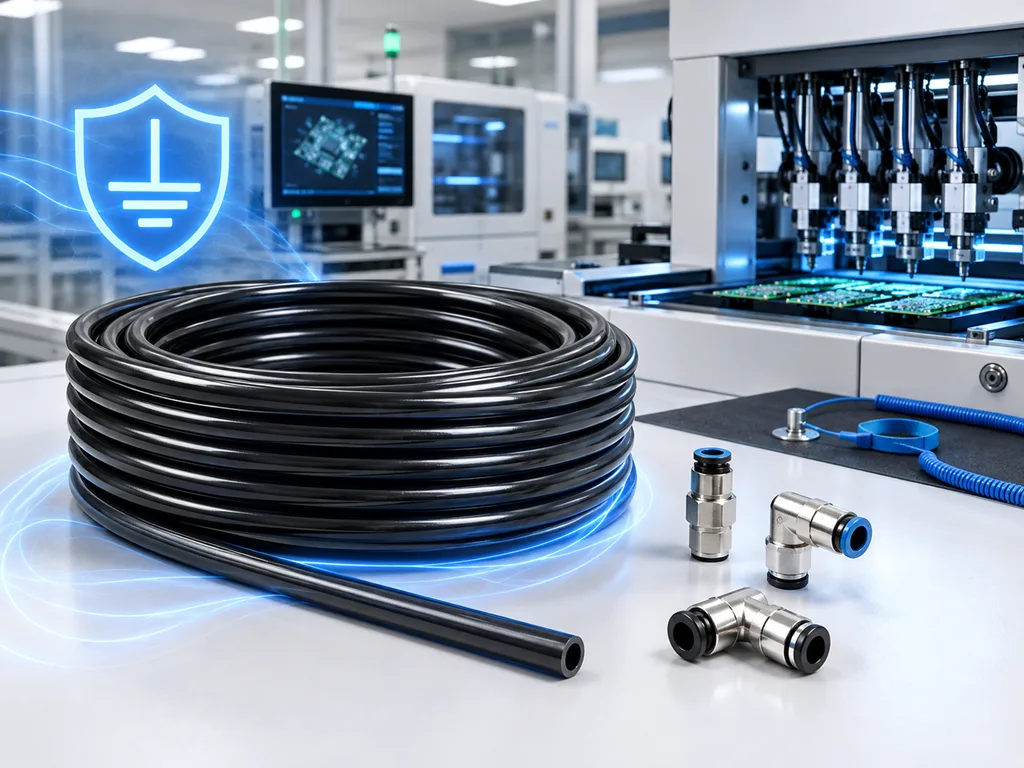
Compressed-air tubing can become part of an electrostatic discharge problem when it is installed around sensitive electronic components, automated test equipment or ESD-controlled workstations. Standard pneumatic tubing may route air correctly but provide no documented anti-static property. In these areas, the hose must be selected as part of the facility’s complete electrostatic control plan.
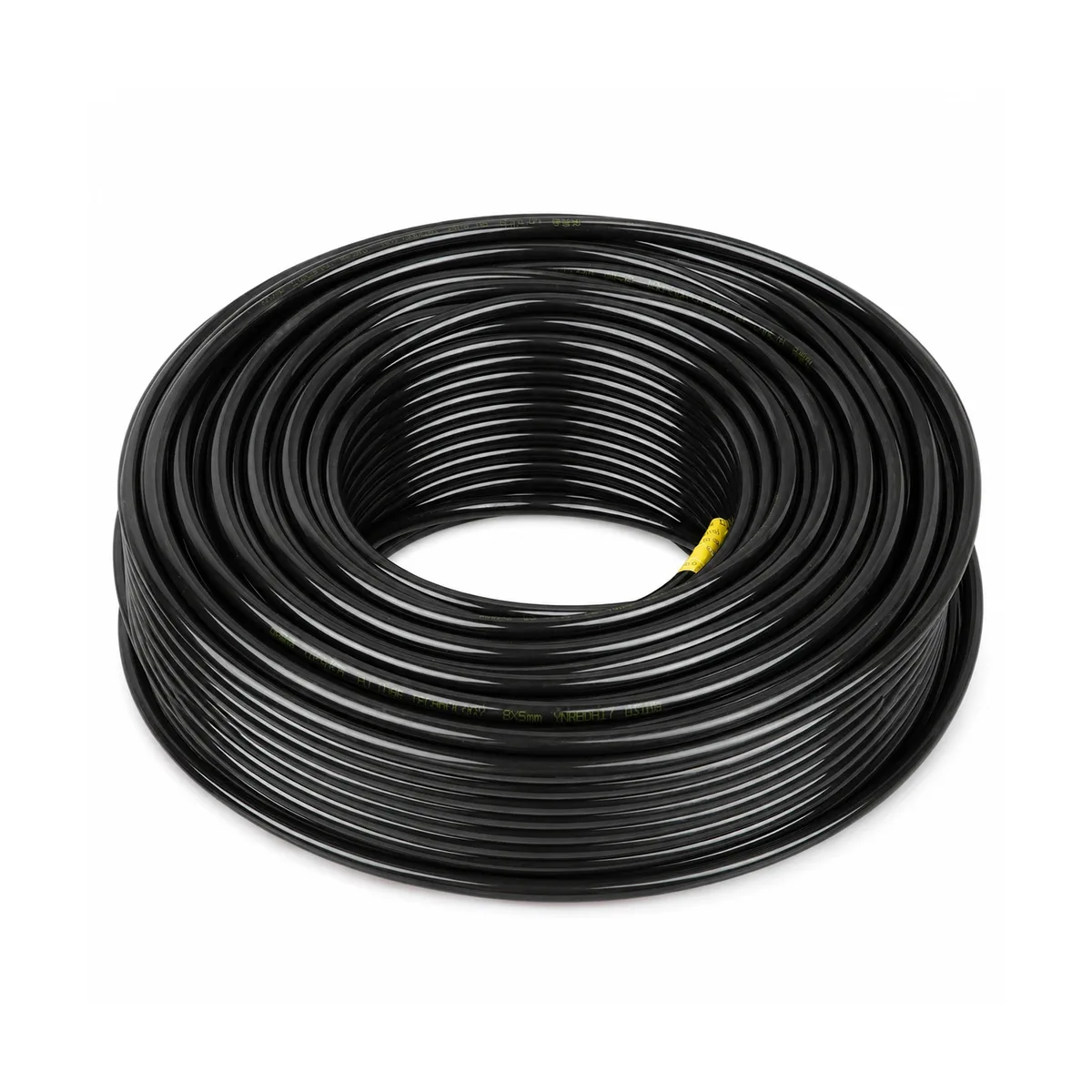
The HOMIPNEU Anti-Static TPU Hose for Pneumatic Tubing is designed for compressed-air lines in electronics manufacturing and other ESD-controlled environments. Its product page specifies 100% high-performance thermoplastic polyurethane elastomer, a surface resistance range of 107 to 109 ohms, dimensional tolerance of +/-0.12 mm, black standard color, and five metric OD/ID options.
Anti-static does not mean universally conductive, grounded, explosion-proof or certified for every ESD program. The published resistance value must be compared with the project’s required standard, measurement method and installed-system design.
What Is Anti-Static TPU Hose?
Anti-static TPU hose is flexible pneumatic tubing made from a TPU compound formulated to provide controlled electrical resistance. The hose carries compressed air while its material helps limit electrostatic charge accumulation compared with ordinary tubing that has no stated anti-static performance.
The reviewed product has a published surface resistance of 107 to 109 ohms. This numerical range is more useful than an unqualified anti-static label, but it is not the entire acceptance test. Surface resistance, point-to-point resistance, resistance to ground and charge decay are different measurements. The ESD coordinator or equipment engineer should define which property and test method apply.
Where Anti-Static Pneumatic Tubing Is Used
| Application | Why Anti-Static Tubing Is Considered | What Still Requires Verification |
|---|---|---|
| Electronics assembly lines | Pneumatic actuators operate near ESD-sensitive components | Installed resistance, grounding path and workstation ESD plan |
| Component pick-and-place equipment | Air lines move with grippers, slides and handling heads | Flex life, bend radius, abrasion and fitting retention |
| Automated inspection and test stations | Small cylinders and air jets work close to exposed electronics | Air cleanliness, static control and allowed blowing method |
| ESD-controlled workstations | Air tools and fixtures need compatible pneumatic supply lines | Operator grounding, tools, bench mat and system-level compliance |
| Semiconductor and precision equipment auxiliaries | Compact air circuits may operate in static-sensitive zones | Cleanliness, particles, outgassing and project-specific approval |
| Electronics packaging and transfer machines | Pneumatic clamps and guides handle sensitive devices | Actual ESD classification and machine risk assessment |
| Maintenance replacement projects | Standard tube may need replacement in a controlled area | Exact OD/ID, pressure, fitting and documented equivalence |
Electronics Assembly Lines
Pneumatic cylinders, stoppers, clamps and slides are common in electronics assembly. Their air tubes may pass close to printed circuit boards, sensors, connectors and exposed devices. Anti-static TPU hose can be specified for these air lines when the ESD control plan requires tubing with a defined resistance range.
The hose does not protect the entire assembly line by itself. Machine frames, operators, tools, trays, conveyor surfaces, clothing, benches and floor systems all influence electrostatic risk. Treat the tubing as one controlled material within a coordinated ESD program.
Pick-and-Place and Component Handling
Robotic and Cartesian handling equipment often carries pneumatic tubing to grippers, slides or vacuum components. Flexible TPU can suit moving routes, while the published anti-static property addresses a separate electrical requirement.
Motion creates mechanical selection questions. Verify minimum bend radius, moving length, torsion, rubbing points, acceleration and cycle count. Use cable carriers or guides where appropriate, and prevent the tube from pulling sideways on the fitting. Anti-static performance does not compensate for a kinked or abraded hose.
If the line supplies a vacuum ejector or suction device, confirm the required air flow and pressure. The hose product is described for compressed-air pneumatic lines; vacuum-side use should be separately approved.
Automated Inspection and Test Equipment
Inspection systems may use small pneumatic actuators for positioning, guarding, probe movement and reject mechanisms. They may also use controlled air for fixture functions. Anti-static tubing helps the machine builder use a documented hose material near sensitive assemblies.
Do not assume that anti-static tubing turns ordinary compressed air into ionized air or makes uncontrolled air blowing safe for electronics. Air cleanliness, moisture, oil, particle control, nozzle design and the permitted use of compressed air must be addressed separately.
ESD-Controlled Pneumatic Workstations
Assembly and repair benches may use pneumatic screwdrivers, cutters, clamps, blow guns or test fixtures. An anti-static air hose can be part of the workstation material specification where conventional tubing is not accepted.
Verify the complete path from the fixed air supply to the tool. A conductive or dissipative hose section connected through insulating fittings may not create the intended route to ground. Conversely, a project may require controlled dissipation rather than a low-resistance conductor. Follow the site’s ESD engineering requirements instead of improvising a grounding connection.
Semiconductor and Precision Automation Auxiliaries
Semiconductor, optical and precision-electronics equipment can contain compact pneumatic circuits for doors, positioning, handling and utility control. The 4 x 2.5 mm and 6 x 4 mm options may fit small machine spaces, subject to flow and pressure needs.
Anti-static performance does not imply cleanroom, low-outgassing, ultra-pure, food-contact or medical certification. If the project controls particles, extractables, volatile compounds or packaging cleanliness, request the required material data and approve the exact production batch and packaging method.
Published Sizes and Packaging
| OD x ID | Standard Color | Roll Length | Typical Selection Focus |
|---|---|---|---|
| 4 x 2.5 mm | Black | 100 m | Compact pilot lines and small actuators; check pressure drop |
| 6 x 4 mm | Black | 100 m | Common small-machine air circuits |
| 8 x 5 mm | Black | 100 m | Higher flow with thicker wall than some 8 mm alternatives |
| 10 x 6.5 mm | Black | 50 m | Machine supply branches and larger actuators |
| 12 x 8 mm | Black | 50 m | Larger air demand and longer fixed routes |
The outside diameter must match the pneumatic fitting. The inside diameter controls flow area and influences pressure drop. Select by both dimensions rather than asking only for 8 mm or 10 mm hose.
For airflow and sizing principles, review the pneumatic air hose size guide.
Surface Resistance: What 107 to 109 Ohms Means for Selection
The published surface resistance gives procurement and ESD teams a defined product characteristic to review. It should not be converted into a compliance statement without knowing the test voltage, electrode geometry, conditioning, humidity, specimen preparation and acceptance standard.
Before approving the hose, ask:
- Does the project specify surface resistance, point-to-point resistance or resistance to ground?
- What test method and instrument are required?
- What environmental conditioning applies?
- Will the hose be tested alone or as an installed assembly?
- How often must resistance be verified?
- What is the acceptable range after aging and cleaning?
A hose that meets its material specification can still be installed in a system that fails the facility’s ESD requirements. Confirm the completed assembly.
Anti-Static vs Conductive vs Grounded Hose
These terms should not be used as synonyms:
- Anti-static hose describes tubing intended to reduce static accumulation and supplied with a stated resistance range.
- Conductive hose normally implies lower electrical resistance, but the required limit depends on the standard and use.
- Grounded hose assembly requires a designed and verified electrical path from the hose or reinforcement to an approved grounding point.
- Explosion-proof is not a general hose property and requires a system, equipment and hazardous-area assessment.
The HOMIPNEU product page publishes anti-static surface resistance of 107 to 109 ohms. It does not state that the hose is a conductive grounding cable or explosion-proof hose.
Anti-Static Hose vs Standard PU Hose
Both products may use polyurethane chemistry and offer flexible compressed-air routing. The important difference is that this specialty TPU hose has a published anti-static resistance range. Standard PU tubing without documented resistance should not be assumed to provide the same ESD performance.
That does not make anti-static hose the automatic choice for every air line. Standard PU may be appropriate outside controlled areas, while anti-static TPU should be reserved for locations where its property is required and can be maintained. A machine may use both, provided the bill of materials and line identification prevent incorrect substitution.
Anti-Static Hose Is Not Anti-Spark Hose
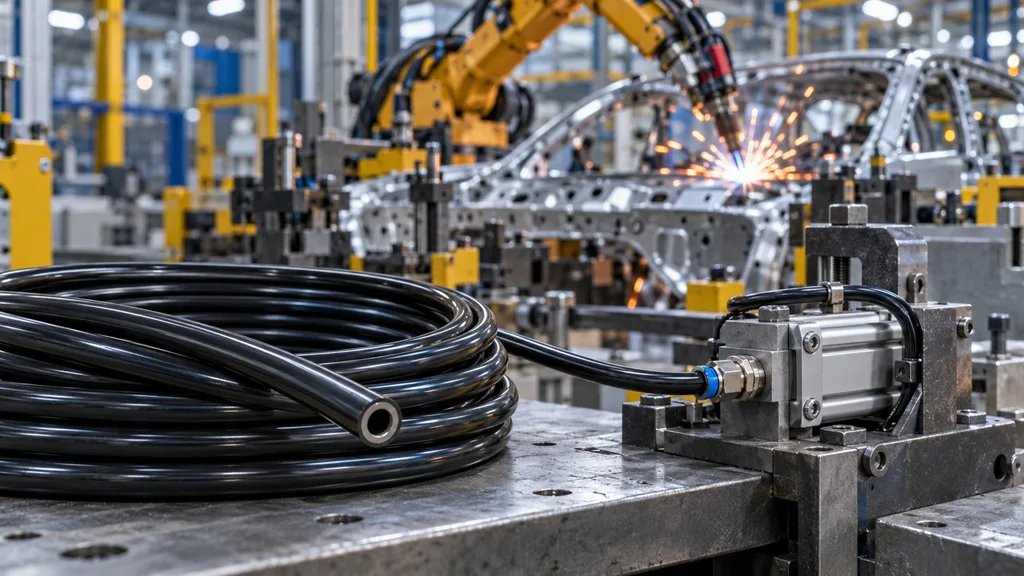
Anti-static TPU manages an electrostatic property. Anti-spark tubing is designed to resist physical damage from welding sparks and harsh metalworking environments. These are different risks. An anti-static hose should not be placed near welding spatter unless it also has the required heat and spark protection.
See the anti-spark pneumatic hose guide when the primary hazard is hot particles rather than ESD-sensitive electronics.
Pressure and Airflow Selection
The product page asks buyers to confirm working pressure but does not publish one pressure value covering every size and condition. Request the allowable working pressure for the exact OD/ID, temperature, fitting and application. Do not copy a rating from another TPU hose.
Pressure at the compressor is not the same as pressure at the actuator. Long small-ID tubes, elbows, flow controllers and simultaneous demand can reduce available pressure. Calculate or test the real circuit with the machine operating at its fastest required cycle.
Temperature Limit and Heat Exposure
The product page advises caution when fluid temperature exceeds 60 degrees C and says to avoid environments above 60 degrees C. High temperature may soften TPU and reduce pressure capability. Nearby heaters, motors, ovens, lamps and enclosed cabinets can expose tubing to temperatures above room measurements.
Measure the temperature at the hose route during worst-case production, not only during machine setup. Use a different approved tube if the limit cannot be maintained.
Chemical and Humidity Precautions
The page warns against unverified use with strong acids, strong alkalis, highly polar solvents and chemical-vapor environments. TPU chemistry can be affected by incompatible chemicals, and an anti-static formulation does not provide universal chemical resistance.
Cleaning agents used on electronics lines must also be checked. A hose carrying clean air can still be exposed externally to solvent spray, vapor or wiping chemicals. Review the tube, printing, fittings and seals together.
Storage guidance says to avoid humid conditions and storage longer than 12 months. Control warehouse humidity, keep rolls sealed and identified, rotate stock by date, and inspect older material before production use. Do not mix untraceable partial rolls into an ESD-controlled build.
Fitting Compatibility
The product’s +/-0.12 mm dimensional tolerance supports repeatable connection, but the fitting must still match the exact outside diameter and tube material. Confirm the collet, seal, insertion depth, pressure range and release procedure.
A fitting can also affect system-level ESD behavior. Metal, plastic and composite connectors create different electrical paths. Do not assume a metal fitting automatically grounds the tube, or that a plastic fitting invalidates every anti-static application. Test the approved assembly according to the project specification.
Browse the pneumatic fittings category for connection shapes, then request material and ESD confirmation for the selected assembly.
Installation Procedure
- Confirm the hose model, OD/ID, batch and resistance requirement.
- Keep the tube clean and capped until installation where contamination matters.
- Cut the tube square with a sharp pneumatic tube cutter.
- Remove scratched, flattened or contaminated sections.
- Insert the tube fully into the approved fitting.
- Route within the specified bend radius and protect against rubbing.
- Keep the tube away from temperatures and chemicals outside its approved limits.
- Label the anti-static line so standard tubing is not installed during maintenance.
- Leak-test and flow-test the pneumatic circuit.
- Perform the required ESD measurement on the installed assembly.
Validation for OEM Machines
OEM builders should approve the hose through a controlled sample process:
- Define the ESD requirement and measurement standard.
- Select the exact hose size, fittings and route.
- Confirm working pressure and temperature in writing.
- Build a representative installed assembly.
- Measure electrical resistance under the required conditions.
- Run pressure, leakage, flow and machine-cycle tests.
- Evaluate bending, abrasion and fitting retention after cycling.
- Repeat ESD and leak tests after cleaning and aging where required.
- Freeze the approved model, color, batch controls and packaging requirements.
For distributor orders, specify whether resistance data, inspection records, sample rolls or custom labels are required. A black hose without a traceable specification should not be treated as equivalent.
Inspection and Replacement
Inspect for cuts, abrasion, kinks, whitening, cracking, hardening, softening, fitting movement and air leakage. Replace tubing after overheating, chemical exposure outside the approved range or any event that damages the surface.
ESD properties are not reliably assessed by appearance. Include resistance testing in the maintenance plan when the installed hose is part of a controlled program. Record the test method, location, environment and result.
When This Hose Is Not the Right Choice
Choose another documented product when the application requires service above 60 degrees C, strong acid or alkali resistance, highly polar solvent resistance, continuous chemical-vapor exposure, welding-spark protection, conductive grounding, explosive-dust conveying, flammable-fluid transfer, high vacuum, sanitary certification, cleanroom approval or a pressure rating that cannot be confirmed.
Do not use anti-static pneumatic tubing as a substitute for a designed grounding conductor, ionizer, antistatic mat, protective earth connection or hazardous-area hose assembly.
Ordering Checklist
- Required surface resistance range and test method
- Tube OD x ID
- Working and peak pressure
- Fluid and ambient temperature
- Air quality and flow demand
- Fitting type and material
- Fixed or moving installation
- Bend radius and cycle requirement
- Chemical, vapor and cleaning exposure
- Standard black or requested color
- Roll length and quantity
- Storage, packaging and traceability requirements
FAQ
What is anti-static TPU hose used for?
It is used for compressed-air lines in electronics manufacturing, ESD-controlled workstations, automated handling, inspection equipment and other static-sensitive environments.
What is the surface resistance?
The published surface resistance is 107 to 109 ohms. Confirm the required test method and installed-system acceptance criteria.
Is anti-static TPU hose conductive?
Do not assume it is a low-resistance conductive or grounding hose. Anti-static, conductive and grounded are different engineering requirements.
Can it make a machine ESD-safe by itself?
No. ESD control also involves grounding, personnel, tools, surfaces, packaging, humidity, procedures and verification.
What sizes are available?
Published sizes are 4 x 2.5, 6 x 4, 8 x 5, 10 x 6.5 and 12 x 8 mm.
Can the hose be used above 60 degrees C?
The page advises caution above 60 degrees C for fluid temperature and says to avoid ambient environments over 60 degrees C. Select another approved hose when this cannot be controlled.
Can it carry strong acids, alkalis or solvents?
Not without full compatibility confirmation. The page specifically warns about strong acids, strong alkalis, highly polar solvents and chemical-vapor environments.
How long can it be stored?
The product guidance says to avoid humid storage and storage longer than 12 months. Use controlled stock rotation and inspect material before installation.
Is black pneumatic hose automatically anti-static?
No. Color does not prove electrical resistance. Require the product specification, traceability and relevant test data.
Control Static Risk with a Verified System
Anti-static TPU hose provides a documented tubing option for pneumatic circuits near ESD-sensitive components. The published 107 to 109 ohm surface resistance, five metric sizes and TPU construction support focused selection, but final approval must cover pressure, temperature, routing, fittings, storage and the complete ESD control plan.
Provide the required resistance test, tube size, pressure, temperature, fitting, machine route, color, roll length and quantity when requesting model confirmation.