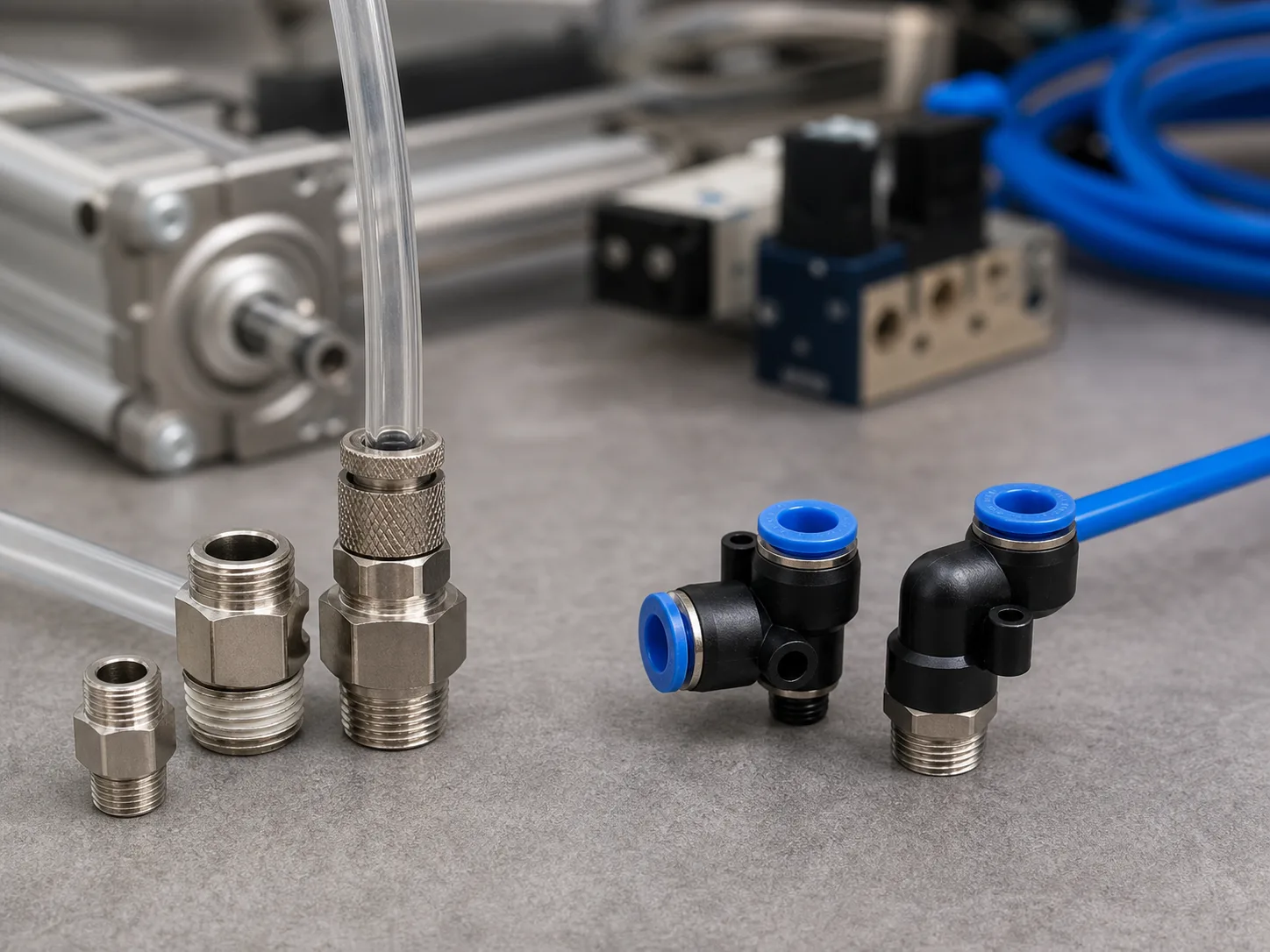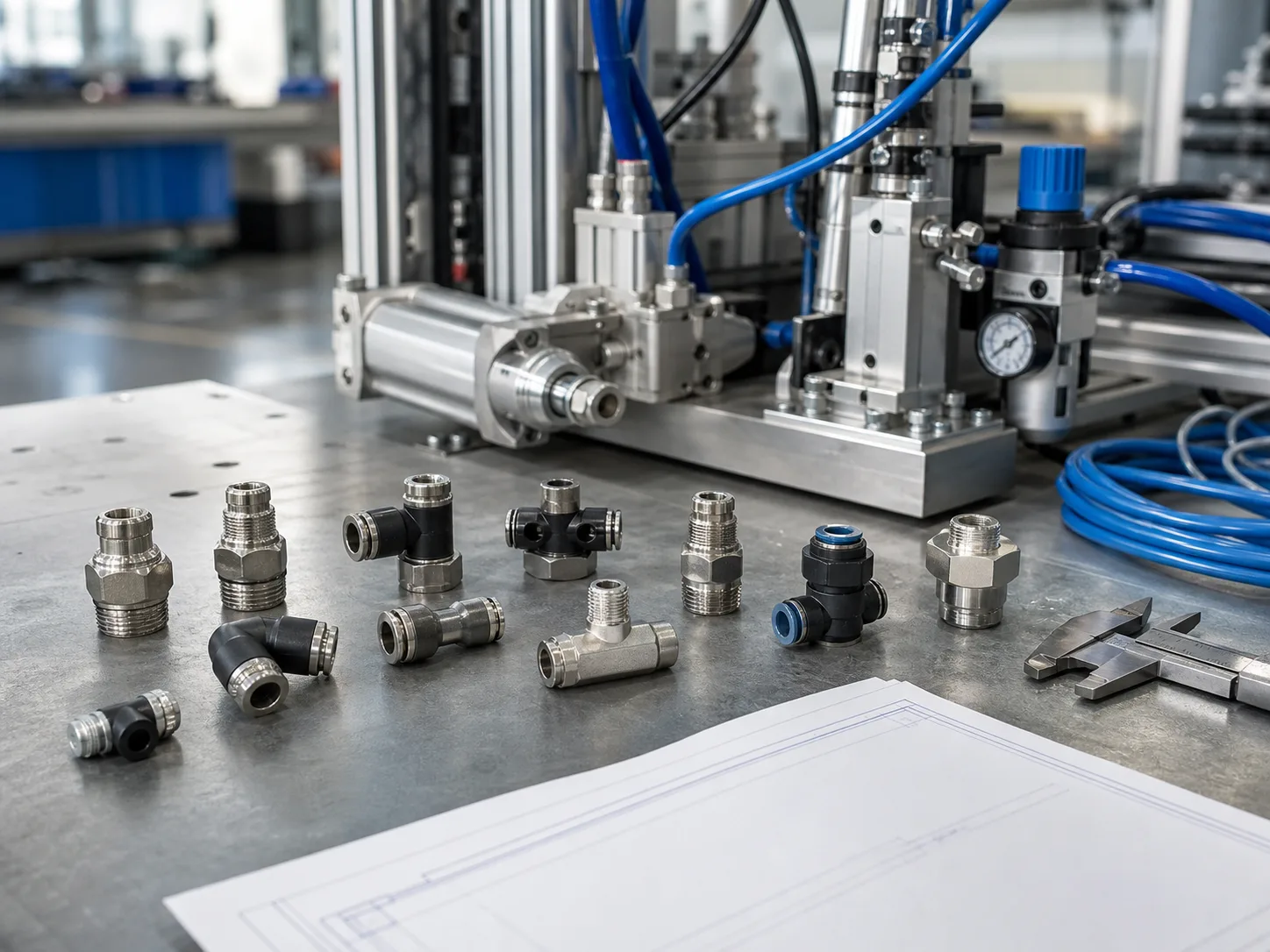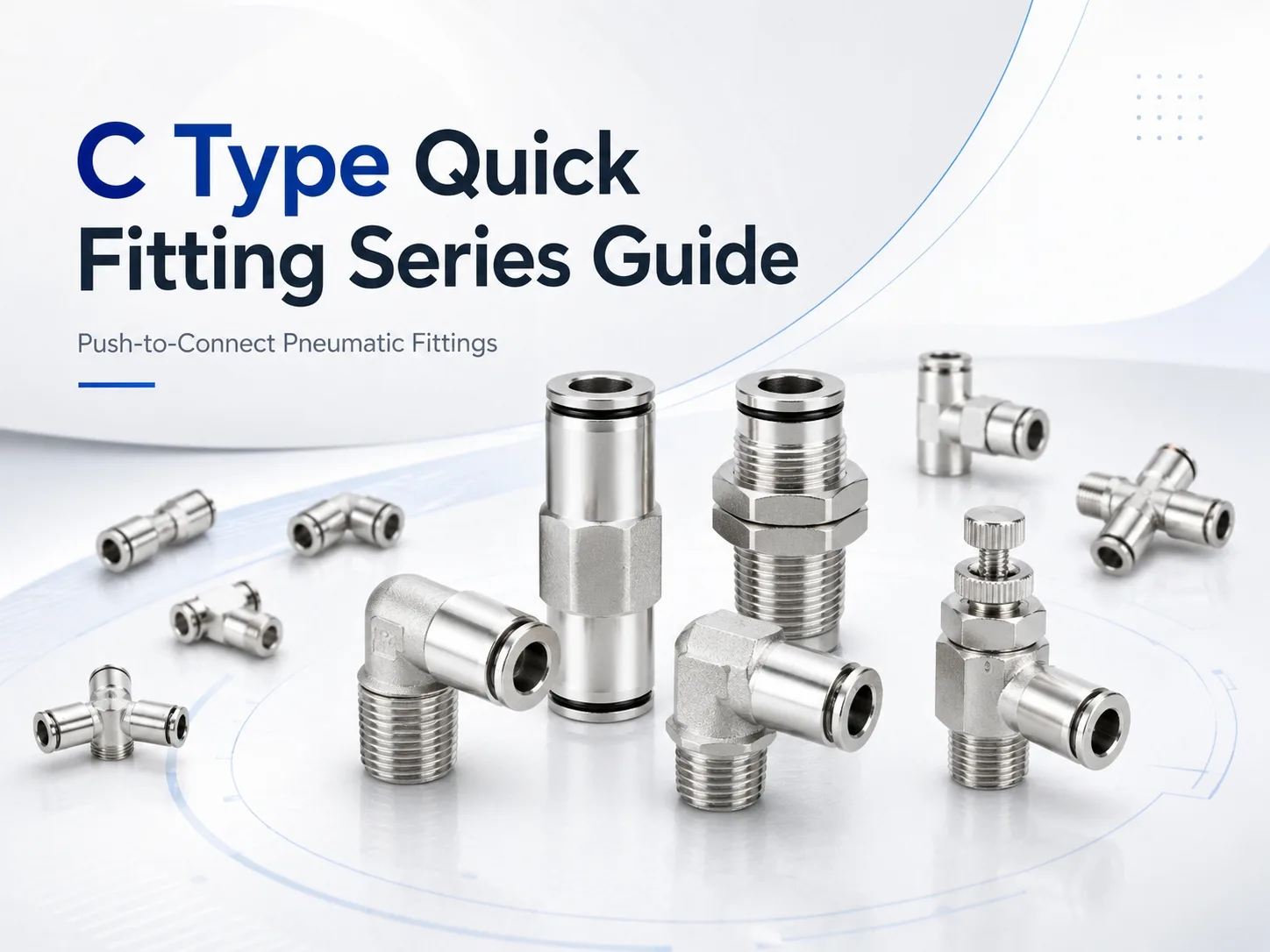
Pneumatic quick fittings are small components, but their connection geometry determines how easily an air circuit can be assembled, routed, serviced, and expanded. A straight union cannot replace a threaded elbow, an equal tee cannot perform the same job as a reducing tee, and a standard connector cannot provide the adjustment function of a throttle valve.
This guide compares 17 HOMIPNEU push-to-connect fitting models selected from the current pneumatic fitting range. It covers tube-to-tube connectors, threaded adapters, branch fittings, panel connections, and an adjustable airflow fitting. For a broader overview before comparing specific models, see our guide to pneumatic fitting types.
What the C Type Selection Scope Includes
The products in this guide share a practical purpose: connecting PU or nylon tube in compressed-air systems with quick installation. Their product pages state air as the operating fluid, a working pressure range of 0 to 1.0 MPa, and a temperature range of 0 to 60 degrees C. Depending on the exact model, the connection may be tube-to-tube, tube-to-thread, or panel mounted.
Nine linked pages explicitly identify the product as part of the C Type Quick Fitting Series: PEGT, PLLT, PZAT, PET, PVT, PGT, PUT, PMT, and PMFT. The other linked pages identify the fitting by model and structure without displaying that series field: PZRT, PDT, PBT, PLFT, PLT, PCFT, PHT, and SL. They are included because they are part of the product selection requested for this guide, but buyers should confirm the series designation and dimensional drawing when interchangeability matters.
Do not select by series name or appearance alone. Confirm the complete model, tube outside diameter, male or female connection, thread standard, thread size, material, pressure, temperature, panel geometry, and required function.
17-Model Quick Fitting Comparison
| Model | Structure | Connection | Main Selection Purpose |
|---|---|---|---|
| PUT | Straight union | Tube to tube | Join equal-size tubes inline |
| PGT | Straight reducer | Tube to different-size tube | Change tube size without changing direction |
| PVT | 90-degree elbow | Tube to tube | Turn a tube route around a corner |
| PET | Equal tee | Three tube ports | Create equal-size branches |
| PEGT | Reducing tee | Mixed-size tube ports | Branch while changing tube size |
| PZAT | Cross | Four tube ports | Create a compact common junction |
| PCFT | Female straight | Tube to female thread | Add an inline female threaded interface |
| PLT | Male elbow | Tube to male thread | Turn 90 degrees from a female equipment port |
| PLFT | Female elbow | Tube to female thread | Turn 90 degrees to a mating male component |
| PLLT | Long male elbow | Tube to male thread | Reach recessed or obstructed threaded ports |
| SL | Hex-body male elbow | Tube to male thread | Provide wrench access for secure installation |
| PBT | Male branch tee | Tube and male thread | Branch air directly from a female port |
| PDT | Side branch tee | Tube and thread | Create an offset branch in limited space |
| PZRT | Male cross | Tube and male thread | Distribute air in multiple directions from a port |
| PMT | Bulkhead straight | Tube to tube through panel | Route tubing through an enclosure wall |
| PMFT | Bulkhead female | Tube to female thread through panel | Create a panel-mounted threaded interface |
| PHT | Elbow throttle valve | Tube to thread | Adjust airflow or actuator speed at the connection |
Tube-to-Tube Fittings
PUT Straight Union
The PUT straight union push-to-connect fitting joins two tubes of the same outside diameter in a straight line. It suits tube extension, modular machine assembly, and replacement of a properly prepared tube section. The product page lists sizes from PUT4 through PUT16.
Choose PUT when neither direction nor tube size changes. A direct union keeps the joint count lower than an assembly made from extra threaded adapters.
PGT Straight Reducer
The PGT straight reducer push-to-connect fitting connects two different tube outside diameters on the same axis. It is useful when a distribution tube transitions to a smaller local line or two machine modules use different tube sizes.
Specify both port dimensions and check airflow after the reduction. Mechanical compatibility does not guarantee that the smaller downstream tube can supply the required flow.
PVT Tube Elbow
The PVT 90-degree elbow push-to-connect fitting changes the direction of a tube-to-tube line. It creates a controlled corner without forcing pneumatic tubing below its permitted bend radius. The page lists sizes from PVT4 through PVT16.
Use PVT around frames, inside control equipment, and wherever a deliberate 90-degree route improves access. Leave enough clearance to push both release collars during service.
Tube Branching and Distribution Fittings
PET Equal Tee
The PET tee push-to-connect fitting connects three same-size tubes in a T-shaped junction. It can split one supply into two branches or combine air paths where the circuit permits. Published tube sizes run from PET4 through PET16.
Equal port size does not ensure equal branch flow. Tube length, downstream restrictions, valve capacity, and simultaneous air demand still affect distribution.
PEGT Reducing Tee
The PEGT reducing tee push-to-connect fitting combines branching and tube-size conversion. It can replace a separate equal tee and reducer when the main route and branch need different tube dimensions.
Map each port before ordering because the location of the reduced connection matters. Record the complete model code in the bill of materials rather than describing the item only as a reducing tee.
PZAT Tube Cross
The PZAT cross push-to-connect fitting provides four tube ports in a compact cross-shaped junction. It can simplify a passive multi-line distribution point and reduce the number of separate tees.
Choose a manifold instead when branches need independent isolation, pressure regulation, clear service zoning, or individual labeling. PZAT is appropriate when the design genuinely requires a shared junction.
Straight and Elbow Thread Adapters
PCFT Female Straight
The PCFT female straight push-to-connect fitting connects pneumatic tube to a female threaded interface in a straight line. Its page lists nickel-plated brass or stainless steel as material options. This structure can link tubing to a mating male component while keeping the connection axis straight.
Confirm that a female fitting is actually required. A female-to-female combination will need another adapter, increasing length and the number of sealing interfaces.
PLT Male Thread Elbow
The PLT male thread elbow push-to-connect fitting turns tubing 90 degrees directly from a female threaded port. Its product page specifies nickel-plated brass construction.
PLT is a general choice for valves, cylinders, manifolds, and equipment ports where a standard-height elbow has adequate clearance. Select tube size and male thread as separate dimensions.
PLFT Female Thread Elbow
The PLFT female thread elbow push-to-connect fitting combines a tube port, 90-degree direction change, and female threaded connection. It is intended for a mating male threaded component where a straight adapter would create an awkward tube bend.
Do not confuse PLFT with PLT: PLFT has a female threaded interface, while PLT has a male thread. Confirm the mating component before selecting either model.
PLLT Long Male Elbow
The PLLT long male elbow push-to-connect fitting extends the threaded elbow body to reach deep, recessed, or obstructed female ports. The extra height can clear adjacent coils, valve bodies, frames, and manifold features.
Use the dimensional drawing to confirm that the added reach solves the actual obstruction without creating interference elsewhere. A longer body also needs adequate support and installation clearance.
SL Male Elbow with Hex Body
The SL male elbow hex push-to-connect fitting adds external wrench flats to a 90-degree tube-to-male-thread connection. The hex body supports controlled tightening where tool access and installation torque are important.
Apply torque only through the specified metal wrench surface. Do not tighten a fitting by twisting the tube or loading the release ring.
Threaded Branch Fittings
PBT Male Branch Tee
The PBT male branch tee push-to-connect fitting mounts to a female threaded port and provides a T-shaped branch arrangement. It can distribute air near a valve, manifold, cylinder, or other pneumatic component without building the branch from multiple separate adapters.
Check the orientation available after thread sealing and tightening. The installed branch directions must align with the intended tube routes without side loading.
PDT Side Branch Tee
The PDT side branch tee push-to-connect fitting uses an offset branch geometry for lateral air distribution. It can be useful where a conventional centered tee conflicts with nearby equipment or produces tubing congestion.
The submitted product list contained PDT twice; it is treated as one model in this guide. Confirm the physical orientation from the drawing because side branch geometry is the reason to choose PDT over another tee.
PZRT Male Cross
The PZRT male cross push-to-connect fitting combines a threaded equipment connection with multi-direction tube distribution. It can reduce adapter count where several air lines must originate at one port.
Before using a cross, calculate total simultaneous flow and decide whether each branch needs independent control. A compact junction should not replace a manifold when isolation or regulation is required.
Panel-Mount Fittings
PMT Bulkhead Straight
The PMT bulkhead straight push-to-connect fitting carries a tube-to-tube connection through a panel. It organizes internal and external tubing on control cabinets, guards, fixtures, and modular equipment.
Check mounting-hole diameter, panel thickness, nut access, body length, and release-collar clearance. The fitting should be supported by its bulkhead hardware rather than by the tubing.
PMFT Bulkhead Female
The PMFT bulkhead female push-to-connect fitting provides a panel-mounted transition between pneumatic tube and a female threaded interface. Its page lists BSP, NPT, and metric thread options, subject to the exact configuration.
Selection requires the tube outside diameter, female thread standard, female thread size, and panel dimensions. The mating male component must use the same thread standard and a suitable sealing method.
Flow-Control Fitting
PHT Elbow Throttle Valve
The PHT elbow throttle valve push-to-connect fitting differs from the passive connectors above because it includes adjustable airflow regulation. The product page positions it for pneumatic actuator speed control and compact 90-degree installation.
Determine whether the circuit requires meter-in or meter-out control and confirm the permitted flow direction from the product documentation. A throttle fitting adjusts flow; it does not replace a pressure regulator, shut-off valve, directional valve, or safety exhaust device.
How to Select the Correct Model
1. Define the Connection Function
Draw the circuit and label every joint. Use PUT for equal-size inline joining, PGT for inline size conversion, PVT for a tube-to-tube corner, PET or PEGT for tube branching, and PZAT for a common four-tube junction. Choose PCFT, PLT, PLFT, PLLT, or SL when the joint includes a threaded component; PBT, PDT, or PZRT when branching begins at a threaded port; PMT or PMFT at a panel; and PHT only where adjustable flow is needed.
2. Confirm Tube Outside Diameter
Push-to-connect sizes refer to tube outside diameter, not inside diameter. Measure and specify every port. This is especially important for PGT and PEGT, which intentionally use different tube sizes.
3. Confirm Male or Female Thread
Do not rely on the word elbow or straight. PLT, PLLT, SL, PBT, and PZRT use male threaded interfaces; PLFT and PCFT use female threaded interfaces. PMFT creates a female threaded panel interface. Verify the exact page and drawing for every configuration.
4. Identify the Thread Standard
Confirm BSP, NPT, or metric thread and whether tapered or parallel sealing applies. Similar nominal sizes are not automatically compatible. Use the specified sealant or sealing washer and keep material out of the internal air passage.
5. Verify Operating Limits
The linked pages specify air, 0 to 1.0 MPa, 0 to 60 degrees C, and PU or nylon tubing. Remain inside all product, tube, and equipment limits during startup, normal operation, shutdown, and pressure transients. Do not assume suitability for water, oil, oxygen, steam, aggressive gas, vacuum, or another medium.
6. Confirm Material by Model
Several pages offer nickel-plated brass or stainless steel, while PLT and PLFT list nickel-plated brass. Material availability is model-specific. Confirm the exact wetted and external construction in the quotation instead of treating one page’s option as available across all 17 products.
7. Check Flow, Space, and Service Access
Review tube length, internal passage, valve capacity, operating pressure, and simultaneous consumption. Also leave enough room to cut and insert tubing, tighten threaded bodies, press the release collar, adjust PHT, and remove the fitting later.
Installation Procedure
- Isolate and fully depressurize the circuit.
- Cut the tube square with a pneumatic tube cutter.
- Remove any scratched, flattened, angled, or contaminated tube section.
- Push the tube straight into the fitting until it reaches the internal stop.
- Pull back gently to confirm retention.
- For threaded models, use the correct wrench flats and sealing method.
- For PMT or PMFT, tighten the bulkhead hardware without distorting the panel.
- Pressurize gradually and leak-test under actual operating conditions.
- Before removal, depressurize again, press the release collar evenly, and pull the tube straight out.
Common Mistakes to Avoid
- Counting PDT twice: duplicate links do not represent a second model.
- Confusing OD and ID: the push-in connection is selected by tube outside diameter.
- Mixing male and female fittings: PLT and PLFT perform different mating functions.
- Mixing BSP, NPT, and metric threads: always identify the thread system.
- Using PET instead of PEGT: PET is an equal tee; PEGT changes tube size.
- Using PHT as a general valve: it is an adjustable throttle fitting, not a directional or isolation valve.
- Ignoring panel dimensions: PMT and PMFT require correct mounting geometry.
- Assuming every linked model carries the same series label: confirm the product page and drawing.
- Using an unlisted medium: the linked pages specify air.
OEM and Distributor Buying Checklist
A complete request for quotation should include model, all tube outside diameters, male or female thread, thread standard and size, material, quantity, operating pressure, temperature, air quality, panel dimensions where applicable, required flow, PHT adjustment requirement, and packaging or labeling needs.
For OEM production, add the approved drawing revision and complete part code to the bill of materials. Distributors should separate visually similar tube sizes and thread standards in stock. Sample approval should verify assembly access, thread engagement, tube retention, leakage, branch orientation, and actual machine airflow before a production order.
FAQ
How many unique products are covered?
Seventeen. The supplied PDT link appeared twice, so it is included once.
Which fitting connects equal-size tubes in a straight line?
PUT is the straight union. Use PGT when the two tube outside diameters differ.
What is the difference between PLT, PLFT, PLLT, and SL?
PLT is a standard male threaded elbow, PLFT is a female threaded elbow, PLLT is an extended male threaded elbow, and SL is a male threaded elbow with an external hex body for wrench access.
Which fittings are intended for panels?
PMT provides a tube-to-tube bulkhead connection. PMFT combines panel mounting with a female threaded interface.
Which model controls airflow?
PHT includes an adjustable throttle function. The other models in this guide are primarily passive connection and distribution components.
Can these fittings be selected by the C Type name alone?
No. Nine pages explicitly show the C Type Quick Fitting Series field, while eight are identified by model and structure. Always confirm the exact product page, dimensions, thread, material, and drawing.
Choose the Structure Before the Size
A reliable selection begins with connection function: straight, reducing, elbow, branch, cross, threaded adapter, bulkhead, or throttle control. After choosing the correct structure, confirm tube outside diameter, thread gender and standard, material, pressure, temperature, flow, installation space, and service access.
Browse the complete HOMIPNEU pneumatic fittings range or provide your circuit drawing and operating conditions for model confirmation.