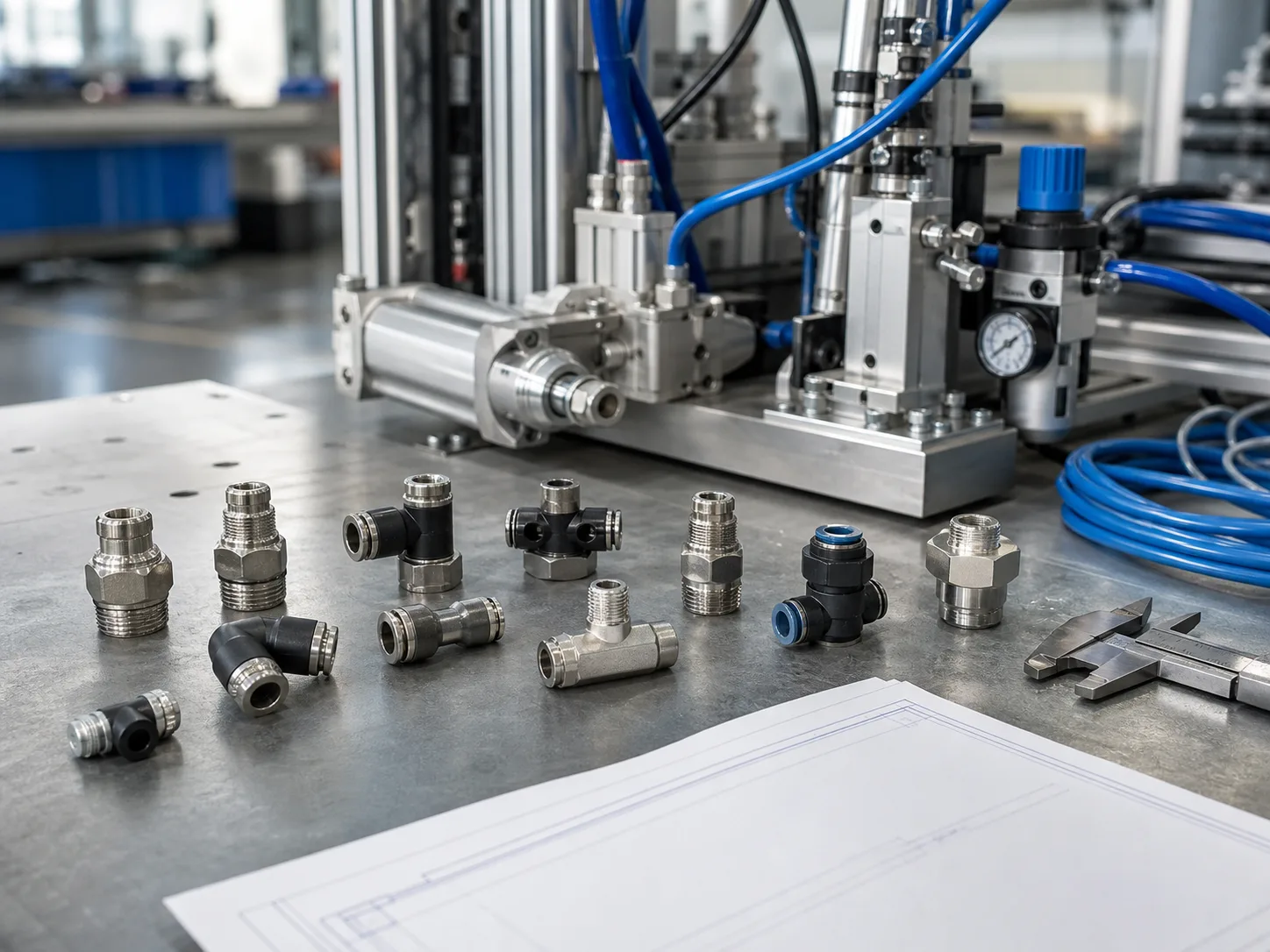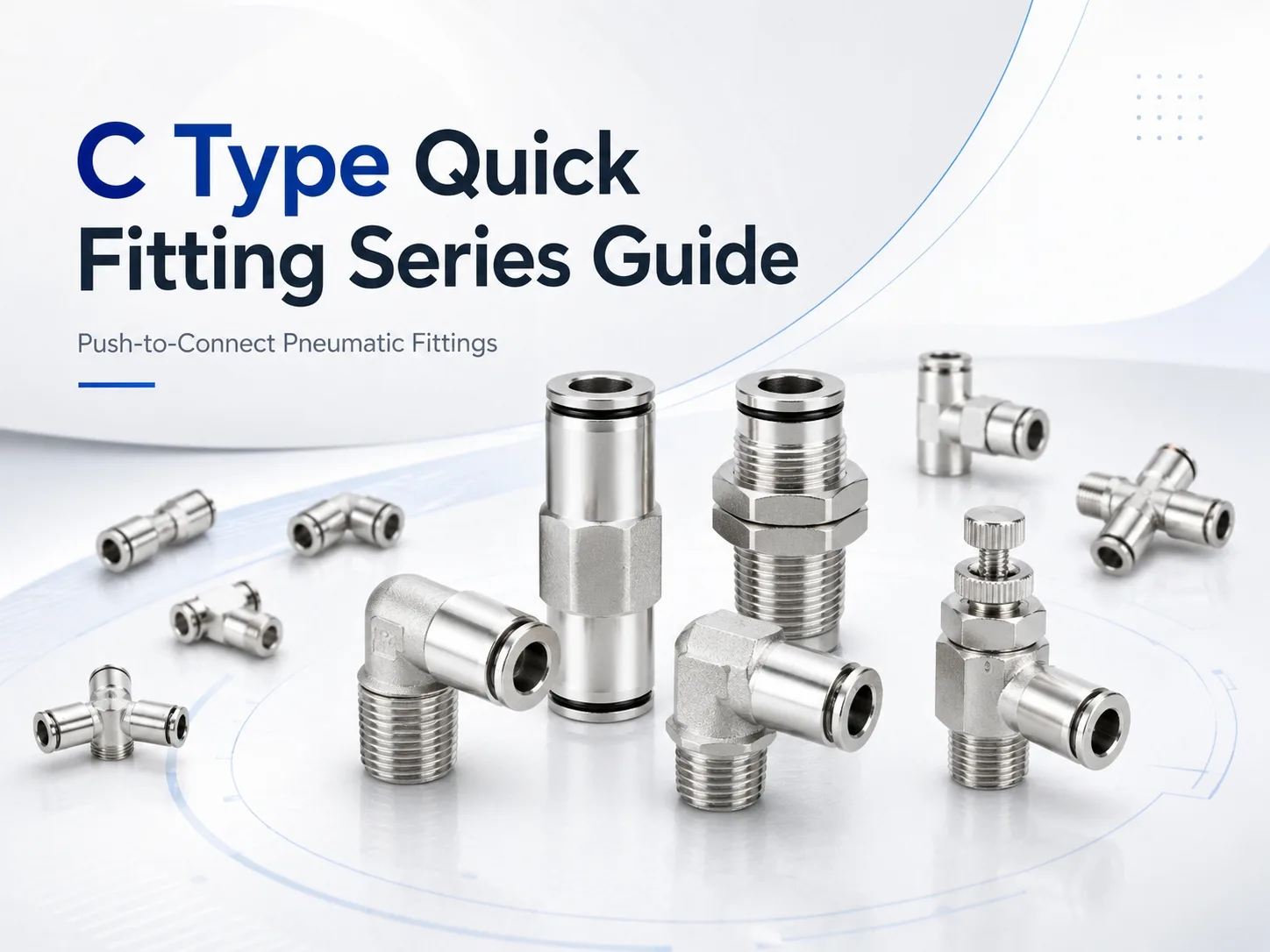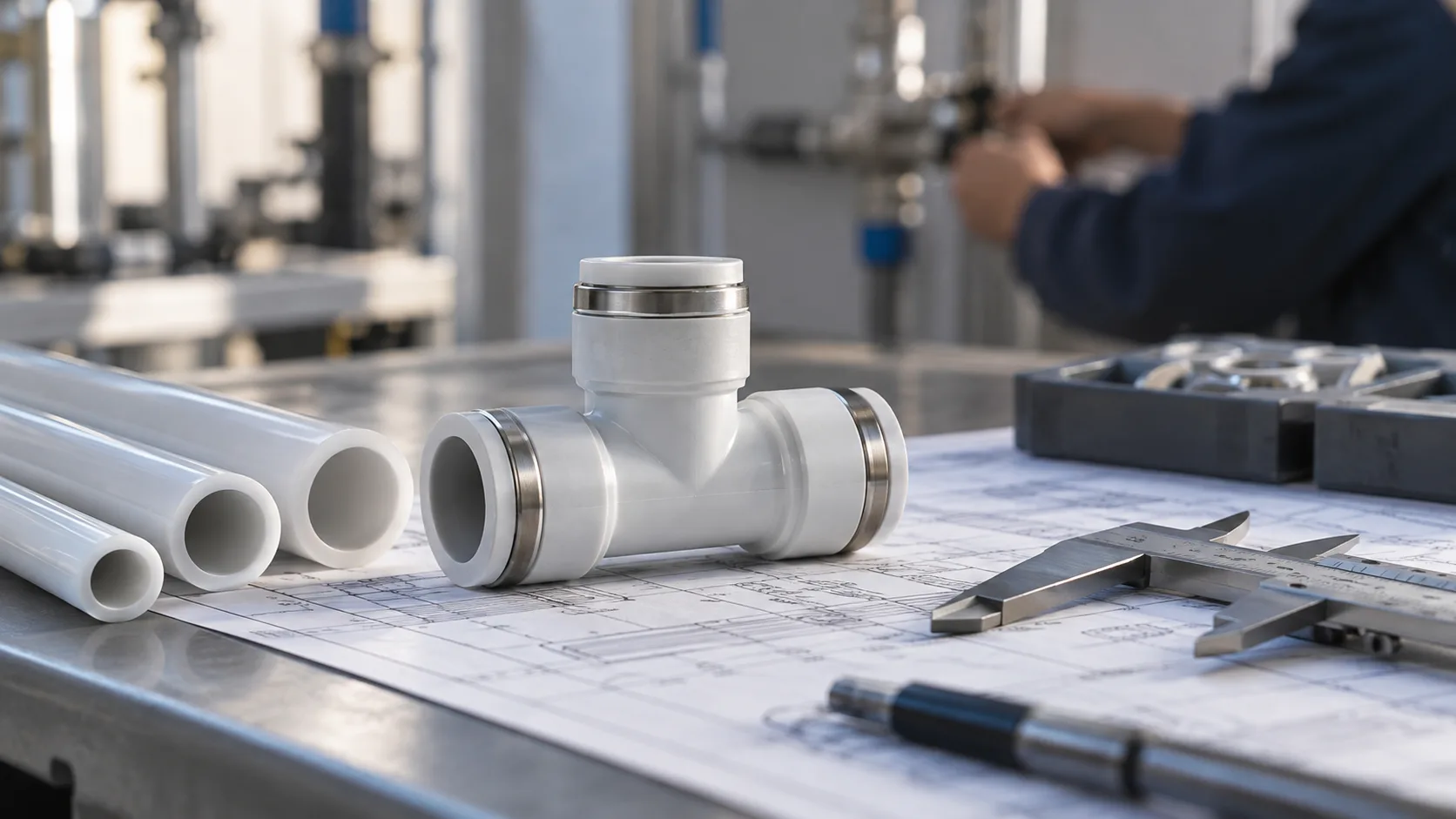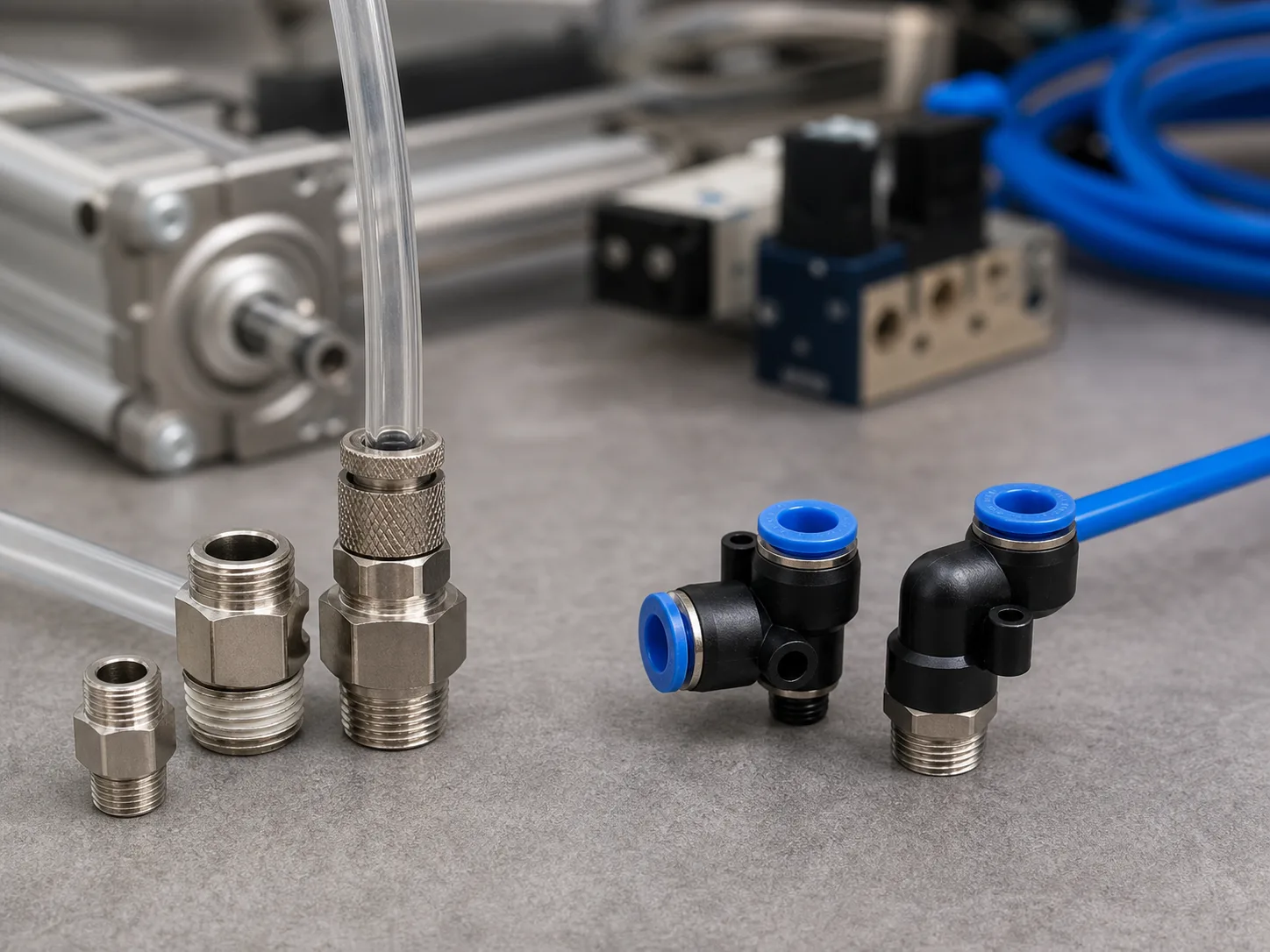
Quick-Tight and push-to-connect fittings can perform many of the same routing jobs, including straight tube connection, threaded port connection, 90-degree direction change, branching, tube-size reduction and panel mounting. Their similar model shapes do not mean that the two families should be mixed without review. Installation structure, body construction, dimensions, thread options and published operating scope must be checked at the product level.
This guide compares standard push-to-connect models with the HOMIPNEU KL Quick-Tight range. It does not assume that one connection family is universally better. The correct choice is the one that matches the approved tube, thread, material, drawing, operating conditions, assembly method and maintenance plan.
What Push-to-Connect Means
A standard push-to-connect fitting accepts a prepared tube through a release collar and holds it with an internal gripping and sealing structure. For example, the PC male straight push-to-connect fitting lists a stainless steel lock claw, O-ring or PTFE sealing, nickel-plated brass, and PU or nylon tubing. The tube can be released after the circuit is depressurized by pressing the collar and pulling the tube straight out.
Push-to-connect describes the tube connection, not every other property. A product may have a threaded equipment side, a tube-to-tube body, a panel nut, a branch shape, or an integrated flow-control function. Always read the complete model description.
What Quick-Tight Means in the KL Range
The KL product pages identify their installation structure as Quick-Tight. The range includes straight threaded connectors, unions, elbows, tees, crosses, reducers, bulkhead fittings and compact M5/M6 models. The published pages generally specify nickel-plated brass, air as the operating fluid, 0 to 1.0 MPa working pressure, 0 to 60 degrees C, and PU or nylon tube.
Quick-Tight is a series and installation description, not an industry-wide guarantee of interchangeability or performance. A KL fitting should be selected from its own model code and dimensional drawing. Do not substitute it for a push-to-connect fitting solely because both accept the same nominal tube size.
Published Comparison
| Selection Point | Standard Push-to-Connect Examples | KL Quick-Tight Examples |
|---|---|---|
| Product range | Straight, elbow, union, tee, Y, cross, reducer, bulkhead, valve and controller | Straight, elbow, union, tee, cross, reducer, bulkhead and mini/micro models |
| Representative straight threaded model | PC male straight | KL-PC straight thread |
| Representative tube union | PU straight union | KL-PU straight union |
| Representative elbow | PL male elbow | KL-PL elbow |
| Representative equal tee | PE tee | KL-PE tee |
| Representative cross | PZA cross | KL-PZA cross |
| Representative reducer | PG straight reducer | KL-PG reducing union |
| Representative bulkhead | PM bulkhead union | KL-PM bulkhead straight |
| Published KL material | Varies by standard model; check each page | Nickel-plated brass on the reviewed KL pages |
| Published KL fluid and range | Varies by model; check exact page | Air, 0 to 1.0 MPa, 0 to 60 degrees C on reviewed pages |
| Applicable tubing on reviewed pages | PU and nylon tube | PU and nylon tube |
The table is a selection map, not an equivalence declaration. Confirm current specifications and dimensions for the exact part number.
Equivalent Layout Functions
Straight Tube-to-Thread Connection
Use a straight threaded fitting when tubing should leave an equipment port on the same axis. Standard PC and KL-PC Quick-Tight both address this layout. Select the actual tube outside diameter and thread code; then compare body width, installed height, sealing method and assembly access.
Tube-to-Tube Union
Standard PU and KL-PU Quick-Tight union join two tubes in a straight line. Use a union at deliberate extension or module boundaries, not to pull misaligned tubing together. Both tube ends must be cut square and inserted according to the selected fitting’s procedure.
90-Degree Direction Change
Standard PL and KL-PL Quick-Tight elbow connect tube to a threaded port while turning the route 90 degrees. The KL-PV adjustable elbow is another KL option where the product drawing and allowed orientation fit the installation.
Compare clearance around the threaded port, wrench surfaces, tube insertion direction and the final route. Do not use the tube as a handle for tightening or orientation.
Three-Way Branching
Standard PE and KL-PE Quick-Tight tee create an equal-size three-way junction. The KL range also includes a KL-PB threaded tee for branching from a port and a KL-TE tube tee.
Select branch geometry from the circuit and machine frame. Equal tube sizes do not guarantee equal airflow; downstream length, restrictions and demand control the distribution.
Reduction and Reducing Branches
Standard PG and KL-PG Quick-Tight reducer transition between two tube sizes in a straight line. The KL-PEG reducing tee combines size conversion with three-way distribution.
Record both tube sizes and the position of the reduced port. Check whether the smaller downstream tube can meet the required actuator response or tool airflow.
Four-Way Distribution
Standard PZA and KL-PZA Quick-Tight cross create a common four-port tube junction. Use either only when a passive shared connection is required. A manifold is more appropriate if branches need independent isolation, regulation, identification or diagnostics.
Panel Mounting
Standard PM supports tube-to-tube routing through a panel. The KL-PM Quick-Tight bulkhead fitting provides a panel-mount option within the KL family. Compare panel-hole diameter, panel thickness, mounting hardware, body length and service access before choosing.
Compact KL Options
The KL-PC-C mini straight fitting is published in 4-M5 and 4-M6 configurations with an O-ring seal. The KL-PL-C micro elbow provides corresponding compact 90-degree configurations.
These models can be considered for small pneumatic panels and compact equipment, but mini does not remove the need for assembly clearance. Verify wrench access, tube bend radius, release or disassembly method, and the available wall thickness around the M5 or M6 port.
When to Standardize on Push-to-Connect
- The machine already has an approved push-to-connect bill of materials and service procedure.
- The selected standard series contains the exact Y, valve, controller, rotary or other specialized function required.
- The tube, thread, material and operating medium have already been validated for the application.
- Maintenance teams stock the correct replacement models and understand the depressurized release procedure.
- The dimensional envelope matches existing panels, manifolds and guards.
This is not an argument that standard push-to-connect is always superior. It means that an approved, documented system should not be changed solely for a different product label.
When to Evaluate KL Quick-Tight
- The project requires a nickel-plated brass Quick-Tight range for compressed air within the published limits.
- KL-PC, KL-PL, KL-PU, KL-PE, KL-PZA, KL-PG or KL-PM provides the required layout shape.
- The machine uses PU or nylon tube and the exact size is listed for the selected model.
- A mini 4-M5 or 4-M6 straight or elbow model fits a compact installation.
- The project can approve samples, drawings, installation instructions and replacement stock before production.
Do not infer higher pressure, wider media compatibility, stronger vibration resistance or longer life from the Quick-Tight name. Those claims require product-specific data and testing.
Nine Checks for a Fair Comparison
- Connection function: straight, elbow, union, branch, cross, reducer or bulkhead.
- Tube outside diameter: confirm every port rather than using tube inside diameter.
- Thread: check gender, size, standard, taper and sealing method.
- Body and sealing materials: review the exact product specification and environment.
- Operating fluid: the reviewed KL pages specify air; do not extend that rating to water, oil, vacuum or other media.
- Pressure and temperature: remain inside the exact product and tubing limits, including transients.
- Dimensions: compare body width, installed height, panel geometry and wrench access.
- Assembly and service: document tube preparation, insertion, tightening, inspection and depressurized removal.
- Sample validation: test retention, leakage, flow, clearance and maintenance on the real machine.
Why Mixed Selection Creates Problems
Mixing fitting families within one machine is not automatically wrong, but it increases purchasing and service complexity. Similar-looking models can use different body dimensions, assembly steps, spare parts or thread conventions. A technician may assume that two 6 mm fittings are interchangeable even when the installation envelope or sealing method differs.
If both families are approved, identify them clearly in the bill of materials and maintenance documentation. Store model codes separately, label replacement bins, and avoid generic descriptions such as 6 mm air fitting.
Sample Approval Procedure
- Select the exact candidate part numbers from both families.
- Confirm drawings, tube OD, thread and published operating conditions.
- Install each sample with the intended tubing and mating component.
- Check insertion or assembly access in the real machine space.
- Pressurize gradually and test leakage at normal and expected transient conditions.
- Verify airflow and actuator response with simultaneous consumers operating.
- Repeat the approved depressurized service procedure.
- Record the final model, supplier revision and acceptance result.
Common Selection Mistakes
- Treating Quick-Tight and push-to-connect as universal standards.
- Comparing only tube size while ignoring thread and dimensions.
- Assuming all products in one category share the same fluid rating.
- Using a standard tee when a reducing tee is required.
- Forcing a straight fitting into a layout that needs an elbow.
- Ignoring panel thickness for bulkhead fittings.
- Claiming vibration or lifetime advantages without test data.
- Approving samples without checking field removal and replacement access.
FAQ
Are KL Quick-Tight fittings the same as standard push-to-connect fittings?
No. They may serve similar layout functions, but selection must use the exact model, drawing, tube, thread, material and installation instructions.
Do both families work with PU and nylon tube?
The product pages reviewed for this guide list PU and nylon tubing. Confirm the exact tube OD, dimensional tolerance, hardness, pressure and temperature rating for the selected fitting.
Is Quick-Tight more resistant to vibration?
Do not assume so from the name. Vibration performance requires product-specific test data and validation in the real installation.
Which KL model is used for a straight tube connection?
KL-PU is the tube-to-tube straight union. KL-PC connects tube to a threaded port. Select the connection function before the size.
Which family is better for compact M5 or M6 ports?
KL-PC-C and KL-PL-C provide published 4-M5 and 4-M6 compact options. Compare them with other approved compact fittings using drawings and physical samples.
Can one machine use both fitting families?
Yes, if every model is individually approved and clearly documented. Standardizing where practical reduces stocking and maintenance errors.
Choose from Evidence, Not the Series Name
Standard push-to-connect and KL Quick-Tight fittings both cover common pneumatic routing tasks. The decision should follow the required shape, tube OD, thread, material, operating scope, dimensions, service method and validated sample performance.
Browse the complete pneumatic fittings category, or review the C Type quick fitting guide when comparing another defined fitting range.