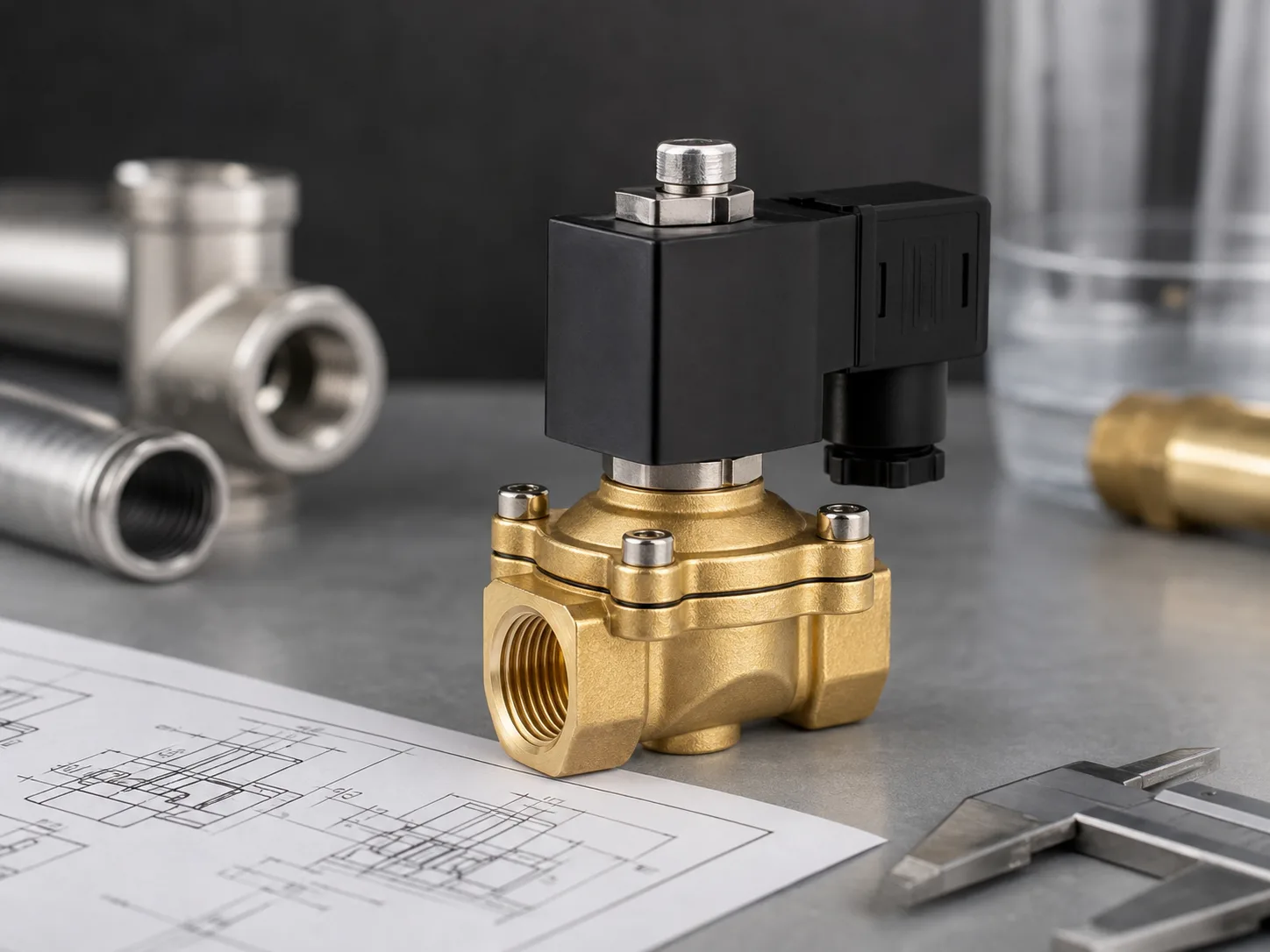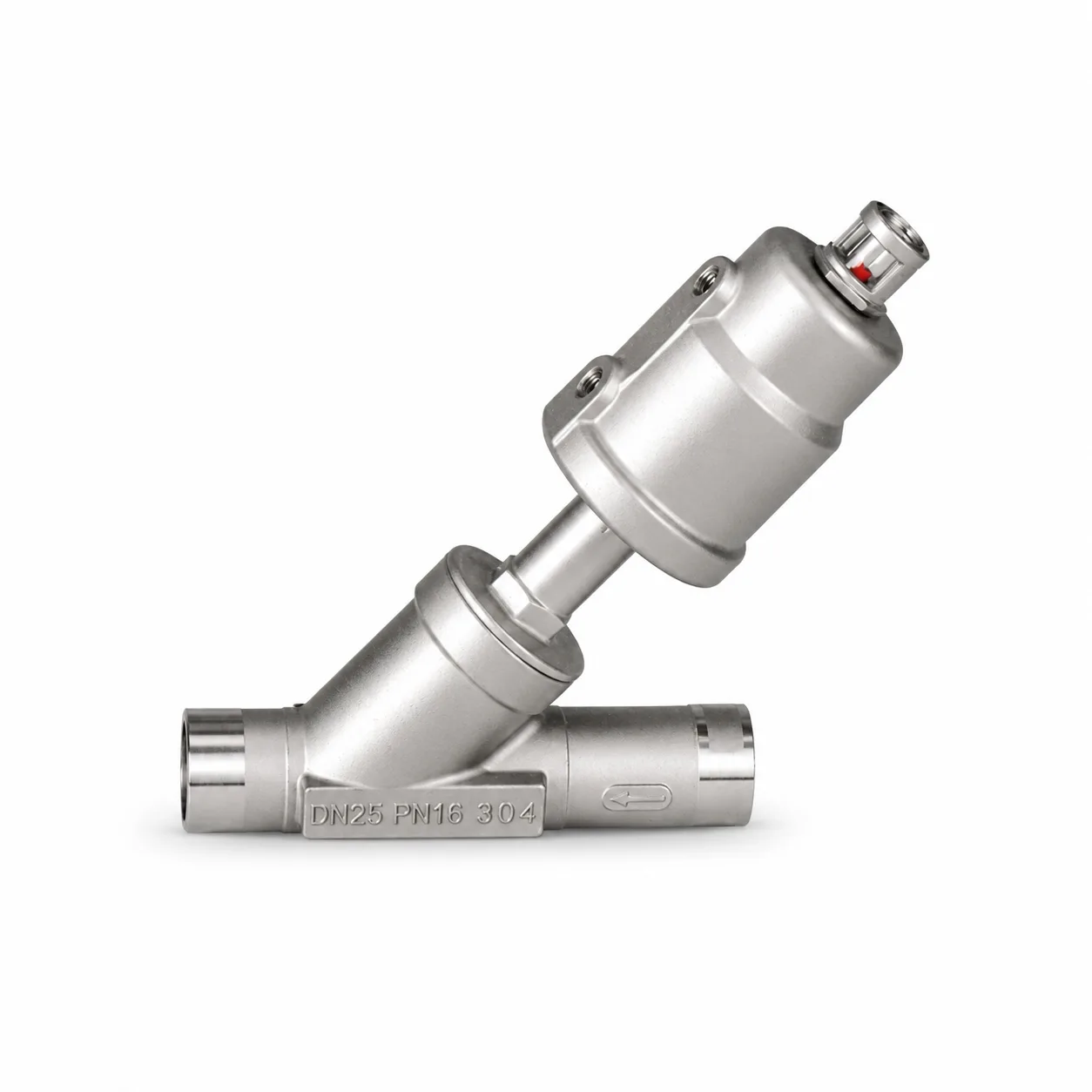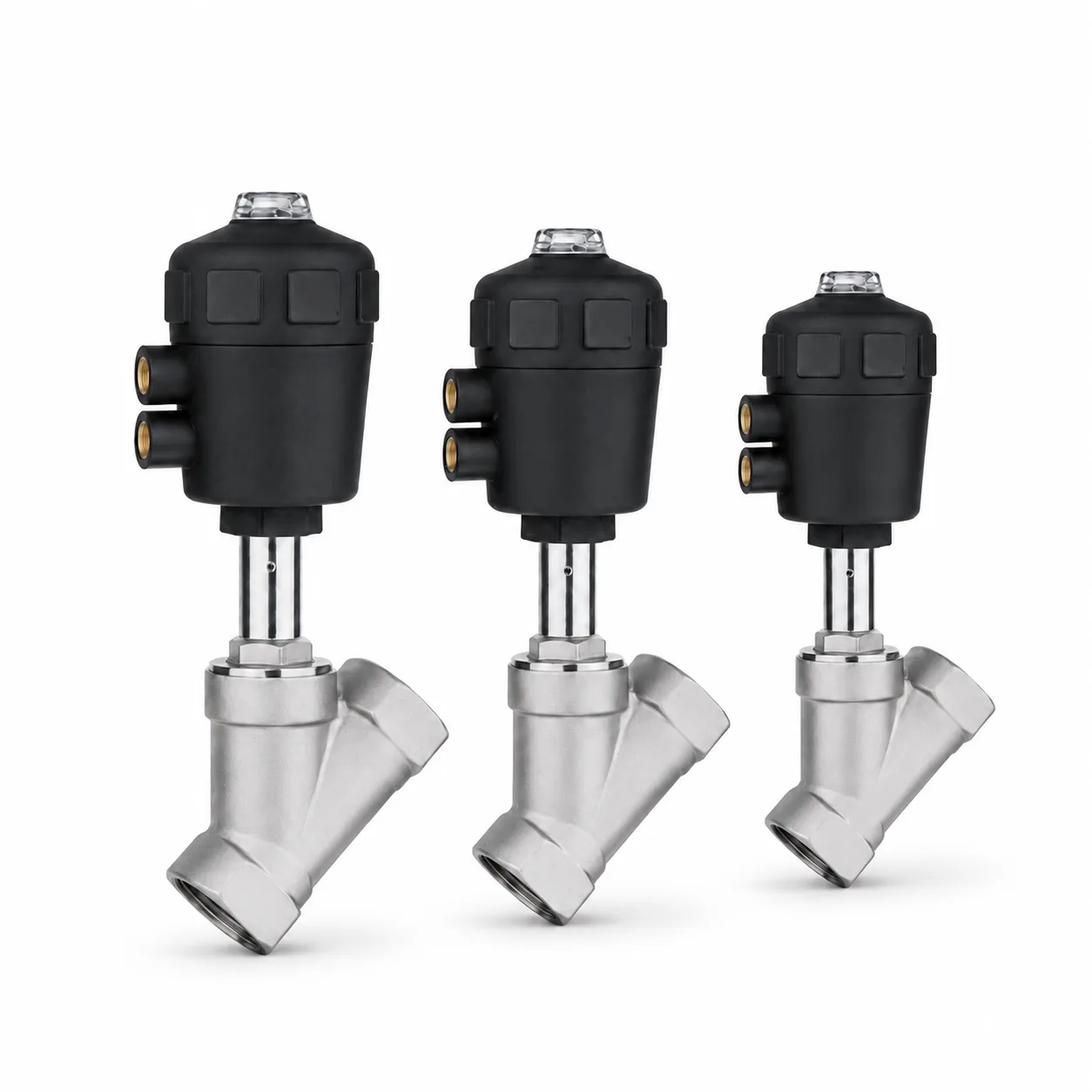
A pneumatic angle seat valve is a pneumatically operated 2/2-way process valve used to control air, water, steam, neutral gases and compatible industrial fluids. Its angled internal flow path provides good flow capacity in a compact body, making this valve suitable for frequent switching in filling machines, cleaning equipment, heating systems, steam pipelines and automated process machinery.
Selecting the correct valve requires more than matching the pipeline diameter. The actuator function, control-air pressure, process pressure, temperature, medium, seal material, connection type and required flow direction must all be considered.
This guide explains how to select a pneumatic angle seat valve and how to choose between normally closed, normally open, double-acting, threaded, flanged, weld-end and quick-clamp configurations.
1. Confirm the Working Medium
Begin by identifying the fluid that will pass through the valve. Common applications include:
- Compressed air
- Water
- Hot water
- Steam
- Neutral gases
- Cleaning fluids
- Compatible process liquids
The medium affects the required valve-body material and seat seal. Temperature and chemical compatibility must be checked before ordering, especially for steam, hot water, cleaning agents or process fluids.
Do not select the valve only according to its port size. Provide the medium name, operating temperature and any relevant concentration information so that the body and seal materials can be confirmed.
2. Select the Required Control Function
Pneumatic angle seat valves are commonly available in normally closed, normally open and double-acting configurations.
Normally Closed Pneumatic Angle Seat Valve
A normally closed valve remains closed when no control air is supplied. Compressed air moves the actuator piston and opens the valve. When the air signal is removed, the internal spring returns the valve to the closed position.
This configuration is commonly selected when the pipeline should automatically stop flowing after a loss of compressed air or electrical power.
Typical applications include:
- Steam isolation
- Water shut-off
- Filling equipment
- Heating systems
- Cleaning machinery
- General process control
A normally closed valve usually requires only one pilot-air connection. However, the available pilot pressure must be sufficient to overcome the spring force and process pressure.
Normally Open Pneumatic Angle Seat Valve
A normally open valve remains open when no pilot air is supplied. Applying compressed air closes the valve, and removing the signal allows the spring to reopen it.
This configuration is suitable when the process should continue flowing after control-air loss or when the valve normally remains open for long periods.
Typical applications may include:
- Cooling-water circulation
- Continuous process flow
- Heating or temperature-control systems
- Fail-open pipeline designs
The required fail-safe position must be confirmed during system design. A normally open valve should not be selected only because it consumes less control air during continuous flow.
Double-Acting Pneumatic Angle Seat Valve
A double-acting actuator uses compressed air to move the valve in both directions. One air connection opens the valve, while the other closes it.
This design is useful when:
- Precise opening and closing control is required
- The available pilot-air pressure is limited
- Process pressure is relatively high
- A larger actuator is needed
- The valve switches frequently
- Spring-return operation is not required
A double-acting valve normally requires a 5/2-way control valve or another suitable pneumatic directional valve.
Some double-acting configurations can also include a spring-assisted closing function. This option provides positive pneumatic control during operation while allowing the valve to return toward the closed position under specified emergency conditions.
3. Check the Process Pressure and Pilot Pressure
Process pressure is the pressure of the medium inside the main pipeline. Pilot pressure is the compressed-air pressure supplied to the pneumatic actuator. These are separate values and must not be confused.
A valve may have the correct nominal diameter but still fail to open when:
- The pilot pressure is too low
- The process pressure differential is too high
- The actuator diameter is too small
- The flow direction is incorrect
- The selected control function is unsuitable
For example, a DN50 valve equipped with a standard actuator may require a larger actuator when the process pressure approaches or exceeds the available control-air pressure.
When requesting a quotation, provide:
- Inlet pressure
- Outlet pressure
- Maximum differential pressure
- Available control-air pressure
- Required control function
- Required fail-safe position
HOMIPNEU can then help determine whether a standard or enlarged actuator is required.
4. Choose the Actuator Material
The two main options are an engineering-plastic actuator and an all-stainless-steel actuator.
Plastic Actuator
A plastic actuator provides a lightweight and practical solution for general industrial equipment. It is commonly selected for water systems, compressed-air lines, steam equipment, cleaning machinery and automated production systems where an all-metal actuator is not required.
HOMIPNEU supplies plastic-actuator angle seat valves with four main connection options:
- Plastic Actuator Pneumatic Threaded Angle Seat Valve
- Plastic Actuator Pneumatic Flanged Angle Seat Valve
- Plastic Actuator Pneumatic Weld-End Angle Seat Valve
- Plastic Actuator Pneumatic Quick-Clamp Angle Seat Valve
The plastic-actuator threaded version supports several thread options, while the flanged, welded and quick-clamp designs suit larger pipelines or specific process installations.
All-Stainless-Steel Actuator
An all-stainless-steel actuator is preferred in wet, humid, washdown or corrosion-prone environments where a plastic actuator housing may not be suitable.
Its external metal construction is commonly selected for:
- Food and beverage equipment
- Cleaning and washing systems
- Process skids
- Steam installations
- Humid production areas
- Industrial equipment exposed to frequent washdown
- Applications requiring an all-metal external structure
Available HOMIPNEU configurations include:
- All Stainless Steel Pneumatic Threaded Angle Seat Valve
- All Stainless Steel Pneumatic Flanged Angle Seat Valve
- All Stainless Steel Pneumatic Quick-Clamp Angle Seat Valve
- Stainless Steel Pneumatic Weld-End Angle Seat Valve
The exact stainless steel grade of the body, actuator housing and wetted components should be confirmed for each order.
5. Select the Pipeline Connection
The connection type affects installation, maintenance, sealing and compatibility with the existing pipeline.
Threaded Connection
A threaded angle seat valve is compact and convenient for small and medium-sized pipelines. It can usually be installed without welding or separate flange hardware.
Threaded valves are suitable for:
- General industrial equipment
- Water pipelines
- Compressed-air systems
- Small steam lines
- Cleaning equipment
- Machinery with limited installation space
Before ordering, confirm the port size and thread standard. Depending on the selected product, available options may include BSP, BSPT, NPT or customized threads.
Choose the plastic actuator threaded angle seat valve for general-purpose equipment, or the all stainless steel threaded angle seat valve when an all-metal actuator is preferred.
Flanged Connection
A flanged angle seat valve is commonly selected for larger pipelines, higher mechanical loads or systems where standardized bolted connections are required.
Advantages include:
- Secure pipeline connection
- Convenient removal for servicing
- Suitability for larger nominal diameters
- Compatibility with established pipeline standards
The flange diameter alone is not enough to confirm compatibility. The DN size, pressure class, bolt pattern, flange thickness, sealing face and applicable standard must all match.
The all stainless steel flanged angle seat valve can be supplied with several flange-standard options. A plastic actuator flanged angle seat valve is also available for general process and industrial equipment.
Weld-End Connection
A weld-end valve is permanently welded into the pipeline. This arrangement reduces the number of threaded joints or bolted flange connections and provides a compact inline installation.
It is suitable for:
- Process equipment
- Steam pipelines
- Water-treatment systems
- Filling machinery
- Cleaning systems
- OEM pipeline assemblies
The welding tube outer diameter, inner diameter and valve-body length must be checked before production. Customized welding dimensions may be available for equipment manufacturers.
For general applications, consider the plastic actuator weld-end angle seat valve. For wet environments or projects requiring an all-metal actuator, select the stainless steel pneumatic weld-end angle seat valve.
Quick-Clamp Connection
A quick-clamp angle seat valve allows faster installation, removal, inspection and cleaning than permanent welded connections.
It is often selected for:
- Food-processing equipment
- Beverage machinery
- Cleaning systems
- Filling lines
- Process skids
- Pipelines requiring frequent disassembly
The nominal valve size does not by itself determine clamp compatibility. Confirm the tube diameter, ferrule outside diameter, gasket specification and clamp standard.
HOMIPNEU offers both a plastic actuator quick-clamp angle seat valve and an all stainless steel quick-clamp angle seat valve.
6. Confirm the Flow Direction
Flow direction influences valve operation, closing force and the possibility of water hammer.
Depending on the selected design, an angle seat valve may be installed:
- With flow under the valve seat
- With flow over the valve seat
- In a conventional flow direction
- In an anti-water-hammer arrangement
Flow under the seat can support smoother operation in many standard applications. Flow over the seat may produce a stronger closing effect but can also increase the risk of hydraulic shock in liquid systems.
The correct direction depends on:
- Medium type
- Process pressure
- Differential pressure
- Valve size
- Control function
- Closing speed
- Pipeline design
- Water-hammer risk
Always follow the direction marking on the supplied valve and confirm any anti-water-hammer requirement before ordering.
7. Check Temperature and Seal Material
The maximum working temperature depends not only on the metal valve body but also on the seat seal, stem seal and actuator arrangement.
Before selecting a valve for steam or hot fluid, provide:
- Normal operating temperature
- Maximum temperature
- Normal operating pressure
- Maximum pressure
- Medium type
- Cleaning chemicals, when applicable
- Required seal material
A valve described as suitable for steam still requires confirmation of the actual pressure, temperature and selected sealing materials.
8. Select the Correct Valve and Actuator Size
The nominal pipe diameter is an important starting point, but it should not be the only sizing criterion.
Also consider:
- Required flow rate
- Acceptable pressure drop
- Inlet and outlet pressure
- Fluid viscosity
- Switching frequency
- Pilot-air pressure
- Actuator diameter
- Installation space
An undersized valve can restrict flow and create excessive pressure loss. An oversized valve may increase cost and make low-flow control less stable.
For on/off applications, select a valve that can provide the required flow without excessive pressure drop while still operating reliably under the available control-air pressure.
9. Consider Water Hammer
Water hammer can occur when a liquid flow is stopped too quickly. The resulting pressure surge may cause noise, vibration, damaged seals or stress on valves and pipeline components.
The risk increases with:
- High liquid velocity
- Long pipelines
- Rapid valve closing
- Large valve diameters
- Incompressible media
- Incorrect flow direction
Possible solutions include selecting a suitable flow direction, using an appropriate actuator configuration, controlling exhaust speed or choosing a larger actuator designed for the required operating condition.
Mention the need for water-hammer protection when submitting valve-selection information.
10. Select the Control Accessories
A pneumatic angle seat valve can be combined with control and monitoring accessories such as:
- Pneumatic solenoid valve
- Air filter regulator
- Pressure-reducing valve
- Flow controller
- Limit switch
- Proximity sensor
- Position feedback device
- Valve positioner
- Manual override control
A single-acting actuator is commonly controlled by a 3/2-way valve. A double-acting actuator normally requires a 5/2-way valve or another suitable directional-control arrangement.
The pilot valve should provide sufficient airflow for the actuator size and required switching speed.
Pneumatic Angle Seat Valve Selection Checklist
Provide the following information when requesting a quotation:
- Working medium
- Nominal valve size
- Pipeline connection type
- Thread, flange, weld or clamp dimensions
- Inlet pressure
- Outlet pressure
- Maximum differential pressure
- Working temperature
- Required body material
- Required seal material
- Normally closed, normally open or double acting
- Available pilot-air pressure
- Required flow direction
- Water-hammer protection requirement
- Switching frequency
- Installation environment
- Required accessories
- Order quantity
- OEM branding or packaging requirements
Providing complete operating data helps avoid selecting an actuator that is too small or a connection that does not match the pipeline.
Common Selection Mistakes
Selecting Only by Pipe Size
Two valves with the same DN size may have different connection dimensions, pressure ratings, actuator sizes and flow capacities.
Ignoring Available Pilot Pressure
The valve may not open reliably if the actuator cannot overcome the spring force and process pressure.
Assuming All Thread or Flange Standards Are Identical
BSP, BSPT and NPT threads are different. Flanges with the same DN size may also use different pressure classes and bolt patterns.
Ignoring the Fail-Safe Position
The system designer must decide whether the valve should close, open or remain pneumatically controlled after a loss of air or electrical power.
Ignoring Water Hammer
Closing a liquid pipeline too quickly can create a damaging pressure surge. Flow direction and closing speed must be considered.
Selecting Seals Without Checking the Medium
Temperature capability alone does not guarantee chemical compatibility with the process fluid or cleaning agent.
Frequently Asked Questions
What is a pneumatic angle seat valve used for?
It is used for automatic on/off control of compatible gases and liquids in steam systems, water equipment, filling machines, cleaning systems, heating lines and industrial process machinery.
Should I choose a normally closed or normally open valve?
Choose normally closed when the pipeline should stop flowing after control-air loss. Choose normally open when the process should continue flowing after air loss. The final selection must follow the safety requirements of the equipment.
When should I use a double-acting angle seat valve?
A double-acting valve is useful when positive pneumatic control is required in both directions, the available control pressure is limited, switching is frequent or the process conditions require a larger actuator.
Which connection is easiest to maintain?
Quick-clamp connections are convenient for frequent removal and cleaning. Threaded connections are practical for compact general-purpose installations. Flanges support standardized bolted assembly, while weld-end connections provide a permanent pipeline installation.
Is an angle seat valve suitable for steam?
Yes, a correctly configured angle seat valve can be used for steam. The steam pressure, temperature, seal material, actuator size and flow direction must be confirmed before ordering.
What is the difference between plastic and stainless steel actuators?
Plastic actuators are lightweight and suitable for many general industrial applications. Stainless steel actuators are preferred for washdown, humid, corrosion-prone or all-metal installation requirements.
Can an angle seat valve reduce water hammer?
A suitable valve configuration, flow direction and controlled closing speed can help reduce water-hammer risk. The pipeline pressure, liquid velocity and installation arrangement must be evaluated.
Can the connection dimensions be customized?
Selected weld-end dimensions, thread types, flange standards and quick-clamp connections can be customized according to project requirements. Complete pipeline dimensions should be supplied before production.
OEM and ODM Pneumatic Angle Seat Valves
HOMIPNEU supplies pneumatic angle seat valves with threaded, flanged, weld-end and quick-clamp connections. Plastic and all-stainless-steel actuator options are available for different industrial environments.
OEM and ODM services can include:
- Customized connection dimensions
- Selected body and seal materials
- Normally closed, normally open or double-acting actuators
- Enlarged actuator options
- Private-label products
- Customized packaging
- Sample supply
- Bulk production
- Export cartons
- Model-selection assistance
For accurate selection, provide the medium, temperature, process pressure, pilot pressure, nominal diameter, connection standard, control function, flow direction and required quantity.