Introduction
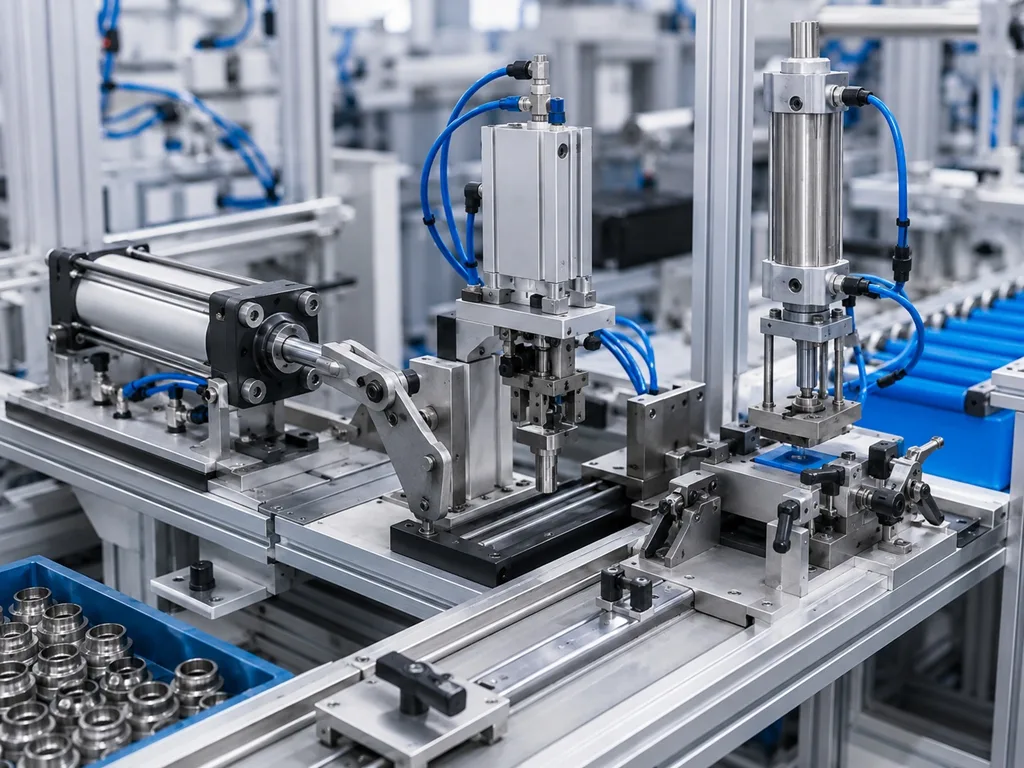
Standard pneumatic cylinders remain one of the most common actuator choices in industrial machinery. They are used for pushing, lifting, clamping, transferring, pressing, positioning, and general automation movement. Compared with compact or special-purpose cylinders, standard cylinders are easier to understand, easier to replace, and available in many bore and stroke combinations.
For OEM buyers and maintenance teams, familiar cylinder families such as DNC, SC, SU, SI, and SE provide practical options for different machine layouts. The best choice depends on force, stroke, mounting style, working environment, and whether an ISO standard body is required.
HOMIPNEU’s standard cylinder products include the DNC ISO 15552 standard pneumatic cylinder, SC standard tie rod pneumatic cylinder, SU standard tie rod pneumatic cylinder, SI standard pneumatic cylinder, and SE ISO 6431 standard pneumatic cylinder.
Why Standard Cylinders Are Still Widely Used
Standard cylinders are popular because they solve many ordinary motion tasks without special engineering. They are robust, available in different sizes, and easy to mount with common accessories. Maintenance teams are familiar with their structure, which reduces troubleshooting time.
In many machines, the cylinder does not need built-in guiding or a special shape. It only needs to provide reliable linear force. Standard cylinders are suitable for this kind of work, especially when there is enough installation space and the load is properly guided by the machine.
They also support longer strokes than many compact cylinders. This makes them useful for transfer mechanisms, opening and closing guards, lifting tables, and larger pushing movements.
DNC ISO 15552 Cylinders
DNC cylinders follow the ISO 15552 style, making them useful where standardized mounting dimensions are important. OEM builders often prefer ISO style cylinders because they simplify design, replacement, and global support.
The profile barrel design can provide a clean appearance and convenient sensor mounting. A DNC pneumatic cylinder is a strong choice for automation equipment that needs stable linear motion and standard mounting.
DNC cylinders are commonly used in packaging machines, assembly lines, transfer units, material handling systems, and industrial fixtures. They are suitable when the machine has enough space and requires a standard industrial actuator.
SC and SU Tie Rod Cylinders
Tie rod cylinders use external rods to hold the end covers and barrel together. This structure is familiar in many factories and is often selected for general machinery. The design is practical, easy to recognize, and available in a wide range of sizes.
The SC standard tie rod pneumatic cylinder and SU standard tie rod pneumatic cylinder are suitable for industrial automation, machine tools, packaging equipment, and transfer systems.
Tie rod cylinders may be preferred where rugged structure and easy installation matter. They also work well in applications where appearance is less important than durability and common replacement.
SI and SE Standard Cylinders
SI and SE cylinders provide additional standard cylinder choices for machine builders. The SI standard pneumatic cylinder is suitable for general automation, while the SE ISO 6431 standard pneumatic cylinder supports applications where ISO 6431 style dimensions are preferred.
When choosing between standard cylinder types, compare mounting dimensions, available bore sizes, stroke options, sensor compatibility, and accessory availability. The best product is the one that fits the machine layout and spare part strategy.
For export equipment, using a recognized standard can make field replacement easier for customers in different markets.
Bore and Stroke Selection
Bore size determines force, while stroke determines travel. Standard cylinders are available in many bore and stroke combinations, so it is tempting to choose quickly. A better approach is to calculate required force, confirm working pressure, and check mechanical constraints.
If the cylinder pushes a load horizontally, friction may be the main resistance. If it lifts vertically, gravity becomes important and safety factors should be higher. If the cylinder presses or clamps, required force depends on process needs and part strength.
Stroke should include only the needed movement plus reasonable adjustment. Excess stroke can make the cylinder longer, slower, and more expensive. Too little stroke can create unreliable positioning.
Mounting and Load Alignment
Standard cylinders can be mounted with front flanges, rear flanges, foot brackets, clevis brackets, trunnions, and other accessories. The mounting style should allow the cylinder to move in line with the load.
Misalignment is a common cause of cylinder wear. If the driven part does not move in a straight path, the piston rod may be forced sideways. This can damage seals and bushings. Use guides, floating joints, or clevis connections where needed.
For longer strokes, rod support and load guidance become more important. A standard cylinder should generate force, not act as the only guide for a heavy side-loaded mechanism.
Cushioning and End Impact
Many standard cylinders include adjustable cushioning. Cushioning helps slow the piston near the end of stroke and reduce impact. This is important for larger bores, faster speeds, and heavy loads.
If a cylinder slams at the end of stroke, check speed control, cushion adjustment, load, air pressure, and valve flow. Repeated impact can loosen machine parts and shorten cylinder life.
In high-cycle machines, smooth deceleration is not just about noise. It protects the actuator, frame, sensors, and product being moved.
Maintenance and Replacement
Standard cylinders are usually easier to replace than special cylinders because their dimensions are familiar. Still, maintenance teams should check bore, stroke, mounting, port size, sensor type, and rod end thread before ordering a replacement.
Air leakage, slow movement, rod scratches, loose mounting, and inconsistent position feedback are common inspection points. If cylinders fail repeatedly, look for poor alignment, dirty air, excessive side load, or impact at end of stroke.
Replacing a cylinder without fixing the cause may only create a short-term repair.
Buying Standard Cylinders for OEM Machines
For OEM builders, standard cylinders should be selected with future service in mind. A machine may ship to another country, run for years, and need replacement parts long after the first order. Using a common cylinder family and clear model structure makes after-sales support easier.
It is also useful to standardize bore sizes and mounting accessories where possible. If every station uses a different cylinder style without a strong reason, the spare parts list becomes longer and maintenance becomes slower. Standardization reduces purchasing complexity and helps technicians identify parts quickly.
Before bulk ordering, test sample cylinders in the real machine cycle. Check cushion adjustment, sensor mounting, rod alignment, air consumption, and end impact. The right standard cylinder should not only fit the drawing; it should keep the machine stable during repeated operation.
Related Pneumatic Products
Standard cylinders often work with solenoid valves, air source treatment units, flow controls, silencers, tubes, and pneumatic fittings. The air circuit should be sized to support the cylinder bore and cycle speed.
For machines requiring high precision or side-load support, consider guided cylinders or slide table cylinders from the pneumatic cylinder category.
FAQ
What are standard pneumatic cylinders used for?
They are used for general linear motion such as pushing, lifting, clamping, transferring, and positioning in industrial machinery.
What is an ISO 15552 pneumatic cylinder?
It is a standardized cylinder type with defined mounting dimensions, making replacement and machine design easier across compatible products.
Are tie rod cylinders durable?
Yes, tie rod cylinders are widely used in industrial machinery because of their robust and familiar structure.
Why does a standard cylinder wear quickly?
Common causes include side load, misalignment, dirty air, excessive impact, poor lubrication, or incorrect mounting.
Should I choose DNC or SC cylinder?
Choose based on required standard, mounting dimensions, machine layout, available accessories, and customer replacement preference.
Conclusion
Standard pneumatic cylinders are reliable workhorses for industrial machinery when selected and installed correctly. DNC, SC, SU, SI, and SE styles each support different design preferences, but the same principles apply: match force, stroke, mounting, alignment, cushioning, and air supply to the real machine.