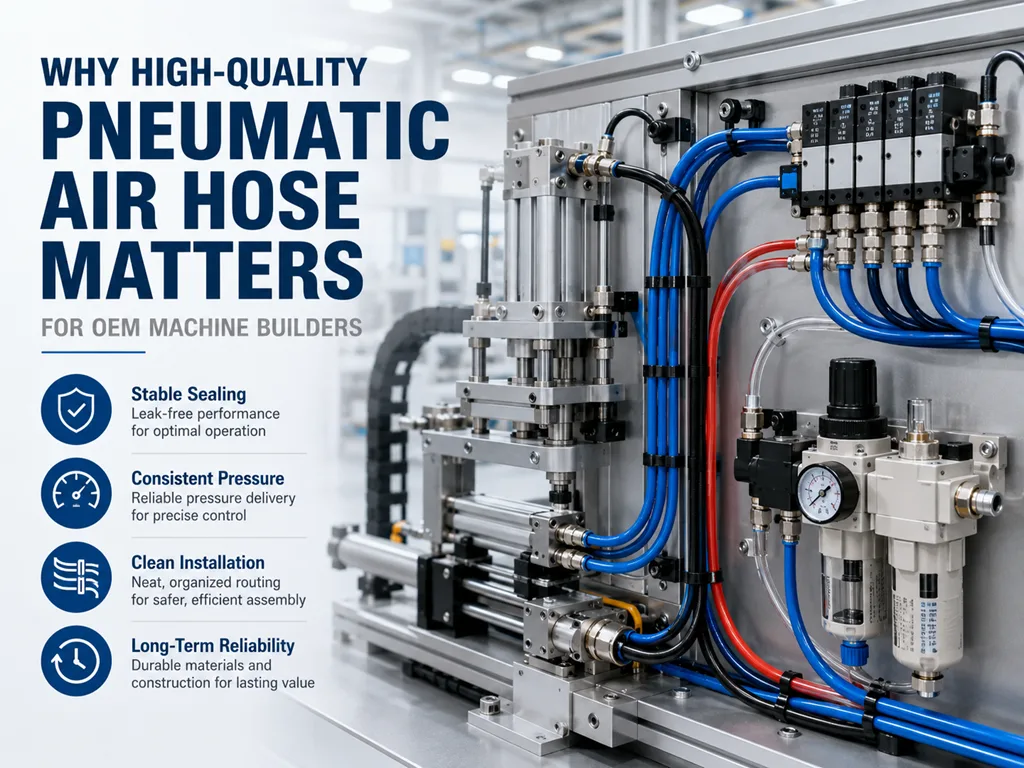
Choosing a pneumatic air hose is not just a matter of picking a tube that fits the connector. In an industrial compressed air system, the hose affects airflow, pressure stability, actuator speed, energy consumption, maintenance time and long-term safety. A line that looks fine during installation can still create pressure drop, leakage or early failure if the material, size or working environment is wrong.
This guide is written for engineers, maintenance teams, OEM machine builders and distributors who need a practical way to select pneumatic tubing for real factory use. It covers the main hose materials, sizing logic, working pressure, bending radius, color coding, fitting compatibility and purchasing checks.
What Does a Pneumatic Air Hose Do in a Compressed Air System?
A pneumatic air hose carries compressed air from one part of the system to another. It may connect an air preparation unit to a solenoid valve, a valve to a pneumatic cylinder, a manifold to a tool, or a main air line to a moving actuator. Because air is compressible, even small restrictions in the hose can affect response speed and pressure stability.
In simple terms, the hose must do four jobs well:
- Deliver enough air volume for the connected component.
- Hold working pressure with a proper safety margin.
- Bend and move without kinking, cracking or pulling out of fittings.
- Remain stable in the actual working environment, including heat, oil, sparks, moisture or repeated motion.
When a pneumatic line fails, the problem is often blamed on the valve, cylinder or fitting. In many cases, the hose is part of the cause. A tube that is too small, too soft, too stiff, poorly cut or mismatched with the fitting can make the whole circuit unreliable.
Start with the Application, Not the Hose Catalog
The first question should be: where will this hose be used? A tube inside a clean control cabinet has different requirements from a hose on a moving arm, a welding fixture or a factory air tool. Before choosing material or size, define the working conditions.
Useful questions include:
- What is the normal system pressure?
- What is the maximum possible pressure peak?
- How much air does the cylinder, valve or tool need?
- Is the tube fixed, moving or frequently bent?
- Will it be near heat, sparks, cutting oil, chemicals or outdoor exposure?
- What tube outside diameter do the pneumatic fittings accept?
- Does the customer need color coding or OEM packaging?
Answering these questions first prevents the most common mistake: choosing a hose because it is familiar, cheap or available, rather than because it fits the job.
PU, PA Nylon and PE Pneumatic Tubing: Which Material Should You Use?
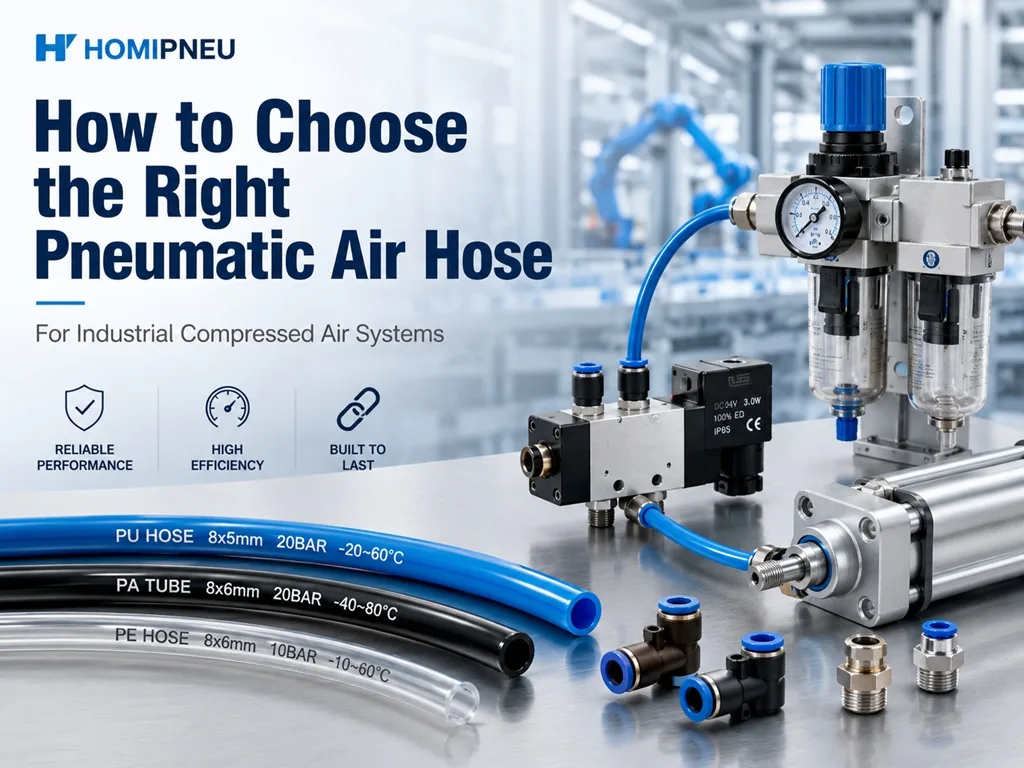
Pneumatic air hose is available in several materials. The most common choices for industrial automation are PU, PA nylon and PE. Each material has a different balance of flexibility, strength, cost and environmental resistance.
PU Pneumatic Tube
PU tubing is widely used in automation because it is flexible, lightweight and easy to route in compact spaces. It is a strong choice for general pneumatic control lines, small cylinders, assembly equipment, packaging machines and areas where the tube bends often.
Its flexibility makes installation easier, especially inside machines where the air line must pass around frames, valves and moving parts. PU is also commonly used for spiral hoses because it can stretch and return neatly after use.
Use PU pneumatic tube when the system needs flexibility, frequent bending and clean routing. Avoid standard PU tube near welding sparks or very hot surfaces unless an anti-spark grade is selected.
PA Nylon Tube
PA nylon tubing is usually selected when the system needs higher strength, better dimensional stability and stronger pressure resistance. It is less soft than PU, so it holds its shape well and is often used in industrial machines, compressed air distribution, vehicle pneumatic systems and longer fixed runs.
Nylon tube can be a better choice in environments where the line should stay stable under pressure and temperature changes. It is also useful when the tube needs better resistance to abrasion or mechanical stress.
Use PA nylon tube when strength, stability and long service life are more important than maximum flexibility.
PE Air Hose
PE tubing is often used for lower-pressure lines, simple air routing and cost-sensitive applications. It can offer good chemical resistance and easy handling, but it is not always the best choice for high-speed motion or demanding industrial conditions.
Use PE air hose when the system is not heavily loaded, the pressure is moderate and economy is an important factor. For high-cycle automation, PU or PA nylon is usually considered first.
Quick Material Comparison
| Material | Main Advantage | Best For | Watch Out For |
|---|---|---|---|
| PU | Flexible and easy to route | Automation equipment, compact layouts, moving lines | Heat, sparks and harsh environments unless special grade is used |
| PA nylon | Strong and dimensionally stable | Industrial machines, fixed runs, higher-pressure circuits | Less flexible than PU |
| PE | Economical and simple to install | Lower-pressure air lines and general routing | Not ideal for demanding motion or high mechanical stress |
Choose the Correct Hose Size
Pneumatic hoses are commonly selected by outside diameter and inside diameter. Examples include 4 x 2.5 mm, 6 x 4 mm, 8 x 5 mm, 10 x 6.5 mm, 12 x 8 mm and larger sizes depending on the product series. The outside diameter must match the push-in fitting. The inside diameter affects airflow.
A small hose is easy to route and works well for compact control circuits, pilot lines and small actuators. However, if the hose is too small for the required air volume, the actuator may move slowly or inconsistently. A larger hose can deliver more air, but it takes more space, costs more and may require larger fittings.
For practical selection, consider three points:
- Air consumption: larger cylinders and air tools usually need larger tube sizes.
- Line length: a longer tube creates more pressure loss, especially if the inside diameter is small.
- Required response speed: high-speed automation often needs more airflow than slow positioning systems.
If a pneumatic cylinder moves slowly even though the valve is correctly sized, check the hose and fitting size before replacing larger components. The restriction may be in the line itself.
Check Working Pressure and Safety Margin
Most factory compressed air systems operate around 0.6 to 0.8 MPa, but pressure spikes can happen during startup, valve switching or abnormal operation. The hose should always have a rated pressure above the actual working pressure, with a sensible safety margin.
Do not select a hose based only on normal pressure. Look at maximum pressure, temperature, bending condition and expected service life. A tube that is safe at room temperature may have a lower effective margin in a hot environment. A tube that works in a fixed line may fail sooner if it is constantly flexing.
Signs that the hose is not suitable include swelling, whitening at bends, surface cracking, air leakage near fittings, unstable cylinder movement and tube pull-out.
Do Not Ignore Bending Radius
Bending radius is the minimum curve the hose can handle without kinking or damaging the tube wall. If the hose is bent too sharply, airflow is restricted and the material is stressed. Over time, that stress can lead to cracks or leaks.
In compact machines, this is a common issue. The tube is often forced around corners because there is not enough room. Instead of forcing a tight bend, use a better route, a longer tube length, an elbow fitting or a spiral hose where appropriate.
Moving parts need extra care. A tube connected to a sliding table, robot arm or pneumatic gripper should have enough length to move naturally. It should not pull sideways on the fitting.
Match Hose and Pneumatic Fittings Carefully
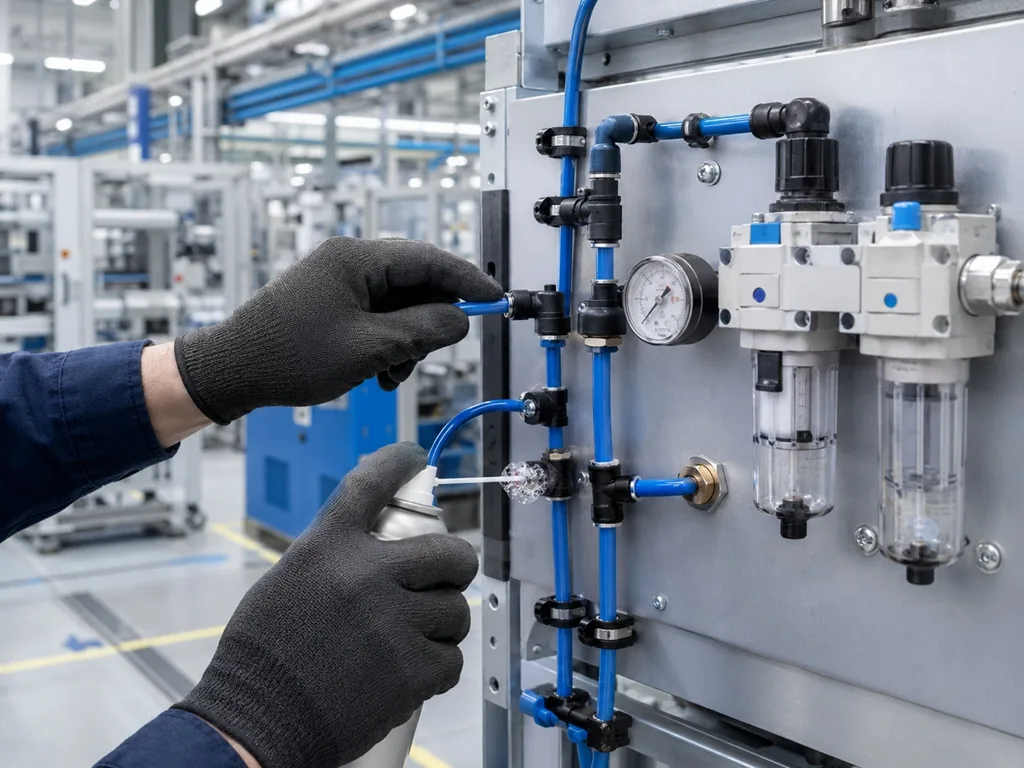
Push-in fittings seal on the outside surface of the tube. That means tube outer diameter, roundness, surface smoothness and cutting quality are all important. A poor tube can leak even in a good fitting. A poor fitting can leak even with a good tube.
For reliable installation:
- Use tubing with accurate outside diameter.
- Cut the tube square with a proper tube cutter.
- Push the tube fully into the fitting until it reaches the internal stop.
- Perform a light pull test after insertion.
- Avoid scratches, dirt or deformation near the sealing area.
If the air line uses many connectors, review the pneumatic fittings together with the hose selection. The tube and fitting should be treated as one connection system, not two separate purchases.
Select for the Working Environment
A hose that performs well in a clean indoor cabinet may not survive in a welding area, outdoor line or oily machine tool environment. The working environment should guide the final material choice.
General Automation
For normal indoor equipment, PU and PA nylon tubes are both common. PU is useful where flexibility matters. PA nylon is useful where stability and strength matter.
Welding and Spark Areas
Standard tubing can be damaged by hot sparks. In welding workshops or near cutting operations, anti-spark pneumatic hose or double-layer tubing is often a better choice.
Tight Machine Spaces
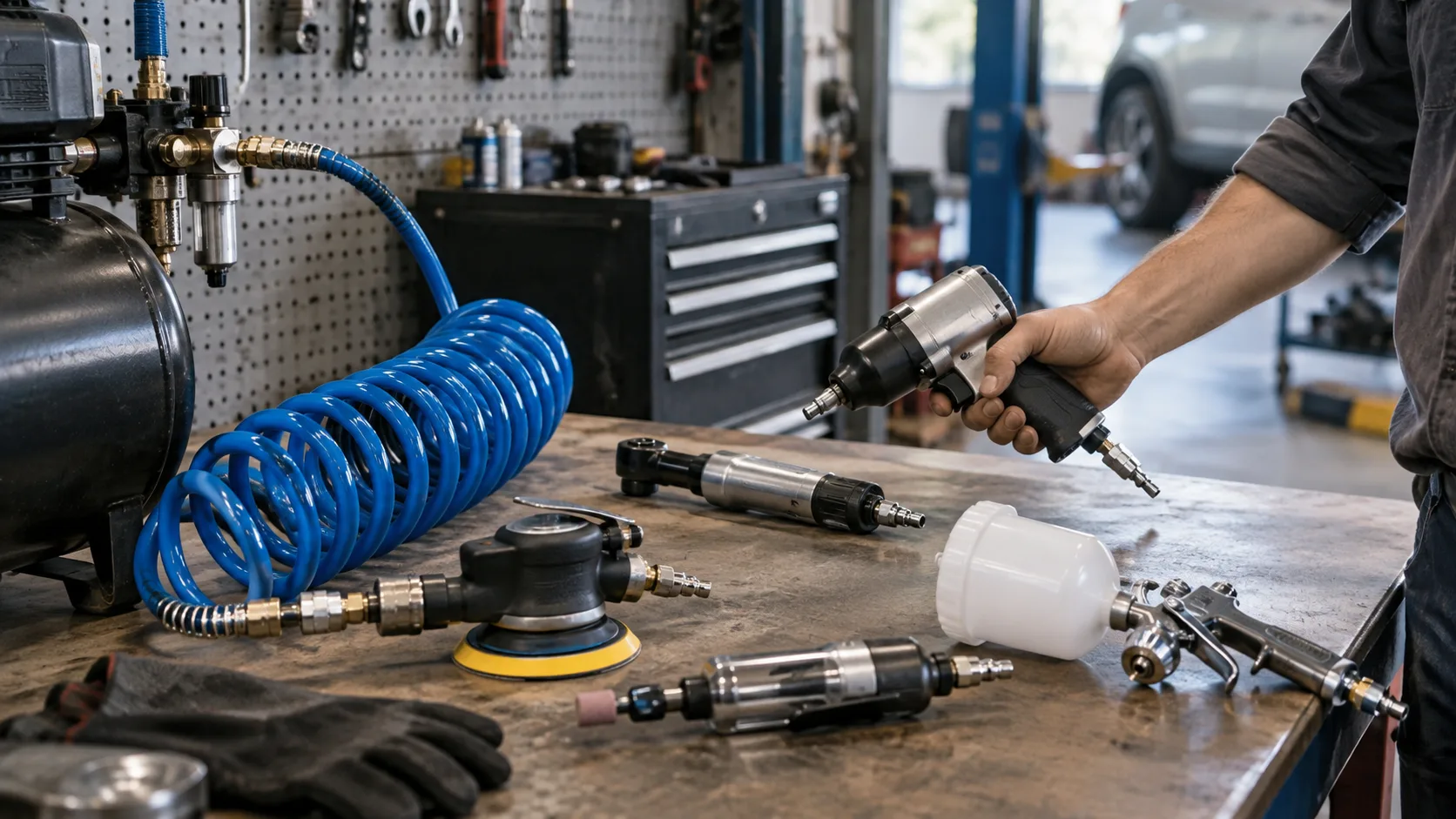
Spiral PU hose can save space and retract after use, making it suitable for hand tools, workstations and compact layouts.
Outdoor or Higher-Temperature Conditions
Outdoor exposure, heat and temperature cycling require more careful selection. PA nylon may offer better stability than soft standard tubing in some of these conditions, but the exact rating should always be checked.
Use Color Coding for Easier Maintenance
Color is not only cosmetic. Blue, black, transparent, red and other colors can help technicians identify lines quickly. One color may mark main pressure, another may mark control signals, and another may mark vacuum, exhaust or special circuits.
Color coding is especially useful in machines with many pneumatic lines. It reduces wrong connections during maintenance and makes troubleshooting faster. For OEM machine builders, consistent color standards also make equipment look more professional.
OEM and Distributor Purchasing Checks
For OEM buyers and distributors, hose consistency matters as much as the material name. A reliable pneumatic air hose should have stable wall thickness, smooth inner surface, accurate dimensions, clean color and good compatibility with push-in fittings.
Before placing bulk orders, check:
- Outside diameter tolerance
- Wall thickness consistency
- Surface smoothness
- Working pressure and burst pressure information
- Bending performance
- Color consistency
- Packaging, labeling and roll length
- Compatibility with the fittings used in your machine
Poor-quality tubing may harden, crack, deform or leak after long use. It may also create random assembly problems when the outside diameter is inconsistent. For a machine builder, those small problems can become warranty claims and customer complaints.
Common Selection Mistakes
The most common mistakes are easy to avoid:
- Choosing a hose only by price, without checking material and pressure rating.
- Using a tube that is too small for the cylinder or tool airflow demand.
- Forcing the hose into a tight bend instead of improving the route.
- Ignoring heat, sparks or chemical exposure.
- Using tubing with poor outside diameter accuracy in push-in fittings.
- Mixing too many colors or sizes without a clear maintenance standard.
A good pneumatic line should be easy to install, easy to inspect and reliable under the real operating conditions of the machine.
FAQ: Pneumatic Air Hose Selection
Is PU or PA nylon better for pneumatic air hose?
PU is better when flexibility and easy routing are important. PA nylon is better when strength, pressure stability and shape retention are more important. Many machines use both materials in different areas.
How do I choose the right pneumatic hose size?
Start with the airflow demand of the connected component, the line length and the required response speed. Small tubes are good for compact control circuits. Larger tubes are better for higher air consumption and faster actuator movement.
Can I use any plastic tube with push-in fittings?
No. Push-in fittings require tubing with accurate outside diameter, suitable hardness and a smooth surface. Random plastic tubing may leak or pull out.
Why does my pneumatic hose leak near the fitting?
Common causes include a poor tube cut, scratches on the tube surface, incorrect tube size, incomplete insertion, side load on the fitting or worn internal seals.
Final Thoughts
The right pneumatic air hose should match the material needs, tube size, pressure, bending radius, fittings and working environment of the system. In a small machine, this improves response and reduces leakage. In a large factory, it can also reduce energy waste and maintenance time.
HOMIPNEU supplies pneumatic air hose options for industrial compressed air systems, including PU tube, PA nylon tube, PE hose, spiral tubing and anti-spark air hose. By matching the correct hose with the right fittings and installation method, users can build cleaner, safer and more efficient pneumatic systems.