Industry Update
Air hose safety is still a serious issue in workshops, shipyards, construction sites, and industrial maintenance areas. OSHA’s rules for pneumatic tools require tools to be secured to the hose or whip by positive means to prevent accidental disconnection. OSHA shipyard rules also state that pneumatic tools must be secured to the extension hose or whip before use.
This is not only a legal detail. A pressurized air hose can move violently if a coupling fails or a tool disconnects. For users of pneumatic tools and compressed air systems, hose connection safety should be part of normal maintenance.
Source references: OSHA interpretation on pneumatic tool connections and OSHA 1915.131 general precautions.
Why Hose Connections Are a Safety Point
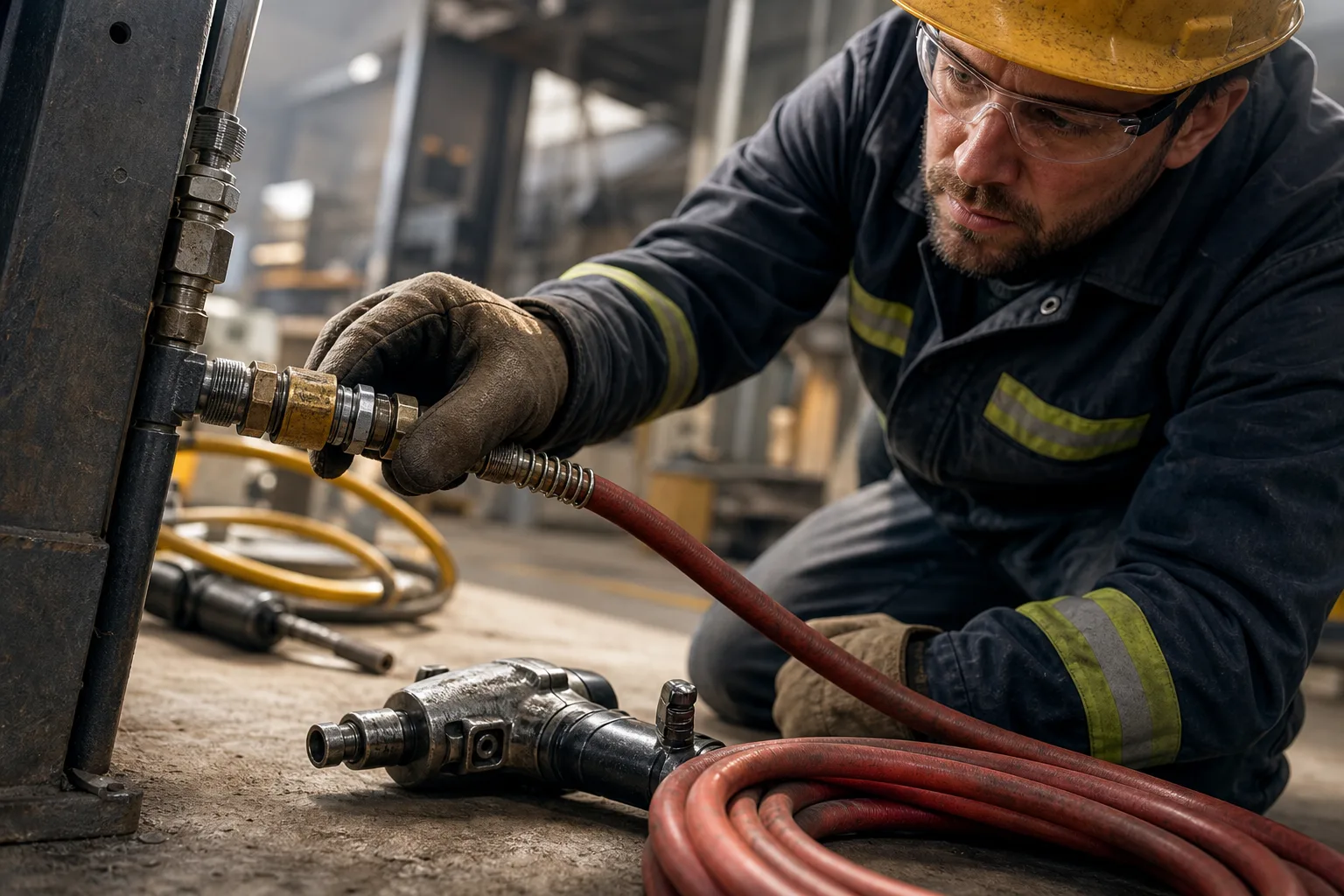
Compressed air stores energy. When a hose connection separates under pressure, the hose can whip, fittings can strike nearby workers, and the tool may drop or move unexpectedly. This is why air hose safety is about more than pressure rating. The connection method, coupling type, hose condition, and operator practice all matter.
In many facilities, air hoses are moved often. They are connected to tools, dragged across floors, hung from reels, and used by different workers. Over time, tube ends wear, couplings loosen, and fittings may be replaced with mismatched parts. That increases risk.
Good air hose management reduces these problems before they become incidents.
Positive Means of Securing Tools
OSHA’s language points to a simple principle: the tool should not accidentally disconnect from the hose. In practice, facilities may use suitable couplings, locking mechanisms, whip checks, restraints, or other approved securing methods depending on the application and pressure.
The correct solution depends on local regulations, site rules, hose diameter, pressure, and tool type. But the core idea is consistent. A compressed air connection should not rely on a weak or poorly matched fitting.
For buyers, this means air hose and couplings should be selected together. A good hose is not enough if the connection is unsafe. A good fitting is not enough if the tube is cracked, kinked, or damaged near the end.
Maintenance Teams Should Inspect Air Hoses
Air hose inspection does not need to be complicated. Maintenance teams should check the hose surface, coupling condition, tube end, bend points, and connection behavior. A hose that has cuts, bulges, hardening, deep abrasion, or damaged fittings should be replaced.
Common warning signs include:
- Hissing sounds near couplings
- Loose quick connectors
- Cracked hose surfaces
- Flattened or kinked sections
- Tube pulling out of push-in fittings
- Damaged threads on fittings
- Excessive bending near tool handles
These signs should not be ignored. Small air line problems can become safety problems when the hose is under pressure.
Product Selection Supports Safer Air Lines
The right product choice helps reduce risk. Spiral PU hoses can keep tool hoses off the floor and reduce trip hazards at workstations. Nylon tubes may provide better rigidity in fixed air line sections. PU tubing is useful for flexible machine routing. Strong fittings and proper tube sizes help connections stay stable.
For pneumatic tools, the hose should also match the required air flow. If the hose is too small, the tool may perform poorly and operators may raise pressure to compensate. That can increase stress on the hose and fittings.
HOMIPNEU’s air hose range and pneumatic fittings can support workshop air lines, pneumatic tool connections, and fixed compressed air layouts.
Safety Is Also a Productivity Issue
Safe air hose systems are easier to maintain. Workers spend less time fighting leaks, replacing damaged hose ends, or dealing with unstable tool pressure. Clean hose routing also reduces floor clutter and makes workstations easier to operate.
In 2026, factories and workshops are paying more attention to practical safety because labor availability and downtime both matter. Air hose may look like a small part, but it affects daily work quality.
Related Pneumatic Products
HOMIPNEU supplies spiral PU air hose, PU pneumatic tube, nylon air hose, pneumatic fittings, air source treatment units, solenoid valves, and pneumatic tools accessories for workshop compressed air and industrial automation systems.