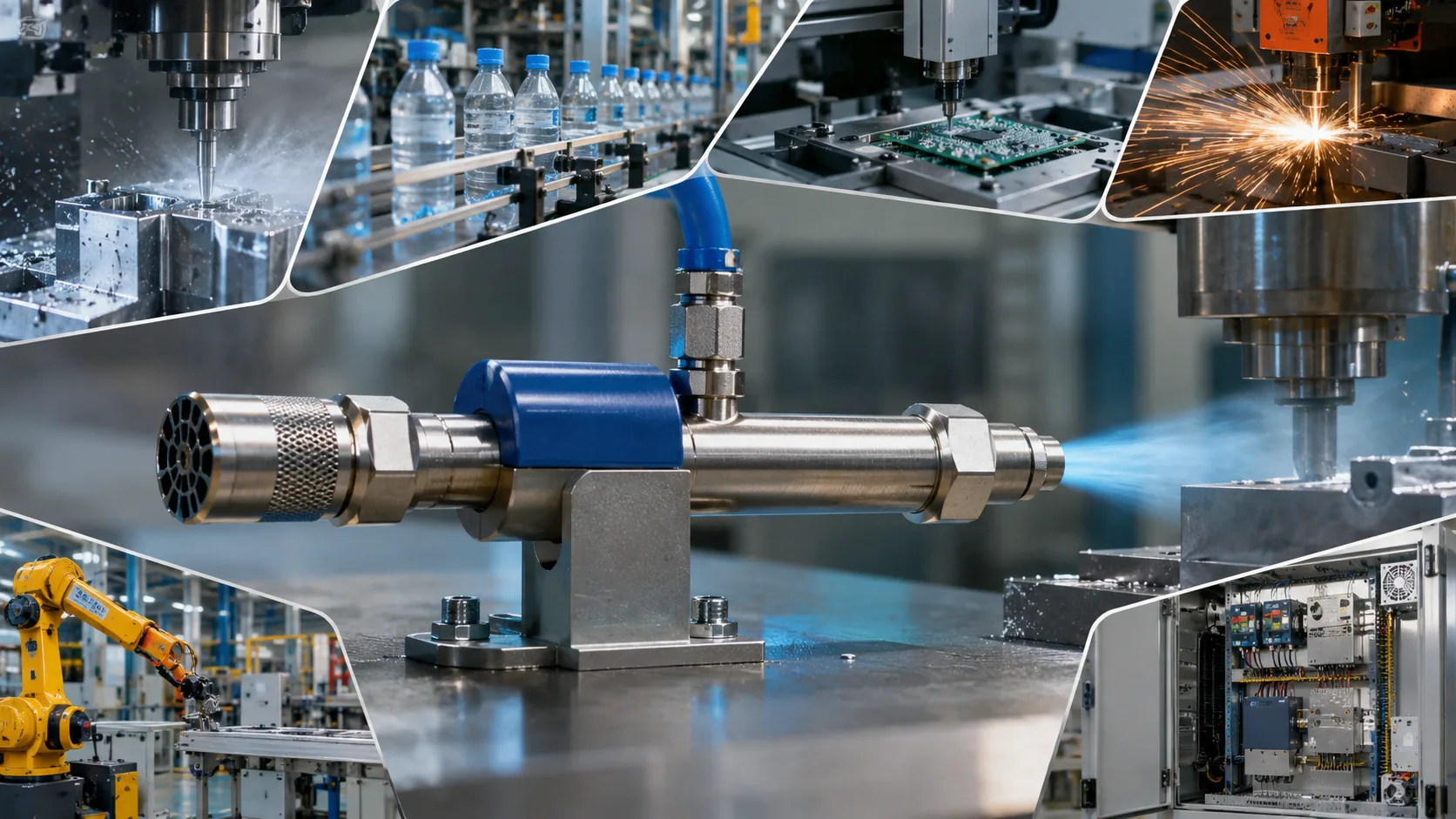
A cutting edge, sewing needle or heated assembly can need cooling at one precise location. In these applications, the challenge is often to place a repeatable stream of cold air close to the target without adding liquid coolant residue or interfering with the work.
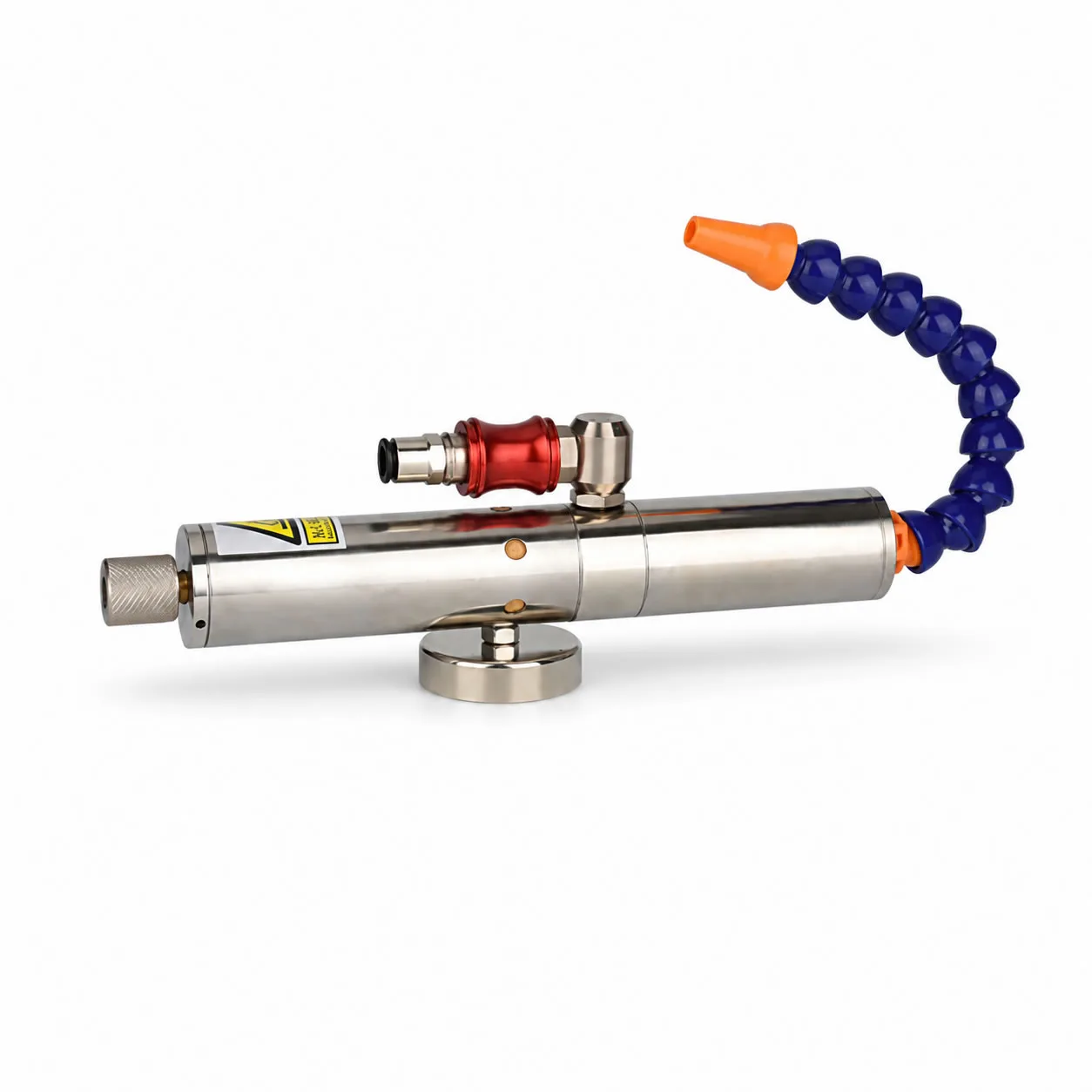
The HOMIPNEU TC-010-B Cold Air Gun for Spot Cooling combines vortex tube cooling with a magnetic base and a flexible directional nozzle. The base supports positioning on suitable ferromagnetic surfaces, while the nozzle allows the cold stream to be aimed toward a tool, workpiece or component.
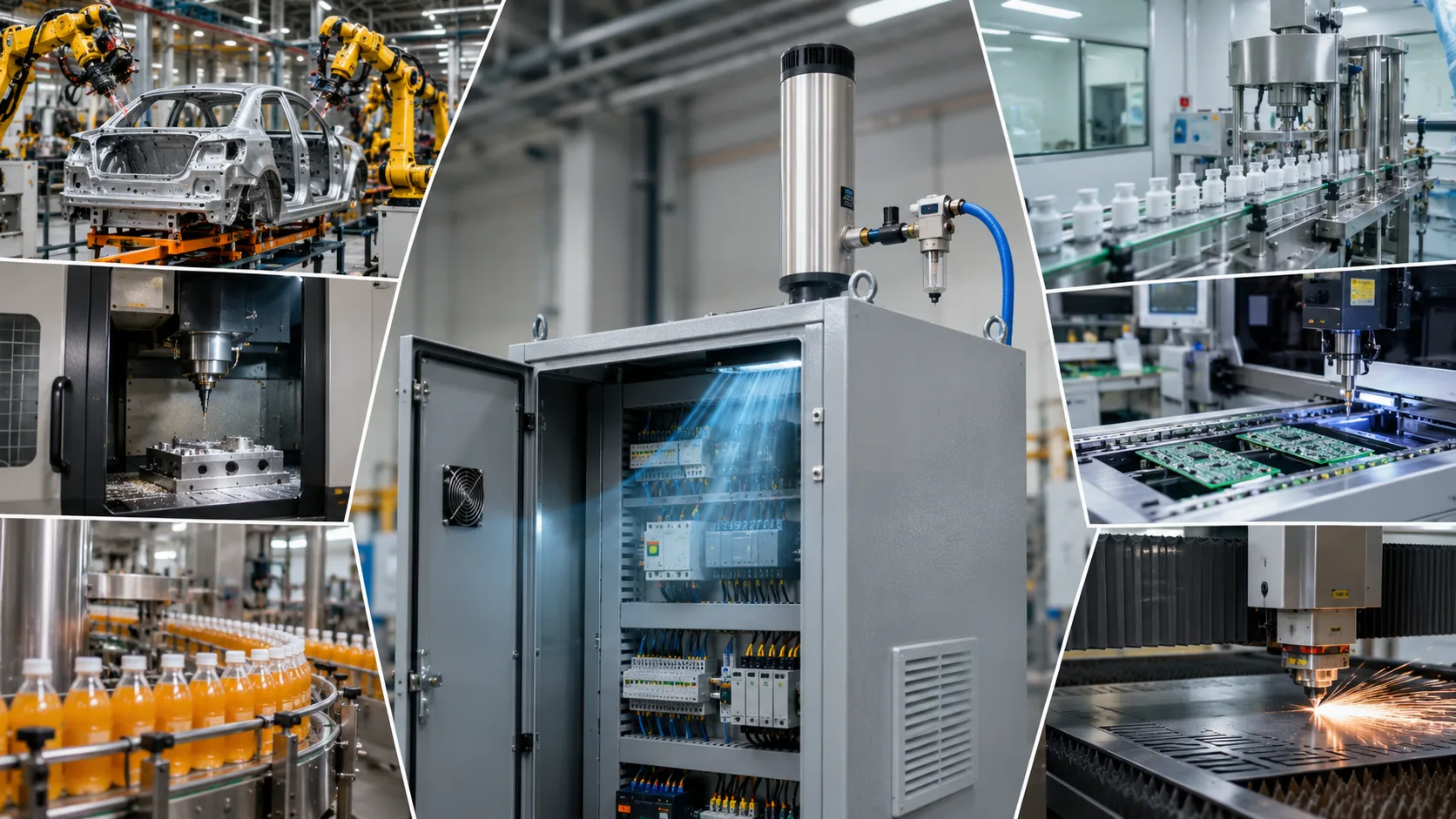
This guide looks at six industries where that arrangement can be evaluated. The examples are application scenarios based on the product’s stated uses, rather than reports of verified customer results. Successful selection depends on the material, heat load, process requirements and available compressed air.
What Makes a Cold Air Gun Useful at a Workstation?
A vortex tube produces cold and hot air streams from compressed air. A cold air gun adds a practical way to position and direct the cold stream. For the TC-010-B, the magnetic base and flexible nozzle are central to that workstation function.
The arrangement can help when the cooling point changes between jobs or when a fixed nozzle would be difficult to align around a fixture. Repositioning should be done with the machine in a safe state, followed by a clearance check before production resumes.
Cold airflow avoids applying liquid coolant at the target. Its cleanliness still depends on the compressed-air supply. It also provides a different cooling and friction-control mechanism from cutting fluid, so process suitability must be established rather than assumed.
Cold Air Gun Industry Applications at a Glance
| Industry | Candidate cooling point | Reason to evaluate cold air | Measure during a trial |
|---|---|---|---|
| Metal machining and toolmaking | Cutting zone, tool or accessible workpiece area | Localized heat management in suitable air-cooled operations | Tool wear, dimensions and surface finish |
| Plastics and rubber processing | Machined surface, accessible mold area or ultrasonic equipment | Cooling a small target without applying liquid | Part quality, temperature and process stability |
| Woodworking and composite machining | Tool and cutting interface | Directed cooling where the material and process permit | Edge quality, heat effects and dust control |
| Electronics assembly and testing | Component, soldered area or test fixture | Accessible localized cooling with an adjustable nozzle | Temperature response, cleanliness and repeatability |
| Adhesive and general assembly | Hot-melt area or selected heated part | A controlled cooling step within the assembly sequence | Bond performance, handling condition and consistency |
| Textile and sewing production | Sewing needle or related contact area | Managing localized heat during suitable high-speed work | Stitch quality, material condition and nozzle clearance |
1. Metal Machining and Toolmaking
The product page identifies drilling, milling, turning, sawing, grinding and tapping as operations for evaluation where air cooling suits the process. In a machine shop, the useful question is which operation has a localized heat problem that directed cold air can address.
The magnetic base can help position the unit beside a fixture on a suitable surface. The flexible nozzle can then be adjusted toward the intended cutting area, allowing a trial without designing a permanent nozzle bracket at the outset.
Confirm the tool and material requirements first. Some operations depend on cutting-fluid lubrication or a specific coolant delivery method. A cold air stream does not provide that lubrication, and lowering temperature alone may not resolve friction, chip evacuation or tool-life problems.
For an approved trial, keep the material, tool, speed, feed and cut comparable. Record tool wear, dimensional results and surface finish over a representative run. Position airflow and guards so chips are contained, and check clearance through the full machine movement.
2. Plastics, Rubber and Mold-Based Manufacturing
Plastic or rubber processing can involve heat-sensitive machining surfaces, accessible mold areas or nearby components that need additional cooling. The product also lists ultrasonic equipment among its possible cooling targets.
Consider the cold air gun when a small, accessible area needs attention and liquid application is undesirable. The flexible nozzle makes it possible to evaluate different positions, but the final approved location should be recorded so the result can be repeated.
Check whether localized cooling changes the process in an unwanted way. Uneven temperature can affect dimensions, surface condition or the behavior of a molded part. Cooling an external surface also does not necessarily correct a temperature problem deeper inside tooling.
For ultrasonic equipment, follow the equipment supplier’s cooling and clearance requirements. Evaluate temperature and product quality together, rather than treating a colder surface as sufficient evidence of a better process.
3. Woodworking and Composite Machining
The TC-010-B page includes suitable woodworking and composite applications. These should be assessed around the actual material and cutting operation, particularly where tool-interface heat or visible thermal damage is the reason for investigating cooling.
A directed nozzle can place air near the work while leaving other areas clear. Confirm that the magnetic base has a suitable mounting surface; a nonmagnetic machine table or guard requires a different approved mounting arrangement.
Dust control is part of the application decision. Airflow can move fine material and change the effectiveness of extraction. Review the nozzle direction with the machine’s collection system so the cooling trial does not simply disperse dust into the surrounding work area.
Inspect edge quality, heat marks, tool condition and any material-specific defects. Composite systems vary substantially, so a result on one material should not be transferred automatically to another laminate or resin system.
4. Electronics Assembly and Component Testing
A flexible cold-air nozzle can be useful for evaluating a selected electronic component or test fixture. The product page also identifies solder joints and heated components as cooling targets where a controlled step is required.
For testing, define the desired component temperature and the permitted rate of change. Record nozzle distance, angle, airflow setting and exposure time. Measure at the component, since the outlet-air temperature does not establish the temperature reached by the sample.
Electronics require suitably clean, dry air. Specify acceptable moisture, oil and particle levels, and include any ESD requirements in the workstation design. A cold air gun’s pneumatic cooling function does not establish the electrical properties of the surrounding setup.
Watch for condensation if a surface is cooled below the local dew point. For soldering processes, validate any accelerated cooling against the approved assembly procedure and joint-quality requirements before changing production timing.
5. Hot-Melt Adhesive and General Assembly
Some assembly operations include a heated joint, adhesive area or part that must reach an acceptable handling condition before the next step. The TC-010-B can be evaluated for a localized cooling stage when the material and process permit it.
For hot-melt adhesive, cooling time is only one part of bond formation. The adhesive supplier’s requirements for application temperature, open time and setting behavior remain relevant. Air introduced too early can alter spreading, wetting or assembly time.
A trial should therefore measure bond performance as well as the time to handling. Keep nozzle placement consistent and check that airflow does not move lightweight parts, spread contamination or affect a neighboring process.
Selected thermal assembly or shrink-fit tasks can also be evaluated, as the product page notes. Establish the actual temperature and dimensional change required before choosing cold air as the cooling method; the page does not promise a particular final part temperature.
6. Textile and Sewing Equipment
The product identifies sewing needles and related contact areas as possible cooling targets during suitable high-speed textile operations. This is a focused application where nozzle position and clearance can matter as much as the cooling source.
If needle-area heat is suspected of affecting a material, record the symptom at the actual production speed. Then evaluate an approved cooling arrangement while keeping needle, thread, fabric and settings consistent.
Mount the unit on a suitable stable surface and keep the nozzle outside the needle, feed and operator movement zones. Check that airflow does not disturb thread handling, lift lightweight fabric or interfere with local extraction.
Evaluate stitch quality and material condition over a representative run. Needle choice, machine setup and other causes of a defect should be reviewed alongside cooling, so the trial addresses a documented process issue.
TC-010-B Product Data for Initial Selection
| Item | Published specification |
|---|---|
| Model | TC-010-B |
| Cooling technology | Vortex tube using compressed air |
| Body material | 316 stainless steel |
| Positioning arrangement | Magnetic base and flexible directional nozzle |
| Listed performance pressure | 6.9 bar |
| Listed air consumption | 1,100 L/min; confirm rating and reference conditions |
| Listed cooling capacity | 2,830 Btu/h |
| Body diameter and listed length | 45 mm and 295 mm |
| Inlet and outlet connections | G1/4 inlet and G1/2 outlet, as listed |
The 6.9 bar figure is a performance reference, not a stated maximum operating pressure. Cooling capacity is a heat-removal rating, not a guaranteed outlet temperature. Request the permissible operating conditions and expected performance for the intended installation.
Confirm the air-consumption units and reference conditions before sizing supply components; the product’s table presents both cfm and L/min entries. Allow space beyond the body dimensions for the nozzle, supply hose and hot discharge.
Cold Air Gun or Bare Vortex Tube?
The cold air gun is relevant when a workstation needs convenient positioning and directed airflow. Its magnetic base and flexible nozzle are practical advantages for an accessible tool, component or workpiece.
A bare vortex tube is a cooling core that an equipment builder can integrate into a different delivery arrangement. The SC Series Vortex Tube offers several listed models for that type of integration.
For whole-enclosure cooling, review a cabinet-specific arrangement with distribution, exhaust and protection requirements. Choosing by the task helps establish which supplied accessories and engineering work are required.
Positioning the Magnetic Base and Nozzle
The mounting surface must be suitable for the magnetic base and stable under machine vibration, hose loading and normal operation. Confirm retention on the actual surface, including its shape and finish. The product page does not publish a universal holding-force value.
Aim the nozzle where the air can reach the cooling target without entering an unsafe path through moving parts, chips or dust. Record the approved distance and angle after testing. There is no published universal nozzle position that suits every operation.
Keep hot-air discharge clear and away from the target, cables and other heat-sensitive parts. The unit produces both streams, so checking only the cold-nozzle location leaves part of the installation unassessed.
Compressed Air Supply and Running Cost
Supply pressure should be measured at the gun while it operates and other machine air users are active. Filters, regulators, hose length and small connection passages can reduce inlet pressure and alter the cooling result.
Use suitably filtered, dry air, with additional treatment defined by the target process. Review compatible components in the HOMIPNEU air source treatment range against the gun’s confirmed requirements.
Calculate operating cost from verified flow, operating time and the site’s cost of treated compressed air. A short cooling step has a different utility demand from continuous running throughout a shift. An approved timed or demand-based control may be useful when it preserves the required process result.
What to Measure Before Approving Production Use
Define a result that matters to the process: surface finish, accepted part dimensions, bond performance, stitch quality or repeatable component temperature. Establish a baseline, then compare the proposed cooling setup under the same relevant conditions.
- Target temperature and its change over the operating cycle
- Product or test quality using the normal acceptance method
- Air pressure and verified consumption during operation
- Mounting stability and nozzle clearance
- Effects on chips, dust, moisture and adjacent operations
- Repeatability after a normal workpiece or job change
Use the findings to document the approved setup. Avoid assuming a fixed tool-life increase or cycle-time reduction; those results depend on the actual material and operation.
Frequently Asked Questions
Which industries can evaluate this cold air gun?
Relevant applications include machining, plastics and rubber processing, woodworking and composites, electronics, adhesive assembly and textile sewing. Suitability is determined at the specific cooling point.
Can it replace cutting fluid?
It can be evaluated where air cooling or dry machining is suitable. It does not supply cutting-fluid lubrication, so tool, material and process requirements must be checked.
Does the magnetic base attach to any machine surface?
It requires a suitable ferromagnetic surface and adequate retention under the actual operating conditions. Confirm mounting if the proposed surface is nonmagnetic or unsuitable.
What outlet temperature does it guarantee?
The current product page gives no guaranteed outlet temperature. Ask for performance at the intended inlet conditions, settings and cooling duty.
Does it require electricity?
The cooling function runs on compressed air. The compressor uses energy, and any external electrical controls have their own supply requirements.
What should I provide for a model review?
Describe the process, material, cooling target, required result, available pressure and airflow, air quality, mounting space and operating schedule.
Bring Directed Cooling to the Actual Work Point
The TC-010-B combines a compressed-air cooling source with an adjustable workstation arrangement. Its industry relevance comes from the ability to direct cold airflow at a defined target and validate the result under production conditions.
Review the HOMIPNEU Cold Air Gun for Spot Cooling specifications and share your process and air-supply details when requesting an application review or quotation.