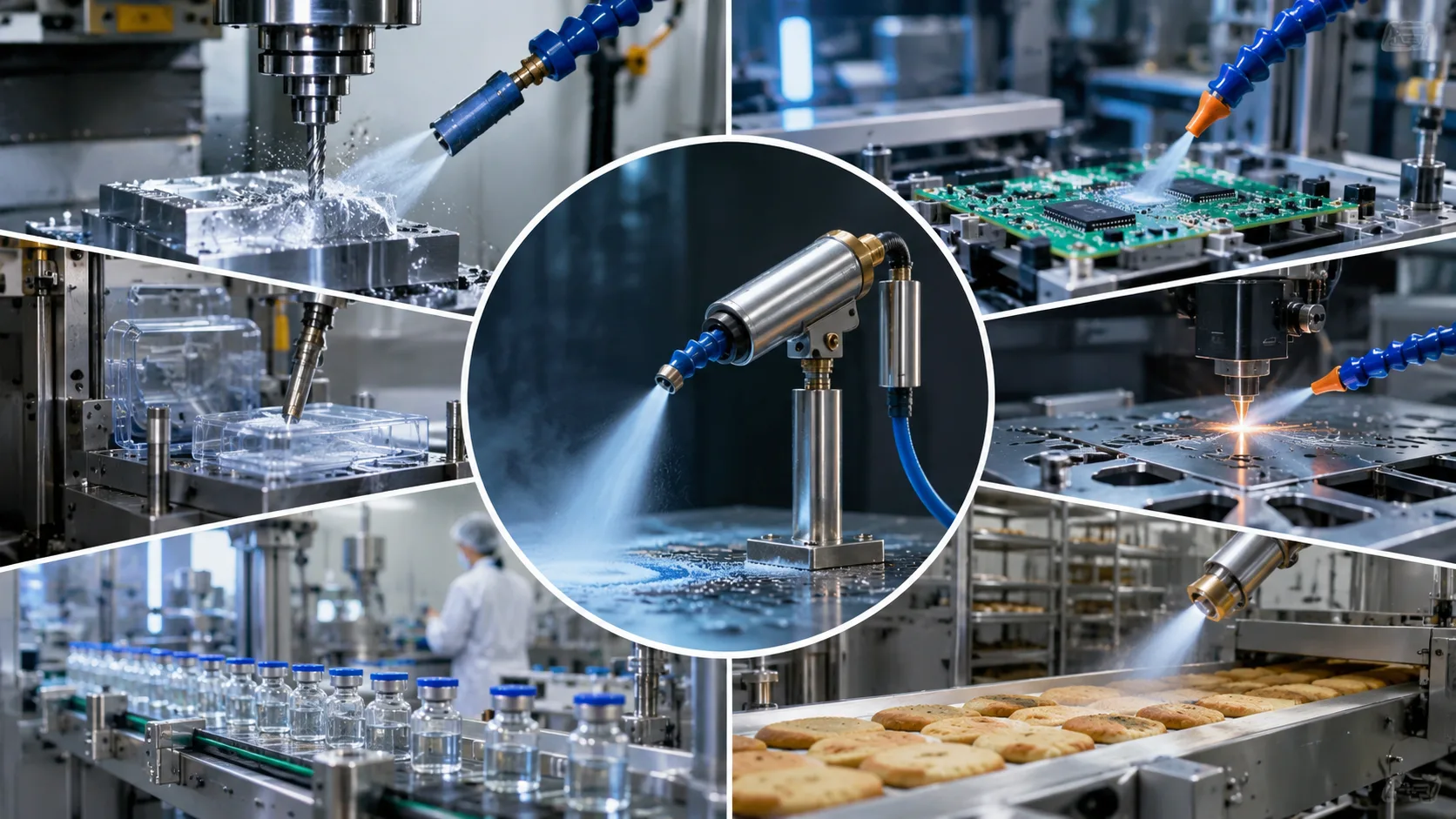
Some industrial cooling problems occur at one small location: a fixture close to a welding operation, an accessible mold area, or a component on a test bench. Cooling an entire room or adding a liquid circuit may be disproportionate when the requirement is limited to that point. A vortex tube offers a way to deliver cold air directly to an accessible cooling target.
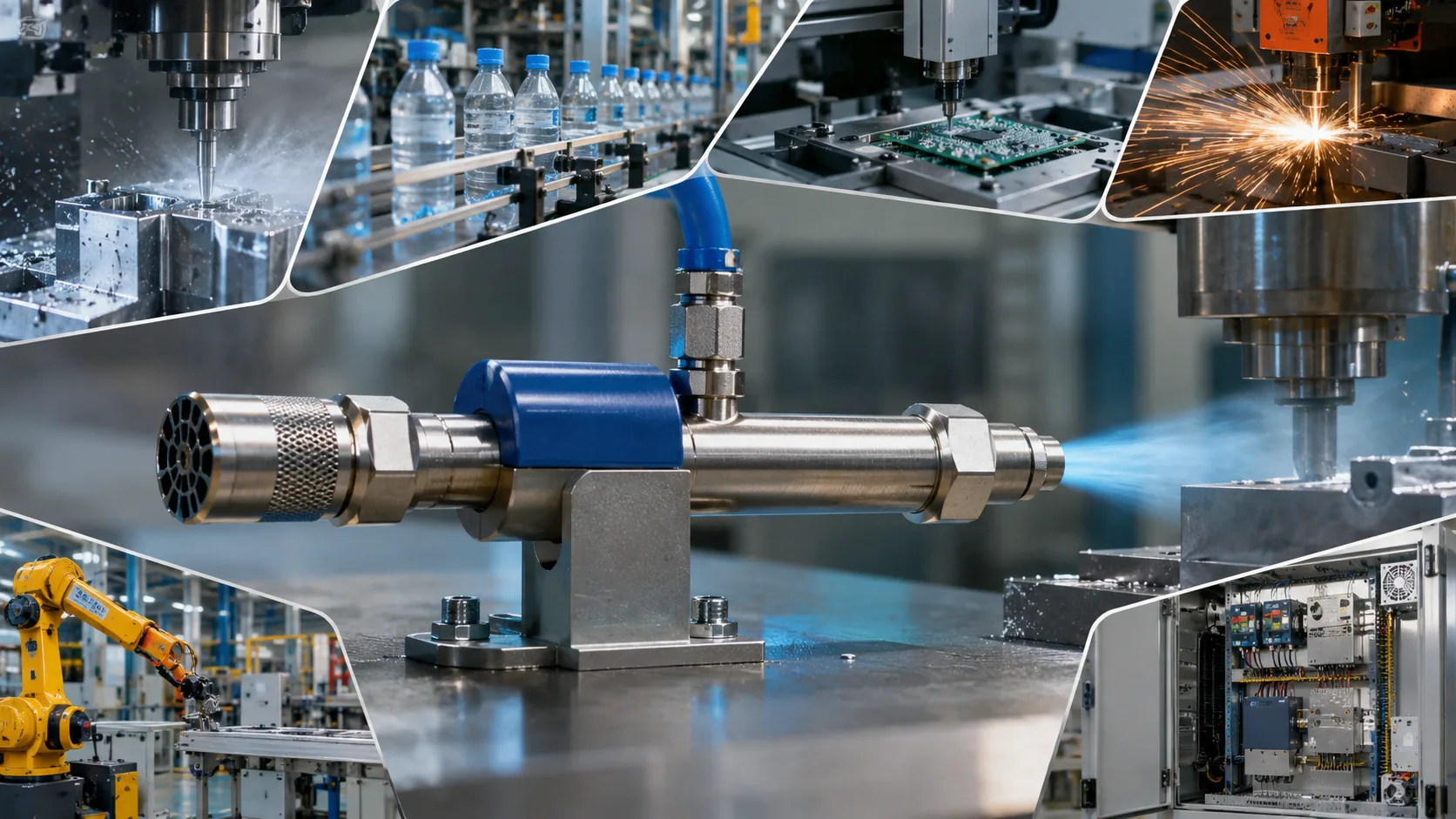
The HOMIPNEU SC Series Vortex Tube for Spot Cooling separates compressed air into cold and hot streams. Its 316 stainless steel body and nine listed models support integration into suitable industrial fixtures, molds and equipment.
This article explores six application areas where the SC series can be evaluated. The examples describe potential uses based on the product’s stated functions; they are not reports of customer installations. Each application needs confirmation of heat load, air supply, mounting and process compatibility.
What Is Industrial Spot Cooling?
Spot cooling removes heat from a selected component or small process area rather than conditioning the entire surrounding space. A cold-air stream is directed toward the surface that needs cooling, with the position and flow adjusted to suit the equipment.
The SC vortex tube generates that stream using compressed air. Its cooling element has no moving parts and needs no electrical connection at the tube itself. The compressor supplying the air still requires energy, and external valves or controls may need electrical power.
Both outputs matter during installation. The cold stream goes to the cooling target, while the hot discharge needs a clear, suitable route away from heat-sensitive components. Keep both arrangements within the manufacturer’s installation requirements.
Six Industry Applications at a Glance
| Industry or process | Cooling target to evaluate | Why directed cold air may be useful | Main application check |
|---|---|---|---|
| Automotive welding and metal fabrication | Selected fixtures and nearby auxiliary components | Targets a localized heat-affected area | Airflow must not disturb the weld or shielding gas |
| Foundry and casting equipment | Suitable accessible tooling and equipment areas | Provides additional cooling at a selected point | Cooling rate and thermal gradients must suit the tooling |
| Plastics and mold-based manufacturing | Accessible mold areas or related components | Can address a localized cooling requirement | Validate the effect on temperature balance and product quality |
| Electronics manufacturing and testing | Components and test fixtures | Allows localized thermal evaluation without applying liquid | Confirm air cleanliness, moisture and test repeatability |
| Industrial automation and control equipment | Selected control-box components | Can supply a cold-air source for an engineered arrangement | Distribution, exhaust and enclosure protection need design |
| Machinery and motor systems | Accessible housings or localized machine components | Directs cooling toward an identified heat buildup | Establish the cause and internal temperature response |
1. Automotive Welding and Metal Fabrication
Welding stations can expose nearby fixtures and auxiliary equipment to concentrated heat. Where one accessible component needs additional cooling, a directed cold-air stream may be worth evaluating before changing the thermal management of the entire station.
The SC product page identifies welding fixtures and nearby components as candidate applications. A practical assessment begins with temperature measurements on the actual target during the production sequence. Determine whether the issue is a short temperature peak, accumulated heat over repeated cycles, or heat conducted from another part.
Air placement is critical. A stream directed into the welding area can disturb shielding gas or otherwise affect the process. Position cooling so it serves the approved target, and have the welding process owner review its effect on weld quality. Cooling timing may also need to be coordinated with the production sequence.
Mount the tube and delivery arrangement where fixture movement and part loading cannot strike them. Check the hot discharge as well as the cold outlet. Any claimed improvement in cycle time or component life should come from a documented trial at that workstation.
2. Foundry and Casting Equipment
Casting operations can contain tooling or equipment areas with localized temperature problems. A vortex tube can be considered for suitable accessible targets where the required cooling duty is within the selected model’s confirmed performance.
The first question is what must be cooled and why. Cooling an auxiliary equipment surface is different from changing the thermal balance of a mold or casting process. The latter can affect material behavior and requires review by the process engineer.
Evaluate cooling rate and temperature gradients before applying a very cold stream to heated tooling. A temperature reduction at one small point does not establish that the overall tooling condition has improved.
This is a spot-cooling assessment, not an assumption that a compact air device can handle the total heat load of a foundry process. Keep the installation away from molten-material exposure and within the confirmed environmental limits of the selected assembly.
3. Plastics Processing and Mold Applications
A mold may have a small accessible region or related component that needs additional cooling. Where that requirement cannot be addressed conveniently by the existing arrangement, a directed cold-air source is an option to investigate.
The SC series is listed for evaluating accessible mold areas and associated components. Performance depends on the heat load, surface access, airflow and process conditions. A jet applied to an external surface will not necessarily correct a temperature problem deep inside a mold.
Define the acceptance measure before a trial. It may be a component temperature, a repeatable thermal profile or an approved product-quality result. Record the existing process, then compare the same operating conditions with the proposed cooling arrangement.
Check for unintended effects on cooling balance, condensation or part handling. Liquid cooling also has different heat-transfer characteristics; choose the method around the actual process rather than assuming that colder outlet air means better overall cooling.
4. Electronics Manufacturing and Thermal Testing
Electronics work can involve evaluating a heat-sensitive component, a small assembly or a test fixture. Localized cold air allows a specific area to be cooled without applying a liquid to it, provided the air and installation meet the process requirements.
For a test bench, control nozzle position, airflow setting, inlet conditions and exposure time. Record temperature at the component or test location, rather than treating the air-outlet temperature as the sample temperature.
Air cleanliness is a significant part of this application. Moisture, oil and particles from a compressed-air system may be unacceptable near electronics. Specify the required limits and treatment before exposing the assembly.
Condensation and electrostatic controls also belong in the test design where relevant. A component cooled below the local dew point can collect moisture, and a vortex tube does not establish an ESD-controlled workstation. Validate the complete setup for the electronics being tested.
5. Industrial Automation and Control Equipment
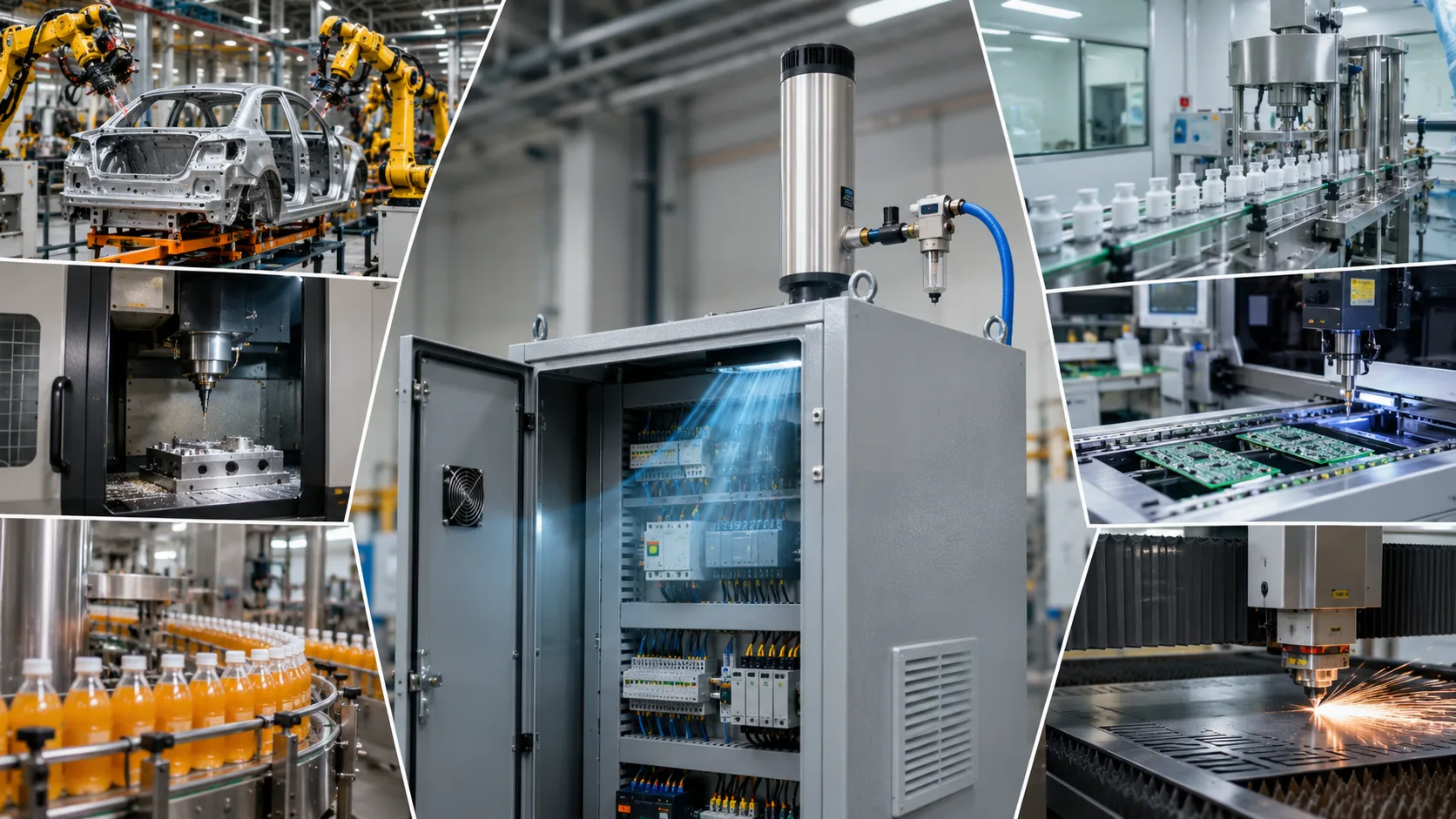
The SC tube can serve as a cold-air source in a properly engineered control-box installation. Such a system needs more than a tube pointed into a cabinet: air distribution, exhaust, moisture control and the enclosure’s required protection must all be addressed.
A small exposed component may present a localized cooling task, while a closed cabinet requires a broader heat-load assessment. Identify which problem is being solved before selecting hardware.
If the application is specifically enclosure cooling, compare the arrangement with a dedicated compressed air cabinet cooler. The cabinet cooler industry applications guide discusses those installation questions in more detail.
For either approach, measure pressure at the cooling device while the rest of the machine operates. Shared pneumatic demand can change the available inlet conditions and therefore the cooling result.
6. Machinery and Motor Components
Accessible motor housings or machinery components can be considered for spot cooling when a localized heat buildup has been identified. The product page lists this application area, subject to the actual heat load and installation.
First establish the cause of the temperature rise. An overloaded motor, blocked ventilation path, mechanical fault or incorrect operating condition requires its own correction. Supplemental cooling should be evaluated as part of the equipment design.
Surface temperature and internal temperature are not necessarily the same. A cold stream can lower a housing reading without adequately cooling the internal part of concern. Use the equipment manufacturer’s approved measurement method to validate the result.
Maintain clearance from moving parts, preserve existing ventilation and mount the air connection securely. Check whether cooling remains effective through the full machine cycle and after surrounding equipment reaches steady temperature.
SC Series Models and Published Cooling Capacity
The following capacities are listed at a performance pressure of 6.9 bar. They are heat-removal ratings, not guaranteed outlet temperatures. Confirm the applicable test conditions and installation performance before choosing a model.
| Model | Listed cooling capacity | Body diameter | Listed length |
|---|---|---|---|
| SC-06 | 530 Btu/h | 28 mm | 130 mm |
| SC-08 | 650 Btu/h | 38 mm | 160 mm |
| SC-10 | 980 Btu/h | 38 mm | 160 mm |
| SC-12 | 1,300 Btu/h | 38 mm | 160 mm |
| SC-15 | 1,600 Btu/h | 38 mm | 160 mm |
| SC-20 | 1,950 Btu/h | 38 mm | 160 mm |
| SC-25 | 2,280 Btu/h | 38 mm | 160 mm |
| SC-30 | 2,600 Btu/h | 38 mm | 160 mm |
| SC-40 | 2,870 Btu/h | 42 mm | 160 mm |
The page lists G1/8 or G1/4 inlet connections and outlet sizes that vary by model. Confirm the drawing and the identity of each outlet before designing adapters. Leave additional space for connections, mounting and hot-air discharge beyond the bare body dimensions.
The published air-consumption columns require confirmation of values, units and reference conditions before sizing a supply. Request a verified flow specification for the exact model instead of inferring consumption from its model number or treating the cfm and L/min entries as interchangeable.
Cooling Capacity and Outlet Temperature Answer Different Questions
A very cold stream is useful only if it removes enough heat from the target. Cooling capacity describes heat removal under specified conditions, while the target’s final temperature also depends on incoming heat, airflow contact, ambient conditions and exposure time.
The SC product page does not state a guaranteed outlet temperature. Request performance for the expected inlet temperature, pressure and airflow settings. If the installation must maintain a narrow temperature band, define the required control arrangement and verify it under changing loads.
For a surface-cooling trial, record both temperature response and the process result. This helps distinguish a visible cold-air effect from a useful improvement in the actual application.
Air Supply, Treatment and Operating Cost
Use suitably filtered, dry compressed air. Define additional oil and particle limits for electronics or other contamination-sensitive work. Pressure should be checked at the tube inlet during operation, with the supply line, filter and regulator sized for the confirmed flow.
The 6.9 bar figure is the listed performance reference; it should not be interpreted as a published maximum-pressure rating. Obtain the permissible operating range and the expected performance at the site’s available conditions.
Evaluate operating cost using the confirmed consumption, running time and the site’s cost of treated compressed air. An intermittent cooling task may have a different economic case from continuous cooling throughout every shift.
Where process timing permits, an approved valve and control arrangement can operate the air only when cooling is required. Confirm that this timing maintains the necessary thermal conditions and does not introduce unacceptable variation.
Plan a Measurable Trial
- Define the target. Identify the component, required temperature or heat-removal task and the reason cooling is needed.
- Record the baseline. Measure temperature and process performance under representative production conditions.
- Confirm the model. Review heat load, inlet conditions, verified air consumption and connection dimensions.
- Install the airflow arrangement. Secure the tube, position the cold stream and provide clear hot discharge.
- Evaluate the result. Measure target temperature, air use and any effect on product quality or adjacent equipment.
- Document the approved setup. Record settings, mounting, air treatment and maintenance requirements for repeat use.
A successful trial at one target does not establish suitability for every process in the same industry. Reassess after changes to tooling, heat input, air supply or cooling position.
Frequently Asked Questions
Which industries can evaluate SC vortex tubes?
Relevant areas include welding and metal fabrication, casting equipment, mold-based manufacturing, electronics testing, industrial controls and machinery. The deciding factors are the accessible cooling target, heat load and available air supply.
Does the vortex tube require electricity?
The cooling element uses compressed air. The compressor needs power, and external control accessories may require electricity.
Can it replace liquid coolant?
That depends on the process. Cold air does not provide liquid coolant lubrication or identical heat-transfer behavior. Validate the application before changing the approved cooling method.
Is a bare vortex tube a complete cold air gun?
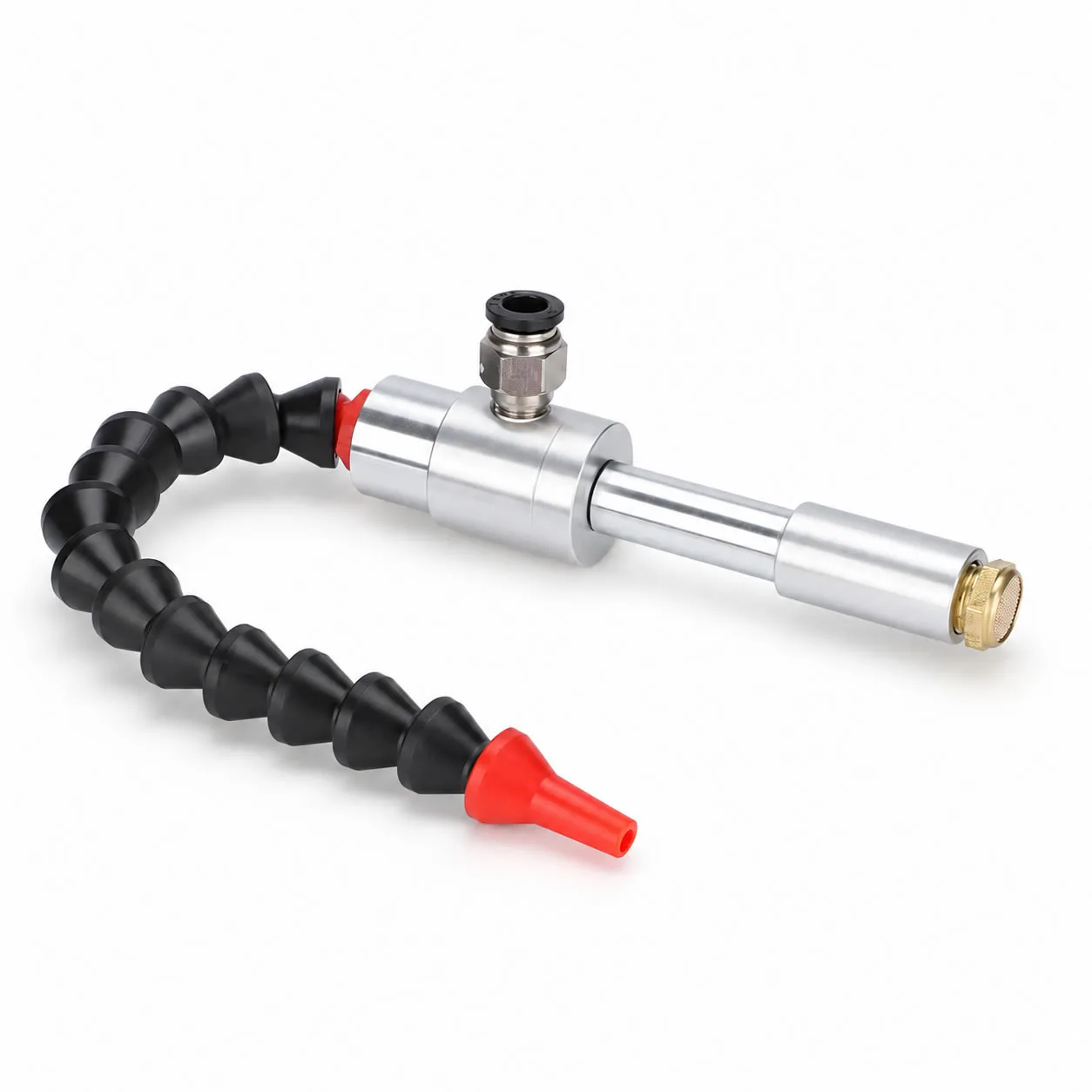
A vortex tube is the cooling core. A cold air gun generally includes accessories for directing and positioning the cold stream. Confirm what is supplied with the selected configuration.
What is the lowest outlet temperature?
The current SC page does not guarantee a numerical outlet temperature. Obtain performance data for the actual inlet conditions and settings.
Can it cool an electrical cabinet?
It can be a cooling source in an engineered system. Cabinet airflow distribution, exhaust, air quality and enclosure protection still need to be designed.
Specify the Process Before Selecting the Tube
The SC series offers a compact compressed-air cooling source for accessible industrial targets. Its value depends on matching the model and airflow arrangement to a defined process requirement, then measuring the result.
Review the SC Series Vortex Tube model specifications and provide your industry, cooling target, heat load, available air pressure and flow, installation space and operating schedule when requesting a configuration.