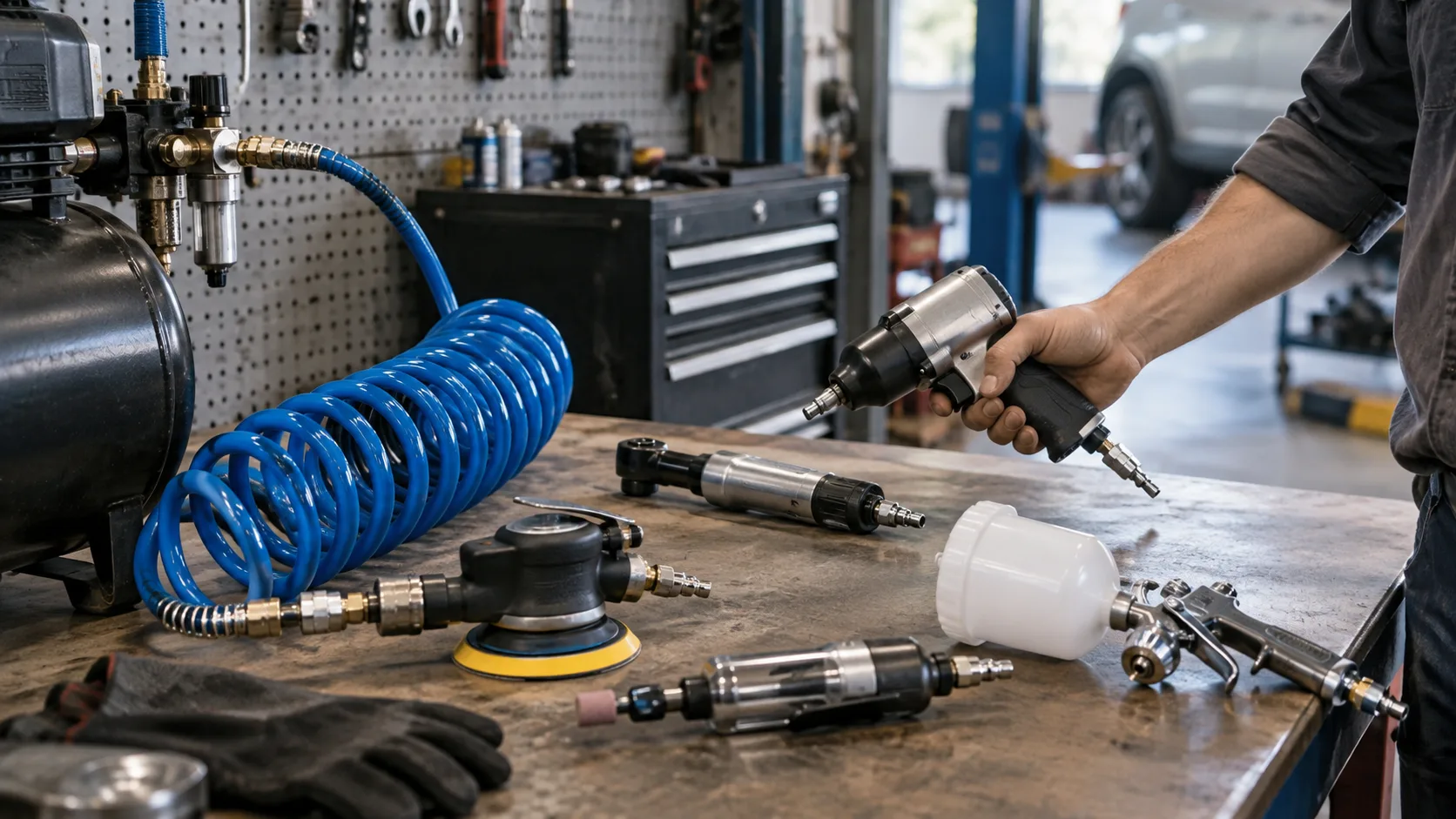
A handheld pneumatic tool needs more than a compressor and a fitting. The hose must deliver enough air, reach the work area without pulling on the tool, and stay out of the operator’s way when the tool is released. A loose straight hose can fall across a bench or workshop floor, create trip hazards and take time to coil after every job.
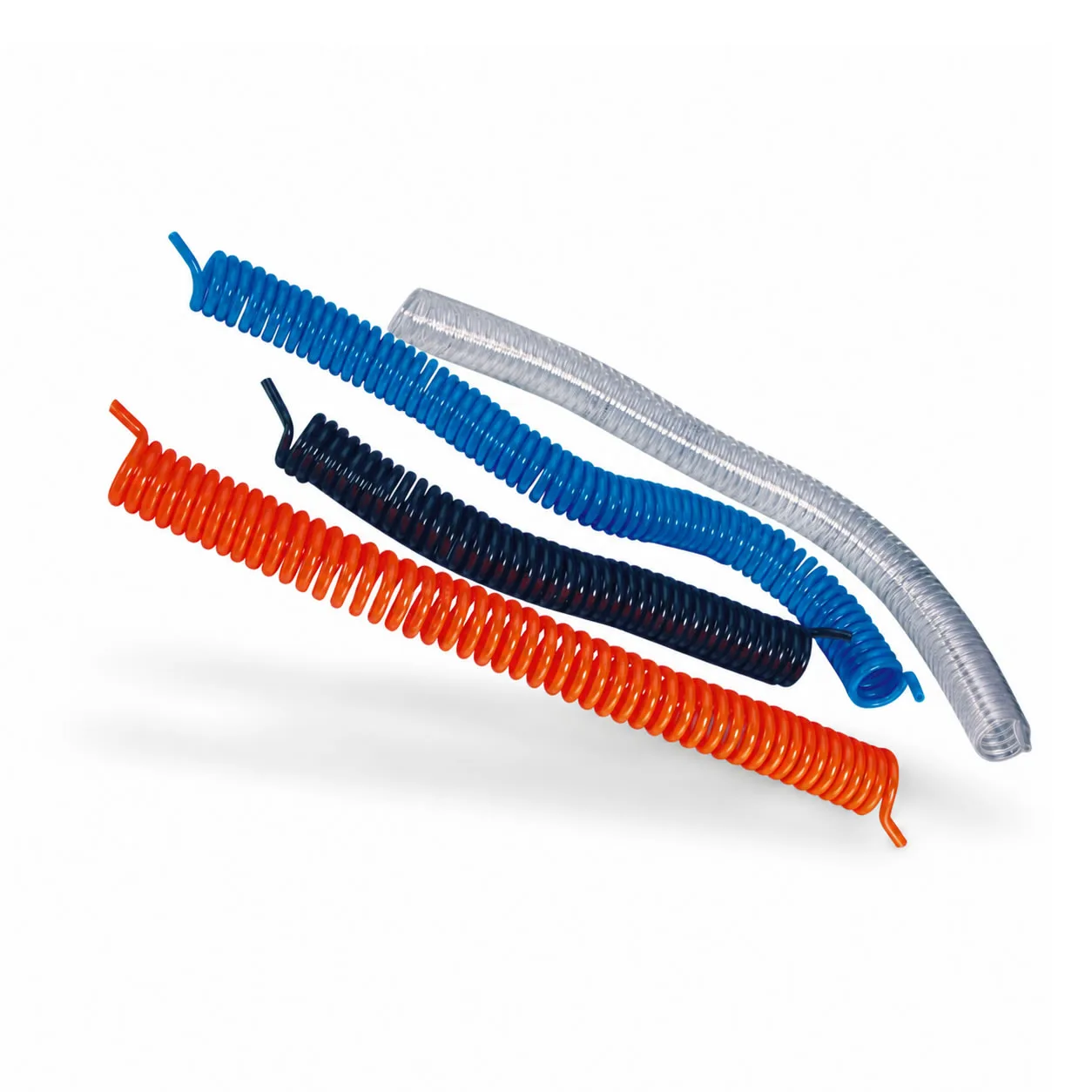
The HOMIPNEU Pneumatic Recoil Air Hose for Air Tools uses a coiled self-retracting structure. It extends as the operator moves away from the air outlet and returns toward a compact coil after release. Available tube sizes, working lengths, colors and end dimensions make it suitable for air blow guns, assembly tools, workshops, maintenance carts and machine-side air outlets.
This guide explains how to choose a recoil air hose by tool demand, working reach, pressure, temperature, connector, coil behavior and installation position. A recoil hose solves hose management; it does not automatically solve an undersized compressor, restrictive coupler or excessive tool airflow.
What Is a Pneumatic Recoil Air Hose?
A pneumatic recoil air hose is a spiral-shaped compressed-air hose designed to stretch during use and retract after release. The coil stores excess length in a smaller footprint than a straight hose, so the operator can move a tool without leaving a long loop across the work surface.
The self-retracting action is useful where the connection is used repeatedly from a fixed point. It can keep an assembly bench, garage bay or maintenance station more organized. The hose still needs a suitable support point, a safe working radius and enough clearance for the coil to expand without catching on fixtures or people.
Why Use a Coiled Hose for Air Tools?
| Workplace Problem | How a Recoil Hose Helps | What Still Needs Checking |
|---|---|---|
| Excess straight hose on a bench | Retracts toward a compact coil after use | Coil position and end support |
| Operator moves around a workstation | Provides an extending working range | Actual reach without stretching the hose tight |
| Frequent tool changes | Keeps the connection near the air outlet | Connector type, coupler flow and strain relief |
| Maintenance carts and service bays | Reduces loose hose storage space | Temperature, abrasion and vehicle movement |
| Several colored air circuits | Color options help identify stations | Color is not a pressure or material rating |
| Limited floor space | Concentrates unused length in the coil | Trip clearance and recoil force |
A recoil hose is not always the best choice. A long fixed route, high-flow machine branch or application requiring unrestricted movement may be better served by straight pneumatic tubing, a flexible air hose or a hose reel. Select the structure around the work pattern, not only around the product name.
Published Specifications
| Parameter | Published Specification | Selection Note |
|---|---|---|
| Structure | Coiled self-retracting tube | Designed to extend and return toward the coil |
| Working medium | Compressed air | Confirm compatibility before using another gas |
| Working pressure | 8 kgf/cm² | Use the confirmed rating for the complete hose and connector assembly |
| Burst pressure | 30 kgf/cm² | Burst pressure is not an operating target |
| Temperature range | −10°C to +40°C | Keep the hose and fittings within the confirmed range |
| Standard colors | Gray, red, black, blue, green, yellow, orange and white | Color identification is available subject to order confirmation |
| Custom dimensions | Straight end A, straight end B and coil diameter C | Useful for fixed outlets and equipment layouts |
| Standard roll basis | 100 m raw hose reference | Finished recoil lengths are selected separately |
Pressure values should be interpreted with the connector, temperature, hose size, manufacturing tolerance and safety factor in mind. Ask for the applicable working pressure when the hose is fitted with a particular plug, coupler or threaded end.
Tube Sizes and Working Lengths
| Published Tube Size | Approx. Weight | Available Finished Lengths | Typical Selection Focus |
|---|---|---|---|
| Φ5 × 8 mm | 38 g/m | 6, 9, 12, 15 m | Light air tools and compact workstations |
| Φ6.5 × 10 mm | 55 g/m | 6, 9, 12 m | General assembly and workshop tools |
| Φ8 × 12 mm | 75 g/m | 6, 9, 12 m | Higher airflow demand and longer reach |
| Φ10 × 14 mm | 83 g/m | 6, 9 m | Larger tools and machine-side branches |
| Φ12 × 16 mm | 128 g/m | 6, 9 m | Highest listed flow-oriented option |
The product page presents these sizes in the published `Φ5 × 8 mm` format. Confirm which number represents inside diameter and which represents outside diameter for the exact quotation, because fitting selection is normally based on outside diameter while airflow depends strongly on the bore.
Choose the working length by measuring the farthest normal tool position, then allow enough slack for the coil to move without permanent tension. A nominal 9 m hose does not necessarily provide 9 m of comfortable working reach when the coil must remain partially extended and the tool needs freedom of movement.
How to Choose the Correct Size for an Air Tool
Start with the tool manufacturer’s air consumption and minimum inlet pressure. A blow gun may use short bursts, while an impact wrench, grinder or screwdriver can demand sustained or repeated flow. The recoil hose must deliver air through the hose bore, connectors, coupler, regulator and filter without excessive pressure drop.
- Light-duty blow-off and small tools: begin with the smaller published size, then verify flow and tool performance.
- Assembly screwdrivers and staplers: compare peak consumption, cycle rate and the pressure available at the tool.
- Impact tools or higher-demand equipment: consider a larger bore and shorter length where the tool manufacturer permits.
- Multiple tools on one station: size the branch and air preparation equipment for simultaneous demand rather than one tool in isolation.
A larger outside diameter does not guarantee better performance if the coupler, valve or compressor is restrictive. Measure dynamic pressure at the tool while it operates at the intended duty cycle.
Working Length, Reach and Coil Behavior
Working length and storage length are different. The coil is compact when released but becomes longer as it is extended. If the operator has to pull it to the absolute limit, the hose can exert a return force on the tool, fitting or wrist.
Place the fixed end above or beside the work zone so the coil can hang naturally. Keep the tool within the normal reach envelope and do not route the hose over sharp corners. For a large work area, two shorter stations may be safer and more ergonomic than one long hose that remains permanently stretched.
Check the coil after installation. It should retract without catching, flattening or striking nearby equipment. If the coil repeatedly drags on the floor, move the support point or select a different connection arrangement.
Airflow and Pressure Drop in Coiled Hoses
A coil does not remove friction. The air still travels through the full internal path, plus the end connections and coupler. Small bore, long working length, sharp connector passages and high tool consumption can reduce pressure at the tool.
To evaluate the circuit, collect the hose size, extended length, supply pressure, tool consumption, coupler type and regulator setting. Test the tool under load rather than only with the trigger released. If the tool slows or loses torque, inspect the filter, regulator, coupler and hose together.
For a long production air line, use a properly sized straight tube or main hose upstream, then use the recoil hose only for the operator’s final flexible connection. This keeps the coil from becoming the bottleneck for the whole station.
Pressure Rating: Working vs Burst Pressure
The product page lists 8 kgf/cm² working pressure and 30 kgf/cm² burst pressure. Working pressure is the value used for normal operation under the stated conditions. Burst pressure indicates a destructive limit under a test condition and must never be used as the normal regulator setting.
Confirm the actual pressure rating for the finished assembly, especially when a custom end, coupler or swivel is added. The weakest component determines the safe operating limit. Also check pressure spikes, compressor cut-in behavior and any stored-energy requirements in the machine risk assessment.
Temperature and Workshop Environment
The published temperature range is −10°C to +40°C. This range suits many indoor workshops and assembly stations, but vehicle bays, outdoor maintenance points, hot machinery and unheated storage may exceed it.
Measure the hose temperature where it is actually used. Compressed air, nearby heaters, sunlight, hot tooling and engine compartments can create a local temperature different from room air. Confirm that the hose, seal and connector are all rated for the same condition.
At low temperatures, a polymer coil may feel less flexible and retract differently. At higher temperatures, material strength and pressure capability can change. Keep the operating condition within the published range unless a specific application approval is obtained.
Choosing Connectors and End Dimensions
A recoil hose is only useful when its ends match the station. The product supports customization of straight end A, straight end B and coil diameter C. These dimensions can help position a plug, coupler, swivel or tool connection away from the first coil turn.
Before ordering, specify:
- Tube size and the required fitting standard
- Male or female thread, plug, socket, barb or bare tube end
- Coupler flow and pressure rating
- Swivel requirement at the tool or fixed end
- Straight-end length at both sides
- Coil diameter and available installation space
- Whether the connection must rotate during tool use
The product page does not establish one standard connector configuration for every order. Confirm whether the quotation includes bare ends, threaded fittings, plugs or couplers.
For connection options, browse the HOMIPNEU pneumatic fittings category and match the fitting to the hose dimension and pressure requirement.
Applications at Assembly Stations
Assembly benches often use pneumatic screwdrivers, staplers, small impact tools and clamps. A recoil hose can follow the operator’s hand while keeping unused length off the work surface. Choose the shortest length that covers the work envelope and confirm that the tool’s peak airflow is available.
Mount the fixed connection where the coil does not pull across the product or operator. Use a swivel if the tool rotates or changes orientation frequently. Mark the hose color by station only after confirming that color is available for the required model.
Applications for Air Blow Guns
Blow guns are commonly used for chip removal, drying, fixture cleaning and workstation maintenance. A coiled hose keeps the air connection close to the bench and reduces loose loops after the gun is returned.
Follow the site’s compressed-air safety rules for blow-off. The hose does not control nozzle pressure, particle direction, eye protection or the use of compressed air near people. Select the blow gun, regulator and nozzle together with the required airflow and safety controls.
Applications in Workshops and Garages
Vehicle service bays and workshops benefit from a hose that stays compact between jobs. Use the recoil hose for tire service, cleaning, small pneumatic tools and equipment maintenance when the temperature, pressure and reach are within specification.
Keep the coil away from vehicle wheels, sharp floor edges, welding areas and oil or solvent pools. A hose that is designed for compact storage can still be damaged by being driven over, dragged across a metal edge or left in a hot engine compartment.
Applications on Production Lines
Production stations may have a fixed regulator or manifold feeding a movable tool. A recoil hose provides a repeatable connection between the station and the operator while helping keep the aisle clear.
Inspect the hose at shift change if it is extended and retracted continuously. Check the fixed anchor, connector, coil turns and the first straight section. If the hose is used on a moving slide or robot, confirm the cycle life separately; a workshop recoil hose is not automatically approved for continuous robotic motion.
Recoil Hose vs Straight Flexible Hose vs Hose Reel
| Selection Point | Recoil Hose | Straight Flexible Hose | Hose Reel |
|---|---|---|---|
| Storage footprint | Compact coil | Requires manual coiling or storage | Compact reel housing |
| Operator reach | Elastic extension within a defined range | Longer reach can be supplied directly | Retracts into a reel |
| Best for | Benches, stations and light mobile tools | Long routes, moving tools and general distribution | Organized bays with a fixed reel mount |
| Pull force | Increases as the coil is stretched | Normally low until the hose is taut | Depends on reel spring and lock |
| Flow selection | Depends on bore, length and couplers | Depends on bore and length | Depends on hose and reel passage |
Choose a recoil design when self-retraction and a compact station are more important than unlimited reach. Choose a straight hose or reel when the operator needs a larger working envelope or continuous movement.
Color Coding and Customization
Gray, red, black, blue, green, yellow, orange and white options are listed. Color can identify a tool station, pressure zone or maintenance circuit, which helps operators return a hose to the correct location.
Color does not prove pressure rating, chemical compatibility or tube size. Keep model and batch information in the purchase record. For OEM programs, request printed markings, private labels, custom straight ends, coil diameter and packaging requirements before production.
Installation Checklist
- Measure the operator’s normal and maximum working reach.
- Choose a tube size based on tool airflow and dynamic pressure.
- Confirm the published temperature range fits the work area.
- Specify the connector, coupler, thread and swivel requirement.
- Confirm straight-end A and B dimensions and coil diameter C.
- Mount the fixed end securely above or beside the work zone.
- Keep the coil clear of sharp edges, hot surfaces, wheels and moving machinery.
- Connect the tool without twisting the first coil turn.
- Pressurize gradually and leak-test the complete assembly.
- Test tool performance at maximum normal demand and confirm safe retraction.
Maintenance and Safety Checks
Inspect the hose for cuts, flattening, cracks, damaged coil turns, permanent stretch, connector movement and air leaks. Check whether the hose still retracts without catching. Replace a hose that has been driven over, exposed to a temperature outside its range or damaged by oil and solvent exposure.
Check the coupler and tool connection for excessive side load. A recoil hose should not hang from a fragile tool port or pull sideways on a small fitting. Use a swivel, bracket or strain relief when the operator changes direction frequently.
Keep pressure within the confirmed working rating and depressurize before cutting, replacing a connector or servicing the tool. Follow local workplace requirements for compressed-air noise, eye protection, hose routing and stored energy.
Common Selection Mistakes
- Choosing only by maximum length: a long coil may exert too much pull and reduce tool comfort.
- Ignoring bore size: a compact hose can restrict a high-consumption tool.
- Using burst pressure as working pressure: burst data is not an operating setting.
- Matching color instead of dimensions: color does not identify the correct connector or flow capacity.
- Forcing a coil around a corner: sharp routing can damage the first turns and fittings.
- Assuming connectors are included: confirm whether the order is bare hose or a finished assembly.
- Installing outdoors without temperature review: the listed range is −10°C to +40°C.
- Using a workshop recoil hose for continuous robot motion: validate flex life and cycle requirements separately.
Ordering Checklist
- Published tube size: Φ5 × 8, Φ6.5 × 10, Φ8 × 12, Φ10 × 14 or Φ12 × 16 mm
- Required finished length: 6, 9, 12 or 15 m depending on size
- Inside/outside diameter convention confirmed with the supplier
- Tool airflow, pressure and duty cycle
- Working pressure of 8 kgf/cm² requirement checked
- Temperature range of −10°C to +40°C checked
- Connector, coupler, thread and swivel specification
- Straight-end A and B dimensions
- Coil diameter C and available mounting space
- Color, printing, quantity and packaging
- Whether custom OEM or ODM dimensions are required
Frequently Asked Questions
What is a pneumatic recoil air hose?
It is a coiled self-retracting compressed-air hose that extends while an operator moves a pneumatic tool and returns toward a compact coil after release.
Which tools can use a recoil air hose?
Typical uses include air blow guns, pneumatic screwdrivers, small impact tools, staplers, assembly tools, maintenance equipment and workshop air outlets. Confirm the tool’s airflow and pressure first.
What sizes are available?
The published sizes are Φ5 × 8 mm, Φ6.5 × 10 mm, Φ8 × 12 mm, Φ10 × 14 mm and Φ12 × 16 mm. Confirm the supplier’s inside/outside diameter convention before ordering fittings.
What finished lengths are available?
Depending on the selected tube size, finished lengths include 6, 9, 12 and 15 meters.
What is the working pressure?
The listed working pressure is 8 kgf/cm² and the listed burst pressure is 30 kgf/cm². Use the lower confirmed rating of the hose, connectors and tool circuit, and do not operate at burst pressure.
What is the temperature range?
The listed range is −10°C to +40°C. Confirm the actual temperature at the hose route, especially in outdoor service, hot workshops and vehicle maintenance areas.
Does the hose include connectors?
The product page does not define one standard connector configuration for every order. Confirm whether you need bare ends, threaded fittings, plugs, couplers or a complete finished assembly.
Can the color and end dimensions be customized?
Yes. Gray, red, black, blue, green, yellow, orange and white options are listed, and straight-end A, straight-end B and coil diameter C can be customized subject to confirmation.
How do I stop the hose from pulling on the tool?
Choose a suitable working length, mount the fixed end correctly, use a swivel or strain relief where needed, and keep the tool within the hose’s comfortable extension range.
Is a recoil hose suitable for a robot arm?
Only after validating continuous flexing, torsion, cycle count, bend radius and fitting retention. The product is primarily described for air tools, stations, workshops and maintenance equipment.
Make the Air Tool Connection Easier to Manage
A pneumatic recoil air hose can improve the ergonomics and housekeeping of a tool station by extending when needed and returning toward a compact coil afterward. The best result comes from matching the bore, working length, connector, pressure, temperature and mounting position to the real job.
Review the Pneumatic Recoil Air Hose specifications, then provide the tool airflow, reach, connector, color and end-dimension requirements for model confirmation. For additional compressed-air products, browse the HOMIPNEU air hose range or the pneumatic tools category.