Industry Update
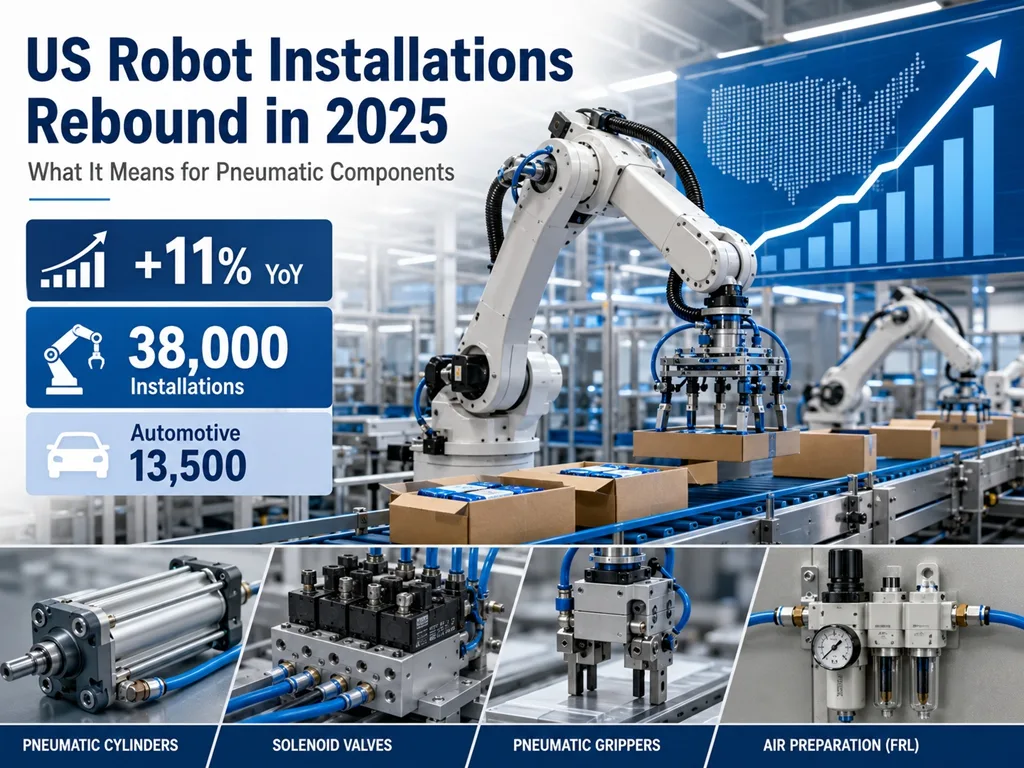
Industrial automation in the United States showed a clear recovery in 2025. According to preliminary statistics released by the International Federation of Robotics on June 18, 2026, industrial robot installations in the United States rose 11 percent year on year to reach 38,000 units in 2025. The IFR also noted strong growth from the food industry and other non-manufacturing sectors, while automotive remained the largest adopter with 13,500 installations.
This matters for the pneumatic industry because robot installations rarely stand alone. A robot cell usually needs grippers, rotary actuators, compact cylinders, clamps, positioning stops, valves, fittings, tubing, sensors, and air preparation equipment. Even when the robot itself is electric, many end-of-arm tools and auxiliary stations still rely on compressed air because it is fast, simple, and cost effective.
For buyers and machine builders, the growth of robot installations means pneumatic components are being used in more mixed automation environments. Instead of being limited to traditional machinery, pneumatic devices now work beside robots, vision systems, conveyors, safety doors, indexing tables, and flexible fixtures.
Source reference: International Federation of Robotics press releases.
Food Automation Is Becoming More Important
The IFR highlighted food industry growth as an important driver of the 2025 rebound. Food and beverage factories often need equipment that can handle repetitive movement, frequent washdown, variable packaging sizes, and strict hygiene expectations. Pneumatic components remain common in these systems because they can deliver quick linear motion, reliable gripping, and simple actuation in compact machine layouts.
Packaging lines may use pneumatic cylinders for pushing, stopping, sorting, lifting, and clamping. Solenoid valves control cylinder timing. Pneumatic grippers handle pouches, trays, bottles, cartons, and small parts. Air fittings and tubes connect the circuit in tight spaces around conveyors and robot guards.
The shift toward more robotic food automation also changes the way components are selected. Machine builders are looking for compact actuators, clean tube routing, fast valve response, stable air supply, and parts that can be replaced quickly during maintenance. A low-cost cylinder or valve is not enough if it creates downtime on a high-speed packaging line.
More Robot Cells Need Better Peripheral Equipment
Robot adoption often brings more attention to the robot arm, controller, and software. But the real productivity of a cell depends on the complete system. If a gripper cannot hold the part reliably, if a clamp cylinder drifts, or if a solenoid valve response is inconsistent, the robot cycle becomes unstable.
This is why pneumatic components for robot cells must be selected as part of the whole motion system. Key questions include:
- What part weight and shape must be handled?
- Does the end effector need parallel gripping, angular gripping, vacuum, or clamping?
- How much stroke is required for positioning or part release?
- What cycle speed does the valve and air circuit need to support?
- Will tube movement create pulling force on fittings?
- Can maintenance teams access the valve manifold, regulator, and fittings quickly?
For example, a robotic packing cell may use a pneumatic gripper or compact cylinder for product handling, a solenoid valve for fast air control, and pneumatic fittings for a clean tube layout near the moving axis.
Non-Automotive Growth Changes Pneumatic Demand
Automotive factories have used robots for decades, but non-automotive sectors often have different requirements. Food, consumer goods, electronics, packaging, logistics, medical products, and light assembly lines may need smaller machines, quicker changeovers, and more frequent product variation.
This creates demand for pneumatic components that are compact, modular, and easy to configure. Instead of one large custom machine built for a single product, many factories are building flexible cells that can be adjusted for different package sizes or part families. Pneumatic cylinders, slides, grippers, valves, and fittings must fit this flexible approach.
For distributors and OEM buyers, this means product range matters. A supplier that can provide standard cylinders, compact cylinders, guided cylinders, rotary actuators, grippers, solenoid valves, air hose, fittings, mufflers, and air source treatment units can support more complete automation projects.
Air Preparation Becomes a Reliability Issue
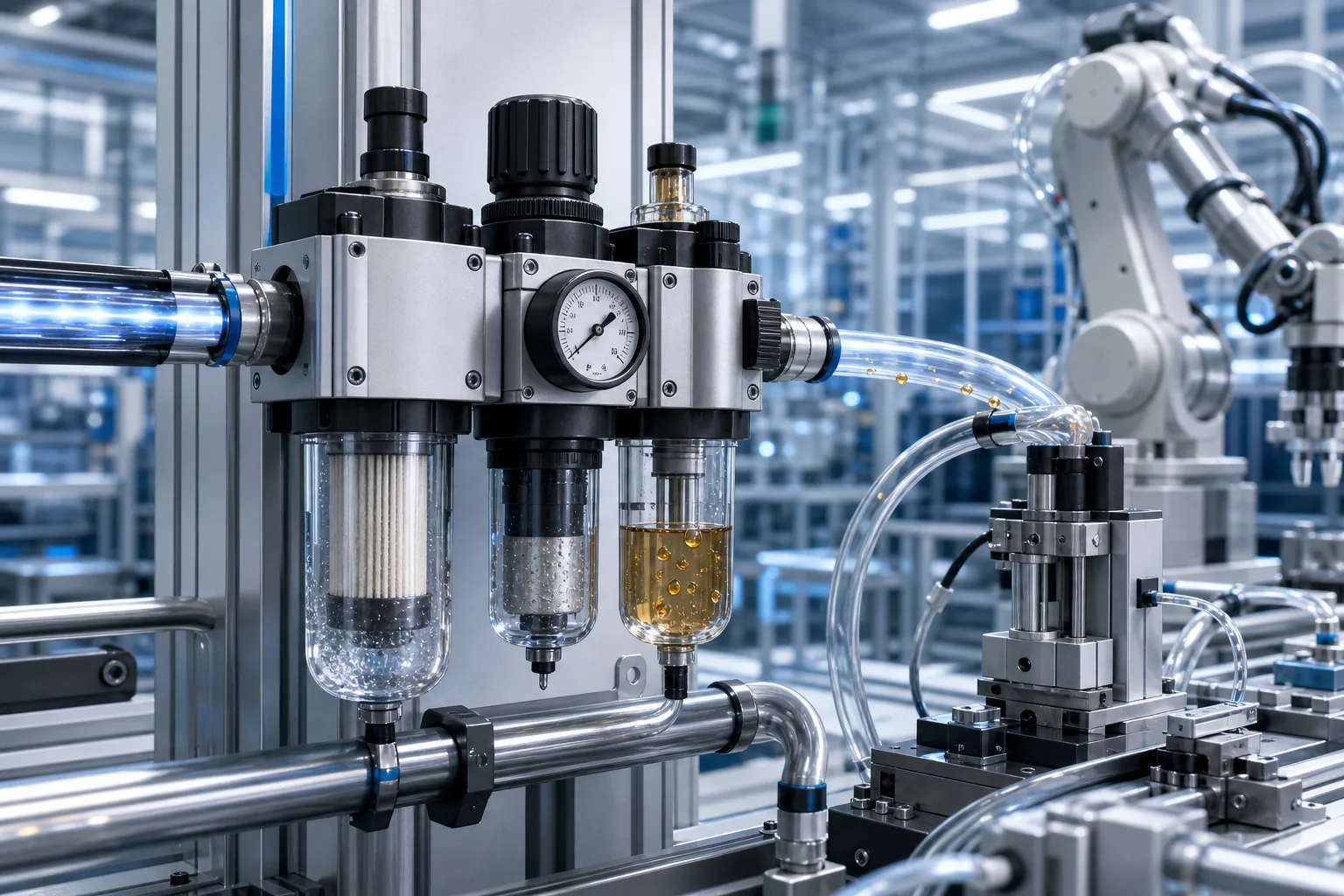
Robot cells often run for long hours, and small air quality problems can become large maintenance issues. Water, dust, oil carryover, pressure fluctuation, and undersized tubing can affect valve response and actuator life. In high-speed robot lines, poor air preparation may show up as dropped parts, inconsistent clamping, slow cylinder movement, or repeat alarm stops.
Good air preparation is not only about installing a filter. It also includes correct pressure setting, sufficient flow, clean tube routing, and leak control. A stable compressed air circuit helps the robot cell repeat the same motion at the same speed, which is essential for automated inspection, packing, and assembly.
HOMIPNEU’s air source treatment products, air fittings, tubes, solenoid valves, and cylinder options are relevant to this kind of automation environment.
What Buyers Should Watch in 2026
The 2025 rebound suggests that more manufacturers are moving forward with automation projects after a period of uncertainty. In 2026, buyers may pay closer attention to robot peripheral equipment, not just the robot itself. Pneumatic components that support quick installation, stable operation, and easy maintenance will be more valuable in robot cells.
For machine builders, the practical lesson is simple: robot performance depends on the complete automation circuit. Choosing the right cylinder, gripper, valve, fitting, tube, muffler, and air preparation unit can reduce commissioning problems and improve long-term reliability.
Related Pneumatic Products
For robot cells, packaging automation, food equipment, and flexible manufacturing lines, HOMIPNEU supplies pneumatic cylinders and grippers, solenoid valves, pneumatic fittings, air hose, mufflers, and air source treatment units for industrial automation systems.