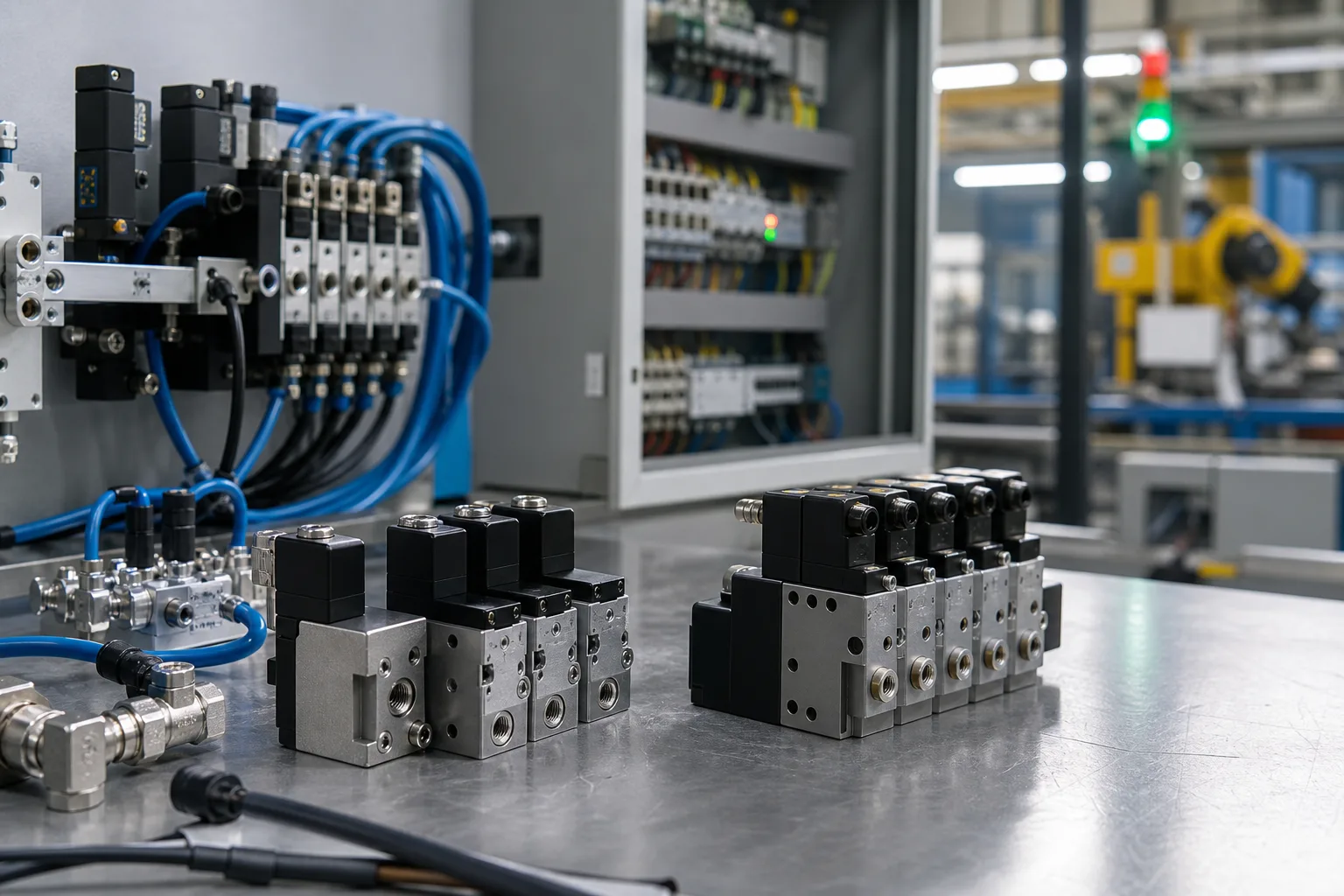
Russian machine builders are entering the second half of 2026 with a more careful approach to automation spending. Instead of large-scale redesigns, many OEMs are looking for compact pneumatic components that can be integrated into existing equipment platforms. This is creating continued interest in 3/2, 5/2 and 5/3 solenoid valves for air control.
The change is visible across packaging machinery, light assembly, filling equipment, material handling and workshop automation. These systems still need cylinders, clamps, pushers and diverters to move reliably, even when customers slow down investment in full production lines. Compact solenoid valves give OEMs a way to keep machine functions stable while controlling cost and installation space.
Why compact air valves fit the 2026 buying mood
In a tighter market, the value of a valve is measured by how easily it solves a practical engineering problem. Russian OEMs are asking for valves that are easy to wire, easy to mount and available in common voltage options. Models such as 2V025-06, 2V025-08, 3V1 and the 4V120-06 / 4V220-08 style valves match that requirement because they are familiar to maintenance teams and can be used in many pneumatic circuits.
| Valve type | Main function | Why Russian OEMs use it |
|---|---|---|
| 3/2 solenoid valve | Single-acting cylinder or pilot signal control | Compact size and simple circuit design |
| 5/2 solenoid valve | Double-acting cylinder control | Common choice for machine actuators |
| 5/3 solenoid valve | Mid-position actuator control | Useful where holding or exhaust logic is needed |
| Manual hand valve | Operator or maintenance control | Provides backup control without electrical signal |
For OEM engineers, the key technical questions usually include port size, coil voltage, response speed, flow rate and operating pressure. A 24V DC coil may be preferred for control cabinets, while 220V AC can still appear in older industrial sites. The ability to support both helps suppliers serve retrofit and new-build projects at the same time.
This is also why buyers browsing Homipneu’s Solenoid Valve category often compare compact directional products first. The 4V120-06 two-position five-way solenoid valve, 4V220-08 pneumatic actuator control valve and SY5120-5LZD piloted solenoid valve are natural examples for OEMs building air-control circuits around standard cylinders.
Retrofit work supports steady demand
Russia’s 2026 manufacturing climate is cautious, with PMI data showing contraction in recent months. But this does not remove the need for maintenance. In fact, it often increases attention to components that are easy to replace. When a pneumatic line is already built around a common valve footprint, buyers usually prefer a compatible valve over a full redesign.
This helps explain why standard series remain attractive. A 2V air solenoid valve can be used in compact pneumatic panels. A 4V series valve can handle common directional control tasks. SY-style valves can support equipment requiring fast, repeated switching. Manual 4H valves give machine operators a simple non-electric control option for test benches or backup circuits.
What suppliers should prepare
Suppliers serving Russia in 2026 should be ready with clear data sheets, wiring information, coil options and cross-reference support. OEM buyers are not only comparing price; they are checking whether a valve can be installed quickly without extra engineering work.
For Homipneu, the opportunity is to present compact pneumatic valves as practical building blocks for OEMs that need reliable air control under tighter budget conditions. The winning message is straightforward: keep the machine moving, keep the circuit simple and keep replacement parts easy to source.