Industry Update
Manufacturers are entering 2026 with a stronger focus on targeted technology investment, supply chain resilience, and flexible operations. Deloitte’s 2026 Manufacturing Industry Outlook notes that renewed strategic focus and targeted technology investments could be essential for maintaining competitiveness. Deloitte has also discussed how agentic AI may help manufacturers manage supply chain complexity, risk, and decision making.
For the pneumatic industry, these trends are practical rather than abstract. A factory that uses AI for planning, predictive maintenance, or production scheduling still needs physical equipment that can change quickly. If the production line cannot be adjusted, the software layer cannot deliver its full value. Pneumatic components must support flexibility at the machine level.
Source references: Deloitte 2026 Manufacturing Industry Outlook and Deloitte agentic supply chain article.
Smart Factories Still Need Simple Motion
AI can improve planning, detect risk, optimize scheduling, and support maintenance decisions. But factory output still depends on physical motion. Parts must be clamped, lifted, pushed, stopped, indexed, gripped, turned, sorted, and packaged. These tasks are often handled by pneumatic cylinders, grippers, rotary actuators, valves, fittings, tubes, and air preparation equipment.
This is why pneumatic components remain relevant in smart manufacturing. They provide simple, repeatable motion that can be controlled by PLCs, sensors, and digital systems. A machine does not become smart only because it has software. It becomes useful when the mechanical, pneumatic, electrical, and control layers work together.
For example, a flexible assembly station may use compact cylinders for positioning, a guided cylinder for stable pressing, a rotary actuator for turning a part, a pneumatic gripper for handling, and solenoid valves for timing control. AI may decide the production schedule, but the pneumatic system performs the movement.
Reconfiguration Is Becoming a Buying Requirement
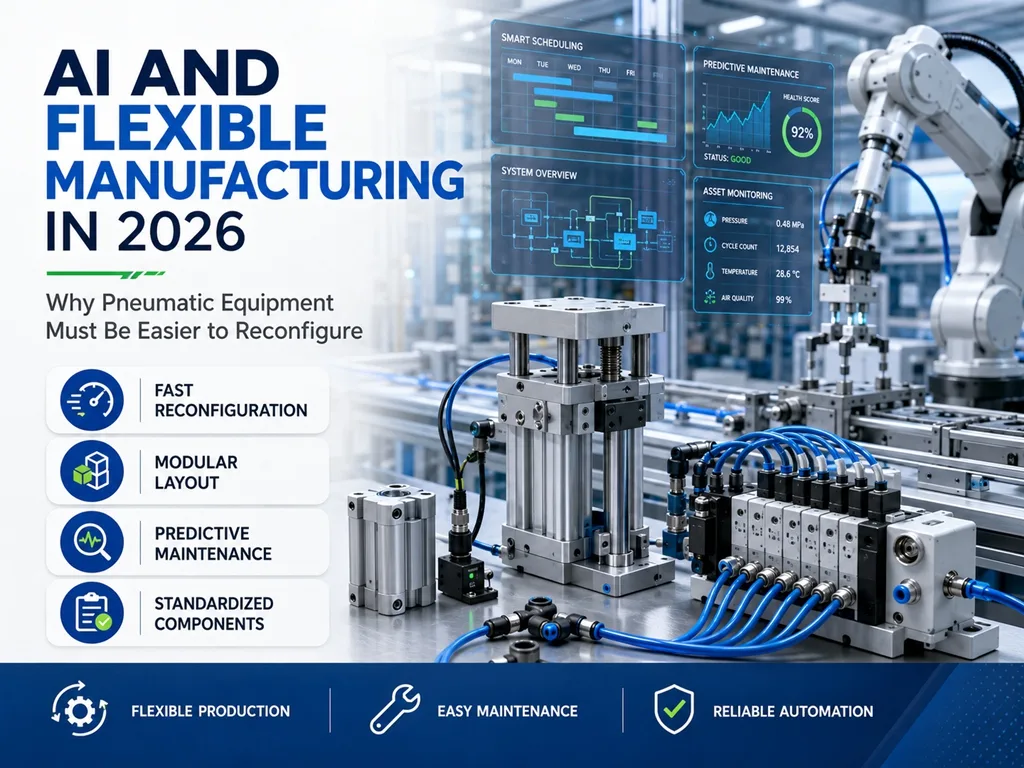
Flexible manufacturing means production lines must adapt to different products, package sizes, batch quantities, and demand changes. This creates a new requirement for pneumatic equipment: it must be easy to reconfigure.
Buyers are looking for components that make layout changes less painful. Push-in pneumatic fittings, modular valve manifolds, compact cylinders, adjustable sensors, standard tube sizes, and common mounting patterns all support this goal. When parts are standardized, maintenance teams can adjust machines without waiting for unusual spare parts.
HOMIPNEU’s pneumatic fittings, air hose, pneumatic cylinders, and solenoid valves are relevant to this kind of reconfigurable automation.
Compact Layouts Need Cleaner Air Circuits
As factories add more sensors, robots, conveyors, and inspection equipment, machine space becomes more crowded. Pneumatic circuits must fit into tighter cabinets, smaller end effectors, and narrower machine frames. Poor tube routing can create maintenance problems, pressure losses, and accidental pulling forces.
Clean air circuit design is becoming more important. Tubes should be routed with enough bend radius. Fittings should be accessible. Valve manifolds should be placed where wiring and tubing are both serviceable. Cylinders should not be forced into positions where fittings collide with guards or moving parts.
In flexible production lines, clean layout also supports faster changeover. If operators can see and access tube connections, sensors, and regulators, troubleshooting becomes easier. A good pneumatic layout saves time long after the machine is installed.
Predictive Maintenance Needs Consistent Components
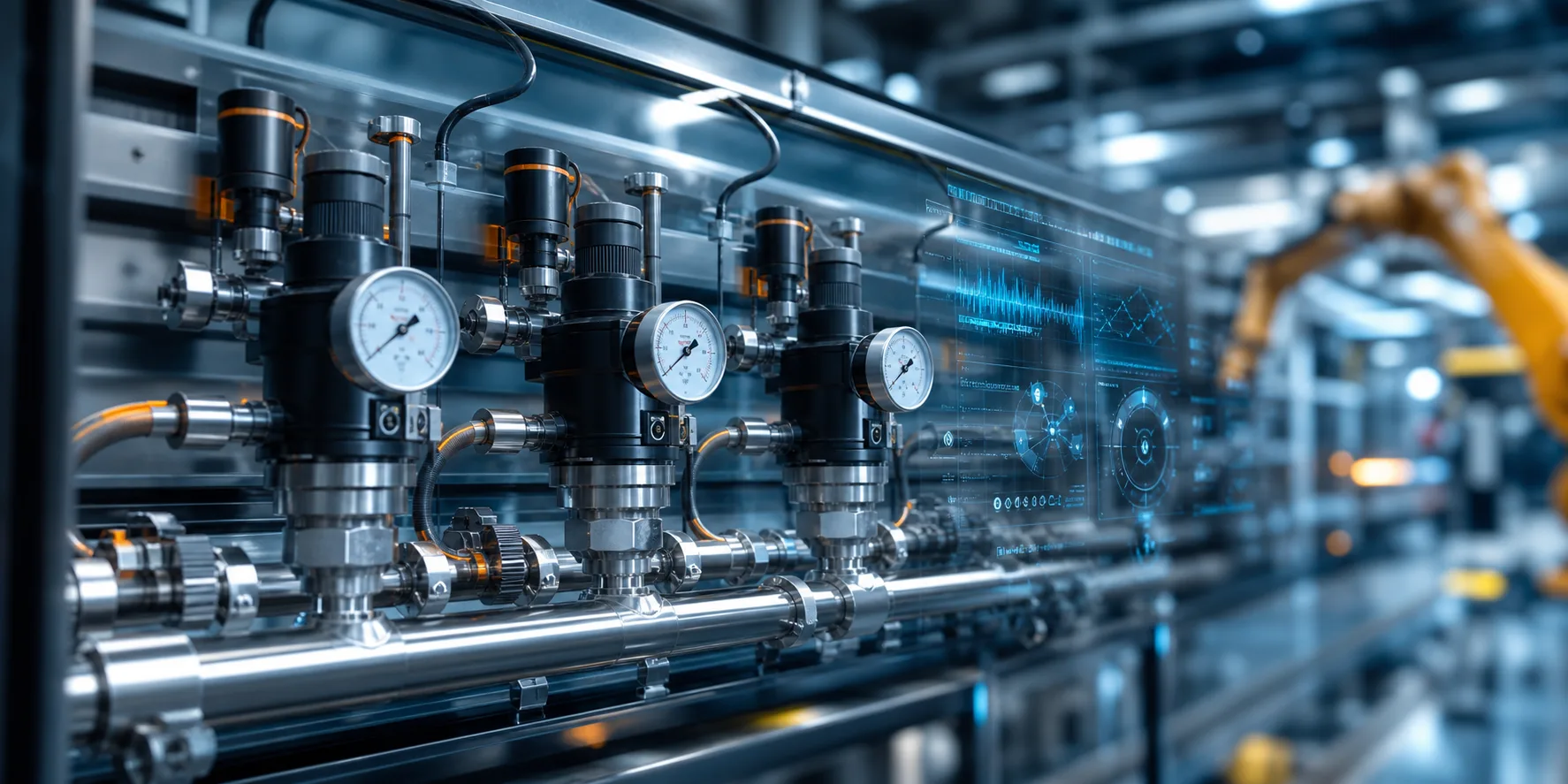
AI and digital maintenance tools depend on stable data. If a pneumatic system has random leaks, inconsistent pressure, or worn parts, it becomes harder to interpret machine behavior. A sensor may show slower cylinder movement, but the cause could be air pressure, valve contamination, tube restriction, or mechanical load.
This is why component consistency matters. Reliable cylinders, valves, fittings, and air source treatment units help reduce noise in the maintenance data. When the pneumatic system is stable, changes in cycle time or pressure are easier to investigate.
Factories that want predictive maintenance should pay attention to basic pneumatic health:
- Keep air dry and clean
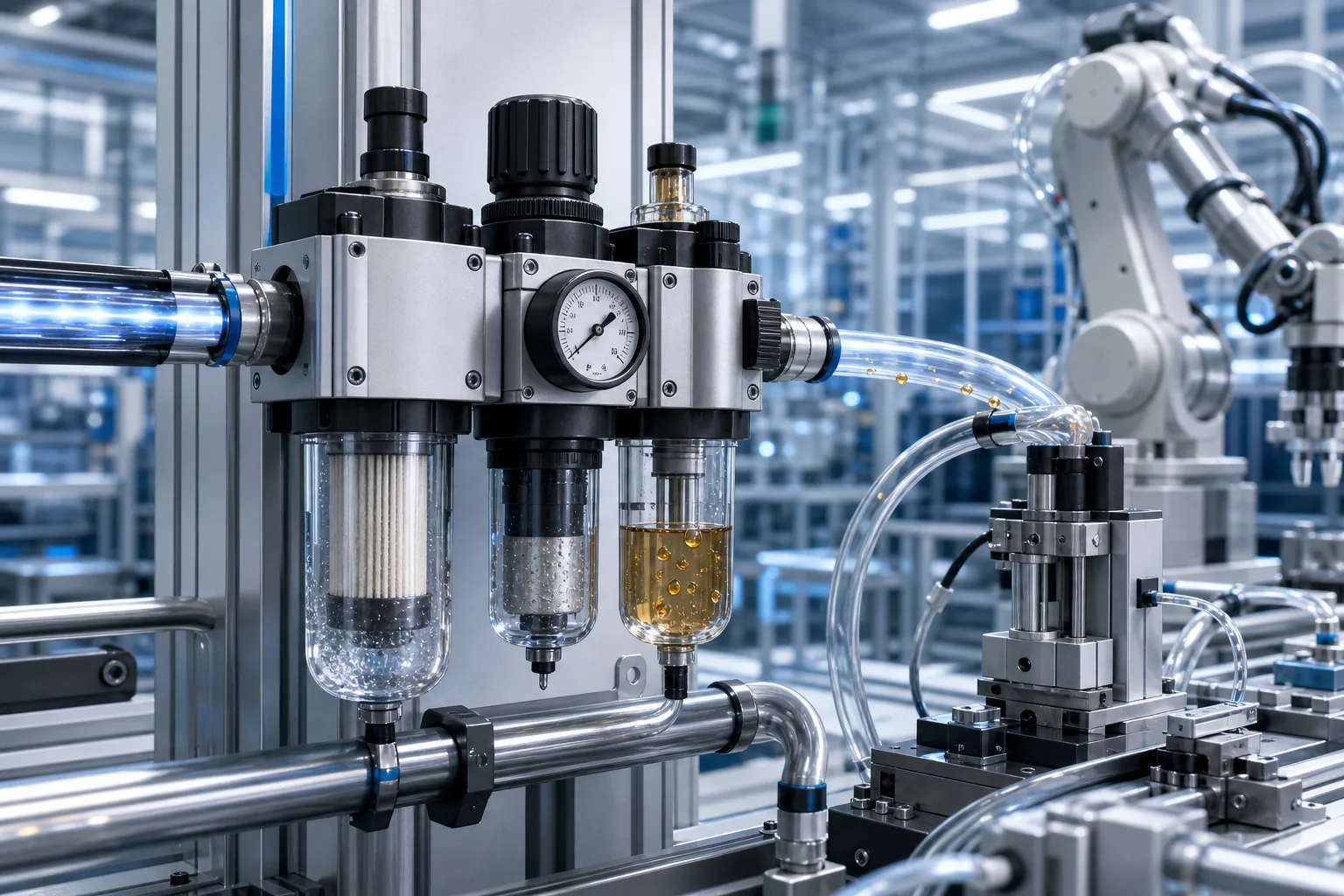
- Use suitable filters and regulators
- Check leaks regularly
- Avoid undersized tubing
- Match valve flow to actuator speed
- Replace damaged tubes and fittings
- Keep spare parts standardized
These steps are not glamorous, but they make smart factory systems more effective.
Supply Chain Resilience Changes Component Selection
Manufacturers are also thinking more carefully about supply chain resilience. A machine that uses too many unusual components may be hard to maintain when spare parts are delayed. This is especially important for pneumatic systems because they include many small components that must be replaced quickly when damaged.
Buyers may prefer suppliers who can provide complete pneumatic product coverage. A single project may require air cylinders, grippers, solenoid valves, push-in fittings, speed controllers, PU tubes, silencers, vacuum components, and air preparation units. Having a stable supplier for these parts helps reduce sourcing complexity.
For OEM machine builders, this also supports repeat business. If customers can maintain the machine easily, they are more likely to trust the machine design and supplier.
What This Means for Pneumatic Product Development
The 2026 manufacturing trend is not only about adding AI to factories. It is about making equipment more adaptable, maintainable, and connected to operational decisions. Pneumatic products can support this direction when they are compact, standardized, easy to install, and reliable over long cycles.
Suppliers should focus on practical industrial needs: clear product ranges, stable dimensions, common sizes, easy replacement, and application guidance. Buyers should look beyond the lowest unit price and consider how pneumatic components affect installation time, downtime, energy use, and flexibility.
Related Pneumatic Products
HOMIPNEU provides pneumatic cylinders, compact cylinders, guided cylinders, rotary actuators, grippers, solenoid valves, pneumatic fittings, air hose, mufflers, and air source treatment units for flexible manufacturing, smart factory equipment, packaging machines, and industrial automation lines.