Need to connect two air tubes directly to one threaded equipment port? A PB pneumatic tee fitting provides that connection in a compact body. It can simplify the air routing around a regulator outlet, machine panel or pneumatic fixture, provided the tube dimensions, thread and combined airflow are correctly matched.
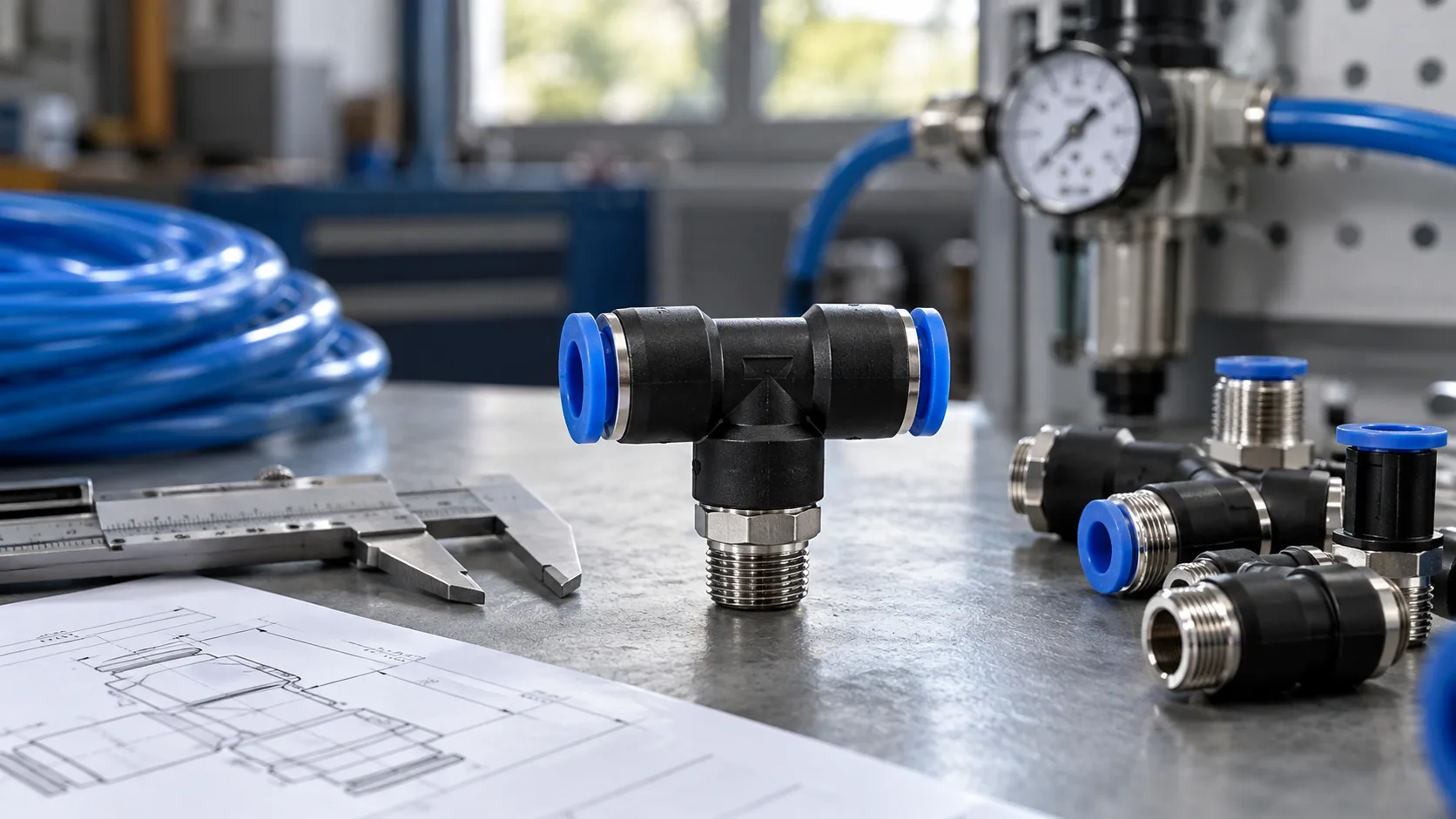
The HOMIPNEU PB Pneumatic Male Thread Tee Fitting has two push-to-connect tube ports and one male threaded port. Its brass and engineering-plastic construction, internal O-ring sealing and range of metric tube sizes make it a practical option for industrial compressed-air branching.
This guide covers how to read PB model codes, choose the thread, compare tee layouts and avoid the installation mistakes that cause leaks or slow machine cycles.
What Is a PB Pneumatic Tee Fitting?
A PB fitting is a three-port air connector with a male threaded branch and two tube connections. The thread mounts into a compatible female equipment port, while the push-in sockets accept the specified pneumatic tube outside diameter.
For example, a suitable regulator outlet can feed two downstream air lines through a PB tee. The tee creates a common connection between the three ports. It does not independently regulate either branch, shut off the air or meter an equal flow into both tubes. Add the appropriate valves or flow controls when those functions are required.
How the Push-to-Connect Connection Works
The tube enters through a release collar and is retained by an internal gripping mechanism. An O-ring seals against the tube surface. A square, clean tube end must be inserted fully for the connection to seal and hold correctly.
The tube side can be assembled by pushing in compatible tubing. The male threaded side requires the correct sealing method and tightening procedure. A push-to-connect description applies to the tube connection; it does not eliminate the need to install the threaded port properly.
PB Fitting Specifications at a Glance
| Selection item | Published specification |
|---|---|
| Operating fluid | Air |
| Connection layout | Two tube ports and one male threaded port |
| Operating pressure range | 0–0.9 MPa, equivalent to 0–9 bar |
| Proof pressure | 1.32 MPa, equivalent to 13.2 bar |
| Ambient and fluid temperature | 0–60°C |
| Applicable tubing | PU tube and nylon tube |
| Listed tube outside diameters | 4, 6, 8, 10, 12, 14 and 16 mm |
| Threads shown in the dimension table | M5, R1/8, R1/4, R3/8, R1/2 and R3/4, depending on model |
Use the product’s specification-table limit of 0.9 MPa for selection. The proof-pressure value is a test reference, not a continuous operating rating. Confirm the allowable conditions for the complete assembly because the tubing, seals and connected equipment may impose a lower limit.
How to Read a PB Model Number
Consider PB8-02. In the published HOMIPNEU table, PB identifies the male-thread tee family, 8 identifies the 8 mm tube outside diameter at both sockets, and 02 corresponds to the R1/4 male thread.
| Thread suffix | Thread shown on this product | Example |
|---|---|---|
| M5 | M5 | PB4-M5: two 4 mm tube ports with M5 thread |
| 01 | R1/8 | PB6-01: two 6 mm tube ports with R1/8 thread |
| 02 | R1/4 | PB8-02: two 8 mm tube ports with R1/4 thread |
| 03 | R3/8 | PB10-03: two 10 mm tube ports with R3/8 thread |
| 04 | R1/2 | PB12-04: two 12 mm tube ports with R1/2 thread |
| 06 | R3/4 | PB16-06: two 16 mm tube ports with R3/4 thread |
These suffix meanings come from this specific product table. Include the written thread designation in a purchase order rather than assuming a similar code from another supplier uses the same standard.
Which PB Sizes Are Available?
The following matrix groups all 27 models listed on the product page. Both tube ports have the same nominal outside-diameter connection.
| Tube OD | Listed models | Male thread choices |
|---|---|---|
| 4 mm | PB4-M5, PB4-01, PB4-02 | M5, R1/8, R1/4 |
| 6 mm | PB6-M5, PB6-01, PB6-02, PB6-03, PB6-04 | M5, R1/8, R1/4, R3/8, R1/2 |
| 8 mm | PB8-01, PB8-02, PB8-03, PB8-04 | R1/8, R1/4, R3/8, R1/2 |
| 10 mm | PB10-01, PB10-02, PB10-03, PB10-04 | R1/8, R1/4, R3/8, R1/2 |
| 12 mm | PB12-01, PB12-02, PB12-03, PB12-04 | R1/8, R1/4, R3/8, R1/2 |
| 14 mm | PB14-02, PB14-03, PB14-04 | R1/4, R3/8, R1/2 |
| 16 mm | PB16-02, PB16-03, PB16-04, PB16-06 | R1/4, R3/8, R1/2, R3/4 |
A thread option available for one tube size is not automatically listed for every other size. For example, the published R3/4 option appears on PB16-06. Check availability for any combination outside this matrix.
Match Tube Outside Diameter First
The number after PB refers to tube outside diameter, not the internal air passage. An 8 mm tube socket requires compatible 8 mm OD tubing. It does not mean the tube has an 8 mm bore.
Measure the existing tube and check its marking when replacing a fitting. Metric and inch tubes that look similar should not be interchanged: 6 mm tubing and 1/4-inch tubing have different outside diameters. The seal and gripping mechanism depend on the correct dimension and tolerance.
Both PU and nylon tubing are listed for PB fittings. Choose between them according to routing, movement, pressure and temperature. The fitting’s compatibility does not increase the tube’s own rating.
Confirm the Male Thread Before Ordering
The detailed PB dimension table specifies M5 and R threads. The page also mentions BSP, NPT and metric options more generally. Treat the drawing and the confirmed order specification as the authority for the version being supplied.
If a machine port is marked NPT or G, do not select a listed R version solely because its nominal size looks similar. Confirm the mating thread and sealing arrangement with the equipment documentation. If an alternative thread is needed, state it explicitly in the inquiry.
For an M5 connection, confirm the thread details and required sealing arrangement as well. Use the approved seal and tightening instructions for the actual fitting; the product page does not publish one universal torque value for every PB model.
PB vs Other Pneumatic Tee Layouts
| Connection requirement | Layout to consider | Why it matters |
|---|---|---|
| Two tubes connected directly to an equipment thread | PB male branch tee | Combines the threaded mounting point and two tube sockets |
| Three tubes joined away from equipment ports | Tube-to-tube union tee | Uses three tube sockets without a male mounting thread |
| Threaded connection needs a different orientation | Male run tee or side-thread tee | Changes the relationship between the thread and tube routes |
| One branch needs a different tube size | Reducing tee or an approved reducing arrangement | The listed PB models have two equal-size tube sockets |
| Several branches need individual controls | Manifold with suitable valves | Provides an organized layout for a larger distribution circuit |
For other connector shapes, the pneumatic fitting types guide provides a useful overview. Select by the connection drawing as well as the family name.
Does a Tee Split Airflow Equally?
No. A tee provides a common passage, while flow through each branch depends on downstream pressure, tube bore, tube length, valves and the equipment demand. Even two equal-size tubes can carry different flows when connected to different loads.
For example, one branch might supply a small fixture while the other supplies an intermittent air jet. When the jet opens, the shared supply may experience a pressure drop that affects the fixture. Check both branches under simultaneous demand, and add independent regulation, isolation or another supply arrangement if the process requires it.
Similarly, two cylinders connected through a tee should not be expected to move in precise synchronization. Different loads, seal friction and exhaust restrictions can change their timing. A tee is a distribution component; synchronization requires a suitable control design.
How to Avoid Pressure Drop at the Branch
Start with the combined peak airflow required by both branches. Then review the equipment port, fitting passage, tube inside diameter, line length and downstream restrictions. A large tube socket on a small threaded port does not establish a high flow rating.
The PB page does not publish model-specific Cv or flow curves. Request flow data or test the complete circuit if cycle time or pressure stability is critical. Record pressure near the equipment during operation, since an idle gauge reading can hide a restriction that only becomes apparent at peak demand.
Where PB Male Thread Tees Are Useful
Packaging Machines and Assembly Fixtures
A PB tee can connect a compatible air supply port to two nearby machine branches. This is useful around compact fixtures, stops and auxiliary devices where minimizing separate adapters helps keep the tubing organized. Check combined demand and provide separate valves where the branches must operate independently.
Pneumatic Control Panels
Control panels often have limited space around regulators, manifolds and instruments. A threaded tee can create a short local branch, provided the body fits between adjacent components and both release collars remain accessible. Leave enough straight tube near each port to avoid side loading.
Automation and Robot Fixtures
A fixed tee on a fixture can feed two tube routes going to separate pneumatic devices. Secure the tubing so robot or slide movement does not pull on the fitting. An adjustable installation orientation, if confirmed for the selected model, should not be treated as permission for continuous rotation in service.
A Practical PB8-02 Selection Example
Suppose an assembly station has a confirmed compatible R1/4 mating arrangement and needs two 8 mm OD tube connections. PB8-02 matches that basic connection specification.
Before ordering, verify that both tubes are an approved PU or nylon type, operating pressure stays within the permitted assembly rating, and ambient and air temperatures remain within 0–60°C. Review the component drawing for wrench access, tube removal clearance and body dimensions.
Finally, check the actual tube bore and simultaneous airflow demand. If the two devices lose pressure while running together, changing only the tee may not resolve the issue; the upstream port, regulator or tube may also be restrictive.
Installing a PB Push-to-Connect Tee
- Isolate the air supply, release stored pressure and confirm the circuit is depressurized.
- Verify the PB model, tube OD and mating thread before assembly.
- Inspect the fitting, threads and tube surfaces for damage or contamination.
- Install the male thread using the specified seal and tightening method. Apply the wrench to the intended metal hex rather than twisting the plastic body.
- Cut compatible tubing square with a tube cutter. Remove scored, crushed or oval sections.
- Insert each tube fully and perform a light pull check to confirm retention.
- Support the tubes and keep their first bends clear of the fitting sockets.
- Restore pressure gradually, check for leakage and test both branches at their normal operating demand.
Before releasing a tube, depressurize the circuit again. Press the release collar as instructed for the fitting and withdraw the tube without forcing it sideways.
Why Does a Pneumatic Tee Leak?
| Symptom | Likely checks | Practical response |
|---|---|---|
| Leak at a tube socket | Wrong OD, damaged tube surface or incomplete insertion | Depressurize, verify dimensions and prepare a clean tube end |
| Leak at the male thread | Thread mismatch, damaged thread or unsuitable sealing | Confirm the thread pair and approved seal before reinstalling |
| Leak appears when machinery moves | Tube tension, tight bend or unsupported route | Correct support and routing, then inspect the connection |
| Low pressure without an obvious external leak | Restricted supply or excessive simultaneous demand | Measure dynamic pressure through the complete circuit |
Repeated tightening is not a reliable remedy for a mismatched thread or damaged seal. Replace damaged components and correct the cause before returning the branch to service.
What to Include in a PB Fitting Inquiry
A useful request states the model and both connection dimensions, such as “PB8-02, two 8 mm OD tube ports, R1/4 male thread.” Include the mating equipment port, tube material and bore, operating pressure, temperature, expected flow, quantity and any material or seal requirements.
For OEM replacements, add a drawing or a clear photograph of the installation and confirm dimensions against the original part. PB family codes are useful identifiers, but the complete specification is what ensures a suitable replacement.
Frequently Asked Questions
What does PB8-02 mean?
In the HOMIPNEU product table, PB8-02 identifies a PB male-thread tee with two 8 mm tube sockets and an R1/4 male thread.
What is the maximum operating pressure?
The specification table lists 0.9 MPa, equivalent to 9 bar. The 1.32 MPa proof pressure is a separate test value. Use the lowest applicable rating of the assembled circuit.
Can PB fittings connect PU and nylon tubing?
Yes. Both are listed as applicable tubing. The selected tube must match the socket outside diameter and the required pressure, temperature and dimensional tolerance.
Can a PB tee connect different tube sizes?
The listed PB models have two equal-size tube sockets. For different branch diameters, choose a suitable reducing fitting or confirm a custom configuration.
Can I use the R1/4 version in an NPT port?
Do not assume compatibility from the nominal quarter-inch size. Confirm the equipment’s thread specification and order a matching version or approved adapter.
Will it make two cylinders move together?
It connects the air passages, but it does not guarantee equal flow or synchronized motion. Cylinder loads and circuit restrictions also determine movement.
Can PB fittings be used for water or vacuum?
The published medium is air and the operating range starts at zero pressure. Water service and vacuum performance are not established by those specifications; obtain application-specific confirmation.
Select the PB Tee for the Actual Circuit
A PB male-thread tee is a compact way to connect two pneumatic tubes at one equipment port. Begin with tube OD and the exact thread, then confirm pressure, temperature, clearance and simultaneous branch demand.
Review the PB pneumatic tee fitting model table and dimensions to select a candidate. For other branch arrangements and connector shapes, browse the HOMIPNEU pneumatic fittings range.