
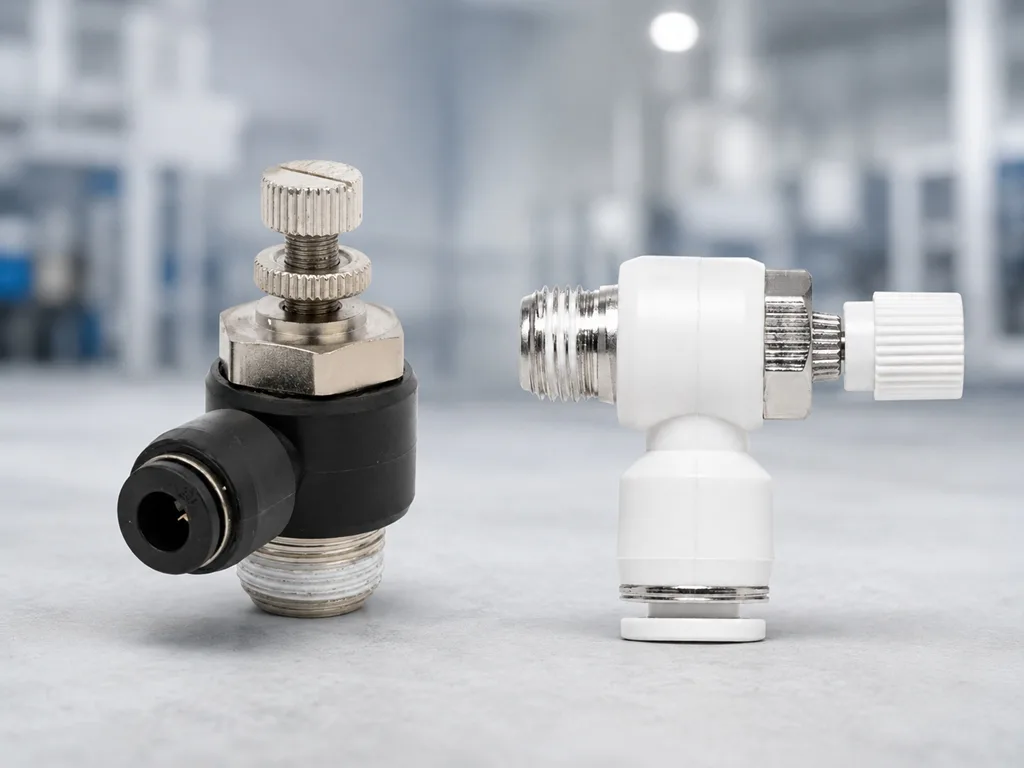
New Product Release: SL Pneumatic Elbow Speed Control Valve with Improved Locking Stability

New Product Release: SL Pneumatic Elbow Speed Control Valve with Improved Locking Stability

In pneumatic automation systems, throttle valves and speed control valves are small components, but they play an important role in machine stability. Pneumatic cylinders, grippers, slides, lifting units, pushing mechanisms, and many other pneumatic actuators rely on speed control valves to regulate airflow and control movement speed. For many automation applications, speed control is not only about adjusting airflow. It is also about keeping the adjusted setting stable during long-term operation. Why Speed Control Stability Matters From the basic structure and operation, a pneumatic speed control valve is not complicated. In most applications, the operator manually adjusts the airflow by turning the control knob. By increasing or reducing the airflow, the valve controls the movement speed of the pneumatic cylinder or actuator. After the desired speed is set, the position is fixed by a locking structure to keep the flow setting stable. The process sounds simple: Adjust the speed. Lock the setting. Let the machine run. However, in real factory conditions, many problems do not appear during the initial adjustment. They often appear after the machine has been running for…

Views: 27     2026-06-27
A Practical Discussion About Stability in Pneumatic Speed Control Valves

A Practical Discussion About Stability in Pneumatic Speed Control Valves

In pneumatic automation systems, throttle valves and speed control valves are common but important components. They are widely used with pneumatic cylinders, grippers, slides, lifting units, pushing mechanisms, and many other pneumatic actuators. Their main function is to regulate airflow and control the operating speed of pneumatic motion. From the basic structure and operation, a pneumatic speed control valve is not complicated. In most applications, the operator adjusts airflow by turning the control knob. Increasing or reducing airflow changes the movement speed of the pneumatic cylinder or actuator. After the desired speed is set, the position must be locked to keep the flow setting stable. The process sounds simple: adjust the speed, lock the setting, and let the machine run. In real factory conditions, however, many problems do not appear during the first adjustment. They often appear only after the machine has been running for some time. Why Stability Matters After Adjustment In continuous automation systems, pneumatic cylinders move repeatedly, machines generate vibration, and air pressure may fluctuate during operation. Under these conditions, a traditional locking structure may gradually become…

Views: 21     2026-06-27